
Cerium(III) Nitrate Hexahydrate: A Practical Guide to a Quiet Rare Earth Compound
How this cerium salt supports catalysts, coatings, polishing chemistry, glass science, and advanced materials research

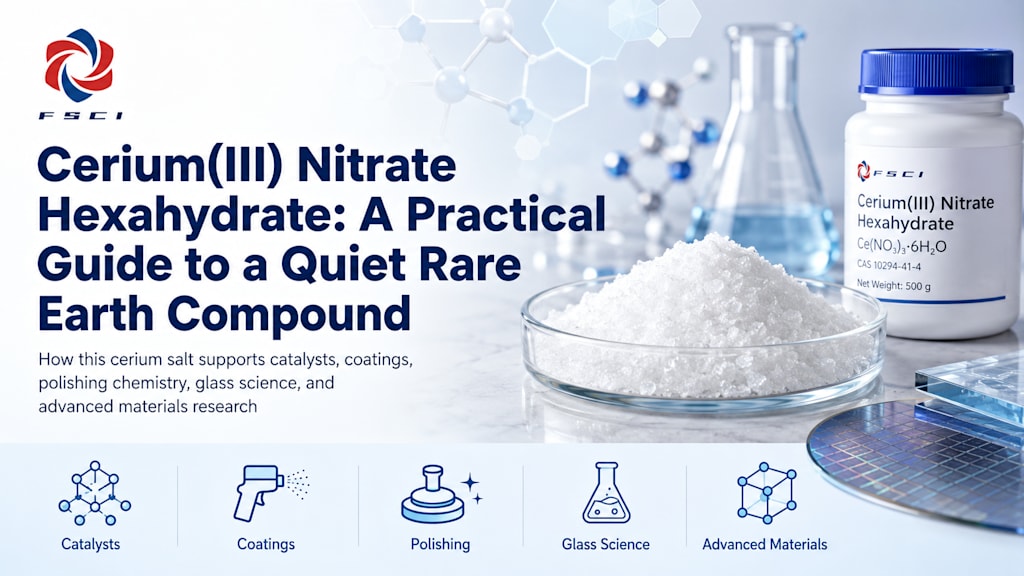
Cerium(III) Nitrate Hexahydrate is not a name that most people encounter outside a laboratory or technical setting. It sounds precise, almost too specialized for everyday discussion. Yet this pale crystalline compound belongs to a much larger story about rare earth chemistry, modern materials, and the hidden substances that help shape industrial progress.
Cerium is one of the most abundant rare earth elements. The phrase “rare earth” can be misleading, because some rare earth elements are not extremely rare in the Earth’s crust. What makes them special is not always scarcity, but their chemical behavior. Rare earth elements often have unusual electronic structures that allow them to influence color, oxidation, surface reactions, polishing performance, and catalytic activity. Cerium is especially interesting because it can move between different oxidation states, most commonly Ce(III) and Ce(IV). That flexibility gives cerium compounds a wide range of uses.
Cerium(III) Nitrate Hexahydrate is a hydrated nitrate salt of cerium in the +3 oxidation state. The word “hexahydrate” means that water molecules are built into the crystal structure. This is more than a small label. Hydration can influence how a compound looks, dissolves, stores, and behaves during processing. In practical chemistry, the solid form of a material often matters just as much as its formula.
One reason this compound is useful is that it can act as a convenient cerium source in solution-based work. Many material processes begin by dissolving a metal salt, mixing it with other ingredients, and then converting it into an oxide, coating, catalyst, or specialty structure. Nitrate salts are often valued in research and manufacturing because they can dissolve readily in water or polar systems, making them suitable for controlled preparation steps.
Cerium chemistry is closely connected with catalysts. Catalysts help chemical reactions happen more efficiently, and cerium-containing materials are widely studied because of their oxygen-related behavior. Cerium oxide, for example, is known for its ability to store and release oxygen under certain conditions. This property makes cerium compounds relevant in environmental catalysis, automotive exhaust systems, oxidation reactions, and other areas where oxygen transfer matters. Cerium(III) Nitrate Hexahydrate may not be the final catalyst itself, but it can be used as a starting material in the preparation of cerium-containing catalytic systems.
This distinction is important. Many advanced materials are not made in one step. A salt, precursor, solution, or intermediate may quietly determine the quality of the final material. Particle size, purity, mixing conditions, heating method, and conversion route can all influence the performance of the finished product. In that sense, Cerium(III) Nitrate Hexahydrate is part of the backstage chemistry that supports more visible technologies.
Coatings are another area where cerium compounds receive attention. Metal surfaces often need protection against corrosion, oxidation, or environmental damage. Cerium-based treatments have been studied as alternatives or complements to older surface protection systems. The chemistry can be complex, but the general idea is that cerium ions may participate in forming protective layers or influencing surface reactions. For industries working with metals, ceramics, or functional surfaces, this kind of chemistry can be valuable.
Glass and polishing applications also help explain the importance of cerium. Cerium oxide is widely known as a polishing material, especially for glass. It can help produce smooth surfaces with high clarity. Although Cerium(III) Nitrate Hexahydrate is different from cerium oxide, it belongs to the same cerium chemistry family and may appear in pathways that lead to oxide materials. This connection shows how one element can move from a soluble salt to a functional powder and finally to a finished surface.
In analytical and laboratory chemistry, cerium nitrate compounds are also familiar because they are easy to introduce into controlled experiments. Researchers may use them to prepare mixed metal oxides, doped materials, nanostructures, or rare earth-containing systems. In this context, the compound functions less like a finished product and more like a precise ingredient in scientific design. A chemist may care about how it dissolves, how it reacts with other metal salts, or how it behaves during drying and heating.
The “rare earth” identity of Cerium(III) Nitrate Hexahydrate also connects it to broader conversations about modern technology. Rare earth elements are used in magnets, batteries, lighting, catalysts, optics, electronics, and advanced manufacturing. Cerium does not carry the same public recognition as lithium, cobalt, or silicon, but it plays its own role in the material world. Its compounds often appear where surface chemistry, oxidation behavior, or optical performance needs careful control.
For anyone trying to understand a compound like this, it helps to look beyond the name and ask a few practical questions. What form is it in? How does it dissolve? What final material is it meant to support? Is it being used in a catalyst, coating, oxide preparation, analytical study, or specialty formulation? These questions are more useful than treating the compound as a simple catalog entry. Chemistry becomes meaningful when the material is connected to a real purpose.
Handling also deserves attention. Cerium(III) Nitrate Hexahydrate should be treated as a laboratory chemical, not an ordinary household substance. Like many nitrate salts and rare earth compounds, it requires controlled storage, clean handling practices, and attention to moisture, contamination, and compatibility. Responsible use is part of the material story. The same compound that is useful in research or technical production should be handled with respect and proper procedure.
From a formulation or research perspective, consistency matters. Rare earth materials can be sensitive to small differences in composition, moisture level, and processing history. A solution prepared from a well-characterized cerium salt may behave more predictably than one made from uncertain material. This is especially true when the final use involves catalysts, coatings, or finely controlled oxide systems. In advanced materials, small variations at the beginning can create noticeable differences at the end.
For readers who want to explore the material more directly, Cerium(III) Nitrate Hexahydrate is commonly introduced as a cerium source used in catalyst preparation, coating studies, rare earth materials, and laboratory research. Its value lies in its ability to bring cerium into solution-based chemistry in a manageable and reactive form.
What makes this compound interesting is not that it dominates one single industry. Instead, it connects many fields quietly. In one setting, it may support the preparation of a catalyst. In another, it may be part of a surface treatment study. Elsewhere, it may help create cerium oxide particles, mixed oxides, or experimental rare earth materials. These uses are different, but they all rely on the same underlying idea: cerium chemistry can influence how materials react, protect, polish, or perform.
Cerium(III) Nitrate Hexahydrate is a reminder that modern material science is built from many small, specialized compounds. The finished technology may be a cleaner catalyst, a smoother glass surface, a stronger coating, or a more controlled oxide material. Behind that finished result, there is often a simple crystalline salt helping the process begin.
That quiet role is exactly why this compound continues to matter. It is not a headline material, but it is part of the practical foundation of rare earth chemistry. In the background of laboratories and technical processes, Cerium(III) Nitrate Hexahydrate helps turn the unique behavior of cerium into something chemists and material scientists can actually use.
About the Creator
Enjoyed the story? Support the Creator.
Subscribe for free to receive all their stories in your feed.
Comments
There are no comments for this story
Be the first to respond and start the conversation.