
Canada Accelerates Global Pivot: Anand Outlines Strategy to Double Non-US Trade Amid Fractured International Order
Foreign Minister Anita Anand details Ottawa’s aggressive "middle power diplomacy" aimed at reducing economic dependence on the United States, forging new security alliances, and navigating a deeply divided G20 landscape.

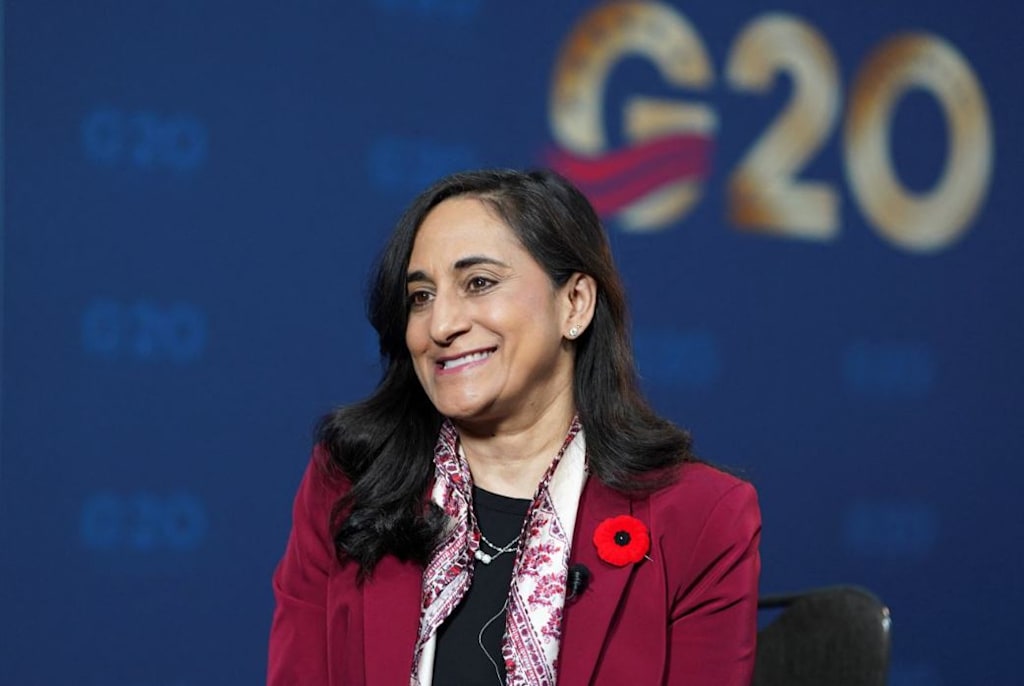
Canada is undertaking a historic recalibration of its foreign policy and economic strategy, with a clear mandate to double its non-US trade over the next decade. Speaking on Saturday on the sidelines of a G20 foreign ministers’ meeting hosted by the United States, Foreign Minister Anita Anand outlined the government’s rapid progress in diversifying trade and security ties globally. The initiative, championed by Prime Minister Mark Carney, comes as a direct response to the economic turbulence caused by President Donald Trump’s tariffs and the broader realization that Canada’s traditional reliance on its southern neighbor is no longer a sustainable long-term strategy.
Navigating a Fractured World Order
The urgency of Canada’s pivot was underscored by the tense atmosphere at the G20 meeting, where the presence of Russian Foreign Minister Sergei Lavrov exposed deep fissures within the grouping. Anand, a vocal critic of Lavrov’s participation, noted that the gathering served as a stark illustration of the "transformed and fractured nature of the international order."
"The meeting helped illustrate... the need for new approaches, groupings, alliances and partnerships," Anand told Reuters. She argued that the old structures of global governance are struggling to address contemporary crises, from geopolitical aggression to technological disruption. In this context, Canada is positioning itself not just as a participant, but as an architect of new diplomatic frameworks. "Canada is coming to the table to ensure that ... there are, if necessary, new bodies, new groupings, new alliances and partnerships in order to address the crises of the day," she said.
"Middle Power Diplomacy" in Action
Anand described Canada’s approach as "middle power diplomacy," a strategy that leverages the country’s soft power, regulatory standards, and niche expertise to build influence without relying solely on military or economic might. This philosophy is already yielding tangible results across several key fronts:
Arctic Security: Collaborating closely with Nordic countries to enhance safety and security in the Arctic region, countering growing Russian threats in the North.
Digital Governance: Partnering with India and Australia to establish robust frameworks for citizen privacy and ethical AI development, ensuring that rapid technological innovation does not come at the cost of individual rights.
European Integration: Expanding ties with the European Union through a newly released national security strategy that prioritizes critical minerals, energy independence, and food security. These sectors are viewed as vital not only for economic growth but for national resilience in an era of supply chain volatility.
Breaking Down Barriers: From Stalemate to Expansion
The push for diversification was accelerated after efforts to reach a new trade accommodation with Washington broke down. With tariff pressures rippling through the Canadian economy, the Carney government has shifted gears, aggressively pursuing trade pacts across the Asia-Pacific, Europe, and the Middle East.
The results of this diplomatic offensive are significant. Ottawa has forged 20 new security and trade agreements with various countries and blocs worldwide, granting Canadian businesses preferential access to a market of 1.5 billion consumers across more than 51 countries. This network provides a crucial buffer against protectionist policies in any single market and opens new avenues for Canadian exports, particularly in clean technology, agriculture, and services.
Leading the G7 in Trade Connectivity
Anand highlighted Canada’s unique position within the Group of Seven (G7), noting that it is the only member nation that holds free trade agreements with every other G7 country. This extensive web of existing relationships serves as a foundation for further expansion. Looking ahead, Anand expressed confidence that Canada is on track to conclude a comprehensive trade deal with the Association of Southeast Asian Nations (ASEAN) before the end of the year. Such an agreement would be a cornerstone of the government’s goal to deepen economic integration with the fast-growing Indo-Pacific region.
As the global order continues to shift, Canada’s strategy represents a bold attempt to redefine its role on the world stage. By building trust-based relationships outside of North America and leading on issues like digital rights and Arctic security, Ottawa aims to secure its economic future while contributing to a more stable, albeit fragmented, international system. For Anand and the Carney government, the message is clear: in a world of increasing uncertainty, diversity is not just an economic advantage; it is a national security imperative.
About the Creator
Mark Lim
Hi I am mark an automotive student and a car, tech and food enthusiast ! Im gonna try and post daily & hope you enjoy what I write and do share my page with people you know. I would gladly appreciate it! Cheers
Enjoyed the story? Support the Creator.
Subscribe for free to receive all their stories in your feed.
Comments
There are no comments for this story
Be the first to respond and start the conversation.