
Can Your Business Actually Make Money?
Run these three checks and find out before you burn your cash.
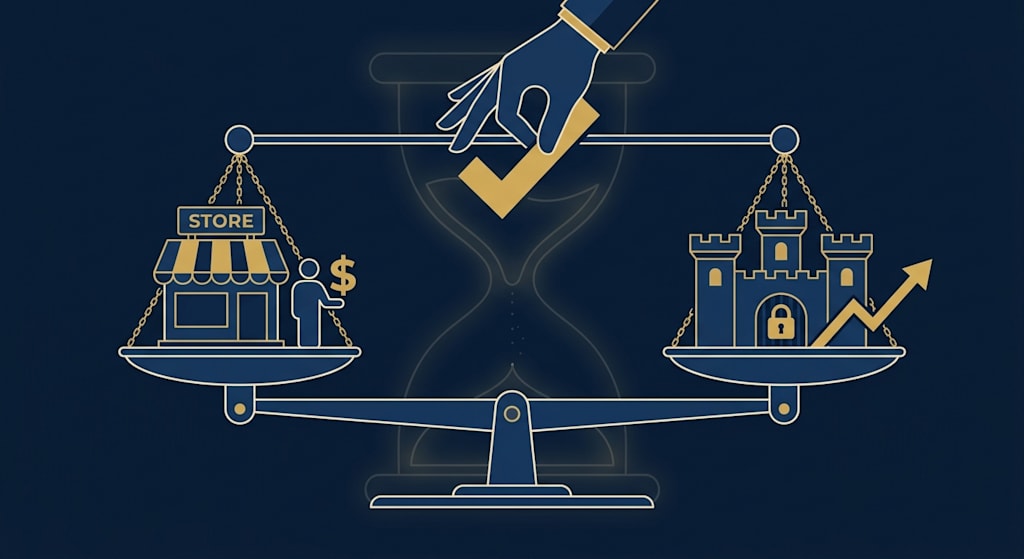
Start with a thought experiment.
You have two business plans in front of you.
Plan A has nine boxes filled out, a market-size slide that says "we expect to capture 1% of a hundred-billion-dollar market," a team bio with big-name alumni, and a roster of fancy advisors.
Plan B has three pages. Page one asks: Has this need actually existed over the past three years? Page two shows: If we open one store, where does every dollar go, and where does every dollar come from? Page three asks: If I start making money today, how long before the guy next door copies me?
Which one would you fund?
Behind that choice lies the entire secret of business models.
Chapter 1: The Business Model Canvas Is a Map, Not the Destination
The Business Model Canvas is a great tool. Value propositions, customer segments, channels, revenue streams, cost structure -- fill in those nine boxes, and the outline of a business does become clearer.
The catch: filling in the canvas is not the same as making the business work.
The canvas handles description, not validation. It tells you what the company plans to do, but it cannot answer the far more lethal question: Can this business actually run?
Chapter 2 of How to Quickly Understand an Industry offers a sharper tool. Its core logic boils down to one sentence:
Describe first. Validate second.
In the description phase, use the canvas as a template. Grab a few industry research reports and stuff the nine boxes. This step does not require genius; it requires patience.
The validation phase is where the real test begins.
Validation has two steps: sales viability and profit viability. Above those two, there is a final-round question: structural moat.
The first two numbers decide whether the business can survive. The third decides how long it can survive.
Chapter 2: The First Number — Sales Viability
Is the demand real?
The fatal flaw of many entrepreneurs is "self-indulgent innovation." They invent something that has never existed in the market and call it a blue-ocean strategy.
In most cases, things that have never existed are exactly the fake demands.
You do not need complex surveys to tell real demand from fake. Two benchmarking methods are enough.
Time-Benchmarking
Successful business models rarely create new demand. They just satisfy old demand in a better way.
Look at the "convenient eating" chain: dried rations, instant noodles, phone-based takeout, internet food delivery, pre-cooked meals. The demand never changed. People do not want to spend time cooking. What changed was the delivery mechanism.
"Text communication": carrier pigeon, letters, telegrams, SMS, WeChat. The demand never changed. People want to talk to someone else. What changed was latency and cost.
"Product selection": street hawkers, TV shopping, livestream commerce. The demand never changed. People want good picks without spending their own time picking. What changed was how trust is built.
Practical application: When you get a new project, trace it back thirty years. If no similar need ever appeared in history, be alert. Human nature has not changed in millennia. You are probably inventing a pain point that does not exist.
Space-Benchmarking
Copy models that have already been validated in mature markets to regions with similar infrastructure but empty space.
Why was China's group-buying war later replicated in Southeast Asia? Because there you had smartphone penetration, nascent mobile payments, and rising spending among young people -- exactly the same conditions as China a decade ago. Spatial migration validates the universality of demand.
If you can find benchmarks in both time and space, the demand is real. You have your entry ticket.
But the ticket is not the finish line.
Chapter 3: The Second Number — Profit Viability
Can the smallest unit make money?
Sales viability is the entry ticket. Profit viability is the life-or-death line.
At the qualitative level, look at two things.
On the revenue side: frequency and elasticity.
High frequency plus inelastic demand is the bedrock of a good business. Drinking water is consumed daily; a few cents price increase goes unnoticed. Office software is used daily; a few bucks more and the company still pays. In contrast, on-demand car washing or shared basketball: low frequency, and if you do not wash the car you still drive, if you do not play basketball you still live. You never recover customer acquisition costs.
On the cost side: standardization.
The higher the standardization, the lower the marginal cost. Software replication cost approaches zero. Fast-food chains use central kitchens for unified distribution; the marginal cost of each new store is far lower than for an independent restaurant. High-end custom services require the same labor input for every order; as you scale, costs rise linearly, with no leverage.
At the quantitative level, build a UE model (unit economics).
The core of UE is "from the smallest unit, see the whole picture." Do not talk about total market size. First ask whether the smallest operating unit can turn a profit.
Case 1: A Murder-Mystery Game Store (Store-Level UE)
Take an ordinary murder-mystery store. Set store revenue at 100%:
Platform commission: 8.4%
Game master (DM) salaries: 27.1%
Rent: 13.0%
Utilities and internet: 3.5%
Snack costs: 6.3%
Script updates: 3.5%
Net profit margin: 38.2%
A single store can deliver nearly 40% net margin. The store-level model holds. Only then does it make sense to talk about scaling by opening more locations.
Case 2: An Escape Room (Customer-Level UE)
Assume a first-tier city escape room with 5 themes, each priced at 300 RMB per person, and 100% retention (every customer plays all 5 themes):
5-theme experience fee: 1,500 RMB per customer
Customer acquisition cost: 500 RMB
Other amortized costs: 600 RMB
Profit per customer: 400 RMB
Now consider a dynamic decision: the store has a lot of idle capacity. Should it run a 20% discount promotion?
After the discount, revenue per customer drops by 300 RMB (20% of 1,500). Acquisition and amortization costs remain unchanged. Profit per customer is still 100 RMB. With higher occupancy, amortized costs per customer will fall further.
Conclusion: Even after the discount, the customer-level UE stays positive, and it uses idle capacity. The promotion is viable.
What if even in an ideal state the UE model does not add up? That is an inherent defect in the business model. The bigger the scale, the faster the bleeding.
Chapter 4: The Third Number — Structural Moat
Why should the eventual winner be you?
If the UE shows a loss today, is the business model dead?
Not necessarily.
If the loss comes from scale effects (the long-run average cost falls as volume grows) and it turns positive at a reasonable scale, the current loss is strategic investment. That is how Amazon started.
If the smallest operating unit can never make money even in an ideal scenario, that is a structural flaw. Why did on-demand car-washing services die en masse? Run the customer-level UE: the fee for washing one car cannot cover the travel time cost of sending a technician to your doorstep. The bigger the scale, the more you lose. The business is inherently negative.
There is an even deeper question.
Even if your UE model is perfectly profitable, if the entry barriers are low, capital and copycats will flood in. Profits will be competed down to zero.
So a good business model must answer a third question: Does my advantage increase or decrease over time?
There are three common forms of increasing advantage:
Network effects. The more users, the more valuable the platform. WeChat. Didi. Airbnb. Every new user creates value for all existing users. A latecomer cannot replicate a just-as-good alternative, because social graphs and accumulated data are not transferable.
Asymmetric bargaining power. The ability to set prices with upstream or downstream players in a way that rivals cannot challenge. Apple's grip on its supply chain: suppliers accept below-industry-average margins because Apple's order volume is huge and its commitments are stable. This relationship cannot be copied by signing a contract; it is a decade of trust and dependence built over time.
Technology and patent moats. Exclusive ownership of foundational technology. Huawei's 5G patents. Pharmaceutical companies' compound patents. Others do not copy because they cannot, not because they do not want to.
A business model without one of these three layers has only one terminal outcome: profits eroded by competition, and the last one standing is the one who can bleed the longest.
Chapter 5: The Timing Window
If all three numbers check out, are you guaranteed to succeed?
Not necessarily.
Innovation has three layers: foundational (chips, algorithms), middle (cloud platforms), and application-layer (specific apps).
The logical sequence is always: first, foundational breakthroughs; then, middle-layer maturity; finally, application-layer explosion.
If your business model rests on foundational technology that is not yet mature (say, building VR social networks a decade ago, or smart rings before battery density improved), even a flawless UE model will not save you. The project will stall in the early-adoption phase. Cash runs out before the technology catches up.
This is not a business-model problem. It is a timing-window problem.
Closing
There is no one "right" business model. In the same industry, different entry timing and different resources yield different viable paths.
Unviable business models share common traits.
The next time you see a business plan claiming "we expect to capture 1% of a hundred-billion-dollar market," do not let the big numbers dazzle you. Take a piece of paper and a pen. Calculate three numbers:
Has this need ever existed in time? Has it ever worked in space?
Can the smallest operating unit (one store, one customer) make money?
If I make money today, how long before the guy next door copies me? What is my defense?
If one store and one customer cannot make money, a hundred stores and ten thousand customers will not save you.
If one store makes money but the guy next door can open an identical one tomorrow, a hundred stores will not save you either. Profits will always return to zero through competition.
Business is hard. But the math is not.
About the Creator
Jin
Writer of reamstories
https://reamstories.com/jin
Enjoyed the story? Support the Creator.
Subscribe for free to receive all their stories in your feed. You could also become a paid subscriber, letting them know you appreciate their work.
Comments
There are no comments for this story
Be the first to respond and start the conversation.