
Businesses; Survived Afghanistan!
The crisis got managed with this!

On August 15, 2021, when the Taliban returned to power in Afghanistan, the country's economy entered one of the most difficult periods in its modern history. The banking system faced severe pressure, Afghanistan was effectively cut off from the SWIFT international payment network, and nearly $9.7 billion of the country's foreign reserves remained frozen abroad. International aid programs that had supported a large portion of public spending were suddenly disrupted, creating uncertainty across every sector of society.
The impact on ordinary Afghans was immediate. Businesses struggled to access cash, employees worried about their salaries, and families feared an approaching winter without sufficient income. International organizations warned of growing poverty, and many observers predicted a complete economic collapse.
Yet Afghanistan did not disappear from the economic map. Despite enormous challenges, millions of ordinary people found ways to adapt, survive, and rebuild their livelihoods. While many large sectors suffered, several types of businesses managed to survive and, in some cases, even grow during the crisis.
One of the first major challenges facing the new authorities was the banking sector. If everyone had rushed to withdraw their money at once, the banking system could have collapsed completely. To prevent this, withdrawal limits were introduced. Although many citizens were frustrated by these restrictions, they helped maintain basic banking operations and prevented an immediate financial panic.
At the same time, Afghanistan's central bank worked to stabilize the national currency. In a country heavily dependent on imports, maintaining confidence in the Afghan Afghani became a critical task. Currency auctions, cash management measures, and tighter controls on financial operations helped reduce some of the pressure that could have led to uncontrolled inflation.
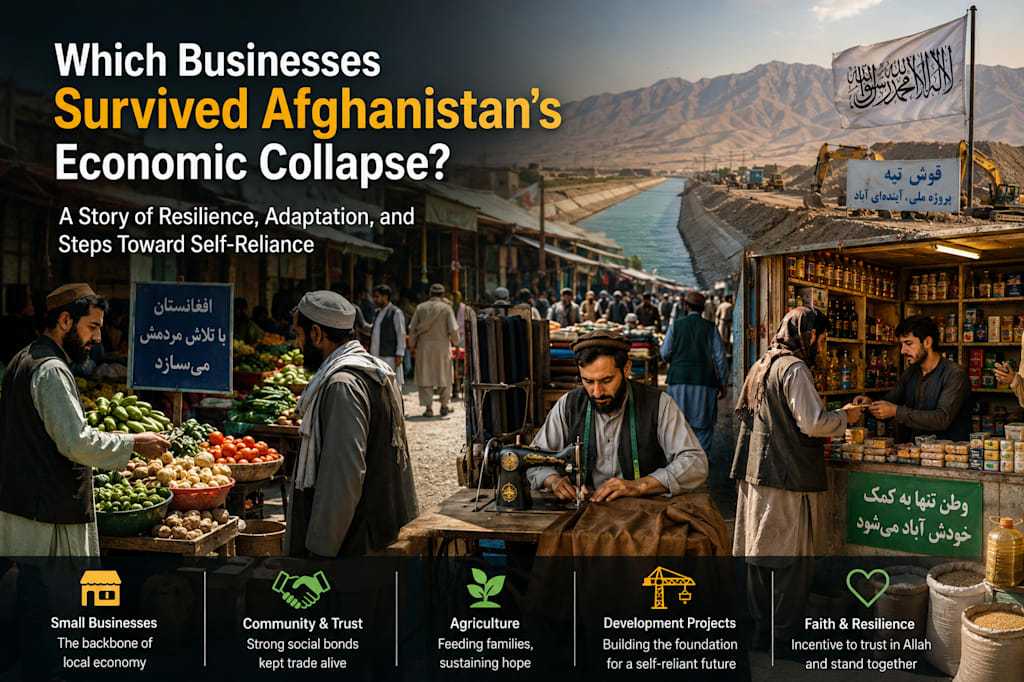
Small businesses became one of the most important survival mechanisms during this period. Across cities and villages, people who lost formal employment turned to self-employment. Small grocery shops, tailoring businesses, repair services, transportation services, agricultural activities, and home-based enterprises became lifelines for thousands of families.
Unlike large corporations that depend heavily on international banking and foreign investment, many of these small businesses relied on local customers and community relationships. Afghanistan's strong social networks and cultural traditions helped people continue trading even when cash was scarce. Trust-based transactions, delayed payments, and community support allowed many families to keep operating their businesses.
Trade also adapted to changing circumstances. As international financial channels became more difficult to use, merchants increasingly relied on regional trade networks. Some transactions involved forms of barter trade or alternative settlement arrangements with neighboring countries. These methods were not perfect solutions, but they helped keep goods moving across borders and prevented complete economic isolation.
Humanitarian assistance played a major role in preventing a larger disaster. Millions of Afghans received food, medical assistance, and emergency support from international organizations and aid agencies. The Taliban administration sought greater control over aid distribution mechanisms within the country, arguing that assistance should be delivered through structures that could reach communities more effectively. The management of humanitarian aid remained a topic of debate among international actors, but there is little doubt that aid itself helped countless families survive the most difficult months following the political transition.
At the same time, many Afghans relied on something that statistics cannot easily measure: faith. Religious belief has always been deeply woven into Afghan society. During a period when international support declined and economic uncertainty increased, many community leaders encouraged people to maintain hope, trust in God, and support one another rather than waiting for solutions from foreign governments. Whether viewed from a religious or sociological perspective, this mindset helped strengthen resilience in many communities.
The first year after the political transition saw the emergence of thousands of small economic activities. Street vendors expanded their operations. Farmers increased cultivation where possible. Local manufacturing workshops continued producing basic goods. Small transportation businesses connected markets. Digital freelancers and online workers searched for opportunities beyond Afghanistan's borders. None of these sectors alone could solve unemployment, but together they softened the impact of a potentially catastrophic economic downturn.
Agriculture remained one of the strongest pillars of survival. Afghanistan has historically been an agricultural society, and many families returned to farming when urban employment opportunities declined. Wheat production, livestock activities, fruit cultivation, and local food markets provided both income and food security for millions of people.
In recent years, attention has increasingly focused on infrastructure and development projects that could improve Afghanistan's long-term economic prospects. Among these projects, the Qosh Tepa Canal has attracted significant interest. Supporters believe the canal could expand agricultural production by bringing additional land under cultivation and reducing dependence on imported food. While the full economic impact will take years to evaluate, many Afghans view such projects as important steps toward greater self-reliance.
Other investments in mining, transportation networks, energy projects, and regional trade corridors are also frequently discussed as potential drivers of future growth. Success will depend on security, technical expertise, investment, environmental considerations, and access to international markets. Nevertheless, these projects reflect a broader desire among Afghans to build an economy that depends more on domestic production and less on external assistance.
The story of Afghanistan since August 2021 is not simply a story of economic collapse. It is also a story of adaptation. Millions of ordinary people faced extraordinary circumstances and searched for practical ways to survive. Small businesses, local trade, agriculture, community cooperation, humanitarian assistance, and personal resilience all played important roles.
Many challenges remain. Poverty continues to affect large segments of the population, access to international finance is still limited, and economic opportunities are far from sufficient for a growing population. Yet Afghanistan's experience demonstrates that societies can develop survival mechanisms even under intense pressure.
The businesses that survived Afghanistan's economic crisis were not necessarily the largest or wealthiest. They were often the small shops, family enterprises, farms, workshops, and local traders that remained connected to their communities. Their endurance reflects not only economic necessity but also the determination of Afghan people to continue moving forward despite uncertainty.
Today, as Afghanistan seeks a path toward greater self-reliance, the resilience shown by ordinary citizens may prove to be one of the country's most valuable assets.
About the Creator
Keramatullah Wardak
I write practical, science-backed content on health, productivity, and self-improvement. Passionate about helping you eat smarter, think clearer, and live better—one article at a time.
Enjoyed the story? Support the Creator.
Subscribe for free to receive all their stories in your feed.
Comments
There are no comments for this story
Be the first to respond and start the conversation.