
Beyond the Assembly Line: Automakers Turn to Defence Spending as Growth Engine
Pickups, Platforms and Underused Factories Repurposed for National Security Revenue Gains Modest but Strategic Shift Accelerates Across Industry

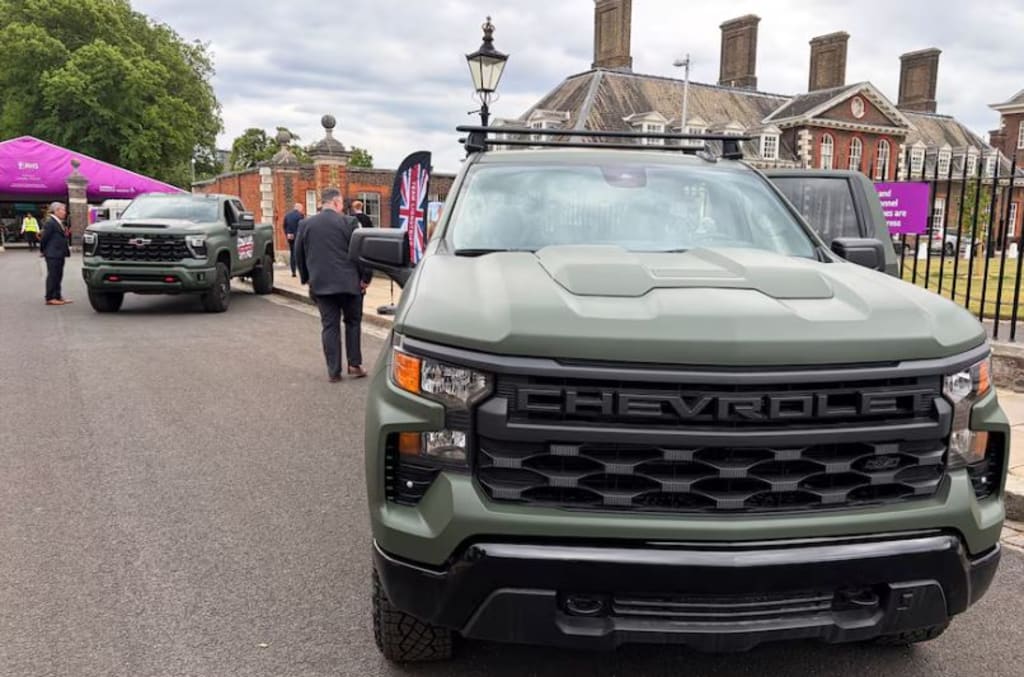
Western automakers are pivoting toward one of the most reliable growth sectors in the global economy: defence. Faced with slowing domestic sales, intensifying competition from Chinese manufacturers, and underutilised production capacity, companies including Ford, General Motors, and Jaguar Land Rover are bidding for military contracts using modified versions of vehicles already in mass production. Others are selling idle plants to defence contractors seeking to scale up without building facilities from scratch. While executives acknowledge that defence-related revenue will not replace core automotive income, the strategic realignment is reshaping how the industry thinks about capacity, diversification, and long-term resilience.
The most immediate opportunities lie where existing products meet military requirements. Ford, General Motors, and JLR have all entered the competition for a £900 million (US$1.2 billion) UK Ministry of Defence fleet contract, initially valued at 3,000 vehicles. Ford’s submission draws on the Ranger pickup, a vehicle already engineered for heavy payloads and demanding terrain. General Motors has fielded retrofitted Chevrolet Silverado trucks as part of the Team LionStrike consortium alongside BAE Systems and NP Aerospace. JLR, a subsidiary of India’s Tata Motors, is offering the Defender — a vehicle designed from its inception for extreme capability and now produced at volumes exceeding 100,000 units annually. Proponents emphasise that these are not ground-up military programmes but adaptations of proven platforms, reducing development risk and cost. “They’re such capable trucks from the beginning; that’s not a heavy lift,” noted Gilbert Nelson, GM Defense’s vice president for international sales and marketing. JLR has confirmed it is pursuing similar tenders across Europe and further afield over the coming 12 to 18 months, viewing the Defender’s established scale as a distinct competitive advantage.
For all the promise, financial realism prevails. General Motors projects its defence division will generate US$700 million in revenue this year and grow at roughly 30% annually, reaching approximately US$1.5 billion by 2029. Impressive as that trajectory appears, it would still represent less than 1% of the group’s US$185 billion revenue recorded in 2025. Jefferies auto analyst Vanessa Jeffriess summarised the broader reality: “In reality, all of these opportunities will have very little financial impact.” Instead, the push reflects a broader strategic imperative, demonstrating to investors that the industry is actively diversifying amid eroding market share at home and rapid expansion by Chinese brands abroad.
Where automakers are finding clearer value is in offloading surplus manufacturing capacity to defence-focused buyers. Italy’s Stellantis has signed a memorandum of understanding to sell a plant to armoured-vehicle manufacturer Roshel, while Volkswagen has reached an agreement to transfer its Osnabrück facility to Israel’s Aurelius Capital and the German state of Lower Saxony, where it will support projects for Rafael Advanced Defense Systems. These transactions address a fundamental mismatch: auto assembly lines are optimised for high-volume, standardised production that rarely aligns with the lower-volume, highly specialised output required for most military equipment. Selling rather than repurposing plants is proving the more practical path, allowing defence firms to move into ready-built industrial spaces without the cost and delay of constructing facilities from the ground up.
Component suppliers may emerge as the quietest beneficiaries of the trend. Unlike vehicle assembly lines, which are engineered for massive throughput, supplier facilities often operate at smaller, more flexible scales that adapt readily to defence specifications. Higher profit margins further sweeten the proposition: Valeo CEO Christophe Perillat noted that defence programmes deliver growth where traditional automotive markets do not, alongside superior returns. Forvia has similarly identified defence as a targeted expansion area and recently transferred a German plant and 300 employees to General Dynamics, repositioning underused capacity into a higher-margin sector.
Not every manufacturer is broadening its footprint, however. Renault is collaborating with Thales to produce military drones starting next year, but the scale is modest compared with its roughly 10,000 vehicles manufactured daily. JLR has explicitly chosen to stay focused on core automotive strengths, declining to branch into unfamiliar defence sub-sectors where specialist firms hold deep technical advantages. “Our core business is vehicles,” JLR North America CEO Mark Cameron affirmed. “We don’t want to stray into any offshoots.” That restraint underscores a consistent theme across the industry: defence is a valuable complement to vehicle manufacturing, not a replacement for it.
Ultimately, the pivot to defence spending reflects a sector in transition. As traditional markets rebalance and competition intensifies, governments are simultaneously increasing defence budgets across Europe, North America, and beyond, creating a rare zone of shared interest between national security and industrial policy. For automakers, the opportunity is not to reinvent themselves as defence contractors, but to leverage what they already do best: building durable, capable vehicles at scale, managing complex supply chains, and operating world-class manufacturing infrastructure. Defence spending will not restore past sales volumes, but it may provide a vital bridge and a new foundation as the industry charts its next chapter.
About the Creator
Mark Lim
Hi I am mark an automotive student and a car, tech and food enthusiast ! Im gonna try and post daily & hope you enjoy what I write and do share my page with people you know. I would gladly appreciate it! Cheers
Enjoyed the story? Support the Creator.
Subscribe for free to receive all their stories in your feed.
Comments
There are no comments for this story
Be the first to respond and start the conversation.