
Beyond Cost: Why Malaysia’s Creative Economic Future Lies In Ownership And Identity
As AI levels the playing field, MDEC declares the outsourcing era is over, and IP is the new competitive advantage

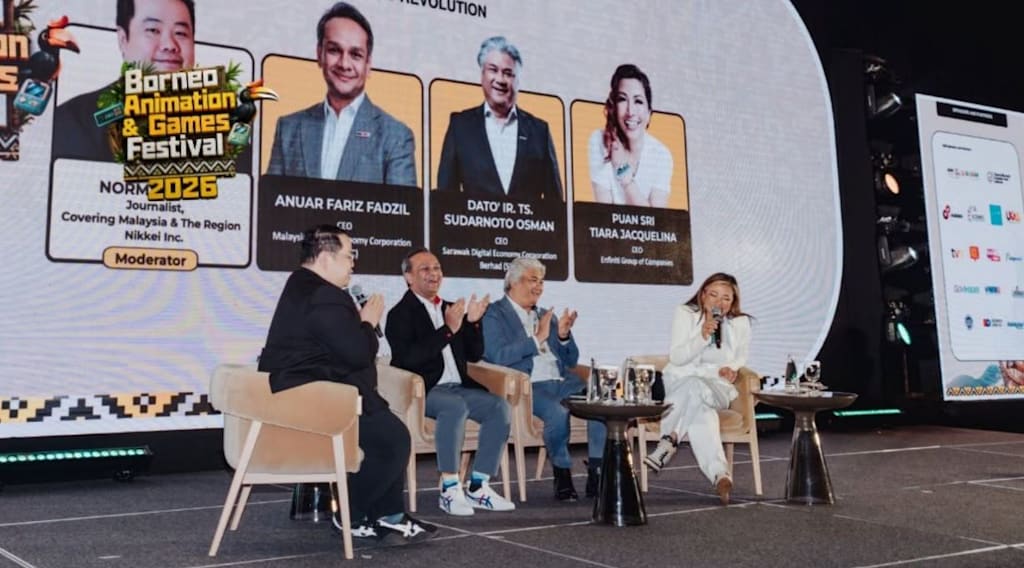
For three decades, Malaysia’s digital and creative industries have built their reputation on being the smart, affordable choice for outsourcing work. It was a strategy that built skills, created jobs, and established the country as a reliable partner to the world. But according to Anuar Fariz Fadzil, CEO of Malaysia Digital Economy Corporation (MDEC), that era has officially come to an end.
Speaking at BAGFEST 2026, the Borneo Animation and Games Festival held in Kuching, Sarawak, from August 19–23 Anuar put it plainly: “We cannot compete on costs anymore.” And in an age where artificial intelligence is democratising content creation making it faster and more accessible to more people everywhere the competitive advantage is no longer about who can produce things cheaper or quicker. It is about who owns what is created.
Outsourcing Hub To IP Powerhouse
The shift is central to MDEC’s Digital Economy Framework 2030, which targets lifting the digital economy’s contribution to national GDP from 25% to 30% by the end of the decade. But the transformation required goes far beyond policy targets; it demands a fundamental change in mindset.
For years, Malaysia excelled at delivering work for others. Now, the goal is to create, own, and control the stories, characters, and intellectual property that travel the world. As Anuar explained: identity and ownership of stories and IP should be the new differentiator.
It is a distinction that cuts deep. Enfiniti Group founder and producer Tiara Jacquelina expanded on the idea during the panel session “Building a Sustainable Ecosystem for the Digital Content Revolution.” She pointed out that the industry too often celebrates completion rather than ownership.
“We fund a film, an animation, a game… and we celebrate when the project is completed. But completion is not necessarily success,” she said. “Who funds development before production? Who funds marketing and audience building? Who helps with international distribution? Who thinks about licensing, merchandise, publishing and who is thinking of the life of the IP five or 10 years from now?”
Her measure of success is simple but powerful: can this story continue beyond the first product? If the answer is yes, then you are building an IP ecosystem, not just a one-off project. If the answer is no, then you are still renting out talent, not owning the value you create.
Sarawak: A Model For The Future
The panel highlighted Sarawak as one of the most promising examples of this new approach. Sudarnoto Osman, CEO of the Sarawak Digital Economy Corporation (SDEC), explained that Kuching is emerging not as a cheaper place to make things, but as a place where IP is created, nurtured, and kept.
Production houses are coming not to cut costs, but because “they know there are IPs to be developed… to be invested in.” Lower living costs in the state also give creators room to experiment, fail, and try again without the crushing financial pressure found in more expensive cities like Kuala Lumpur.
Sarawak has set its own ambitious targets: growing the creative industries to contribute 20% of state GDP by 2030, and expanding the number of studios from roughly 10 to 40 or more. But beyond the numbers, the priority is clear: building an ecosystem where ownership stays local.
AI As An Enabler, Not A Replacement
The conversation inevitably turned to AI, and Anuar’s perspective was both pragmatic and empowering. He does not believe AI will replace creators. Instead: “Your job will be lost to the person who knows how to use AI.”
The danger, he warned, is not the technology itself, but the risk that AI becomes another tool only affordable to the wealthy, widening rather than narrowing the gap. That is why MDEC is planning to subsidise AI tokens for businesses and individuals across the country, ensuring broad access to these powerful tools.
But access comes with a vital warning: “Do not outsource your thinking.” AI can accelerate, assist, and improve the work but the vision, the story, and the ownership must remain human. Just as Malaysia spent three decades building skills through outsourcing without owning the end product, creators today must use AI to amplify their ideas not to replace the ideas themselves.
The message from BAGFEST 2026 was clear: Malaysia has built the skills. Now it must build the ownership. The outsourcing years were not wasted; they were training. But the next era belongs to those who control their own stories, their own IP, and their own future.
As Anuar put it: “Don’t just use the tools. Know what you’re doing with them.” Because in the end, speed and cost will always be matched. But an idea that is owned, nurtured, and built upon year after year is something no one can copy.
About the Creator
Mark Lim
Hi I am mark an automotive student and a car, tech and food enthusiast ! Im gonna try and post daily & hope you enjoy what I write and do share my page with people you know. I would gladly appreciate it! Cheers
Enjoyed the story? Support the Creator.
Subscribe for free to receive all their stories in your feed.
Comments
There are no comments for this story
Be the first to respond and start the conversation.