
Best Models for OpenClaw 2026: Price, Privacy, and Provider Strategy
OpenClaw 2026

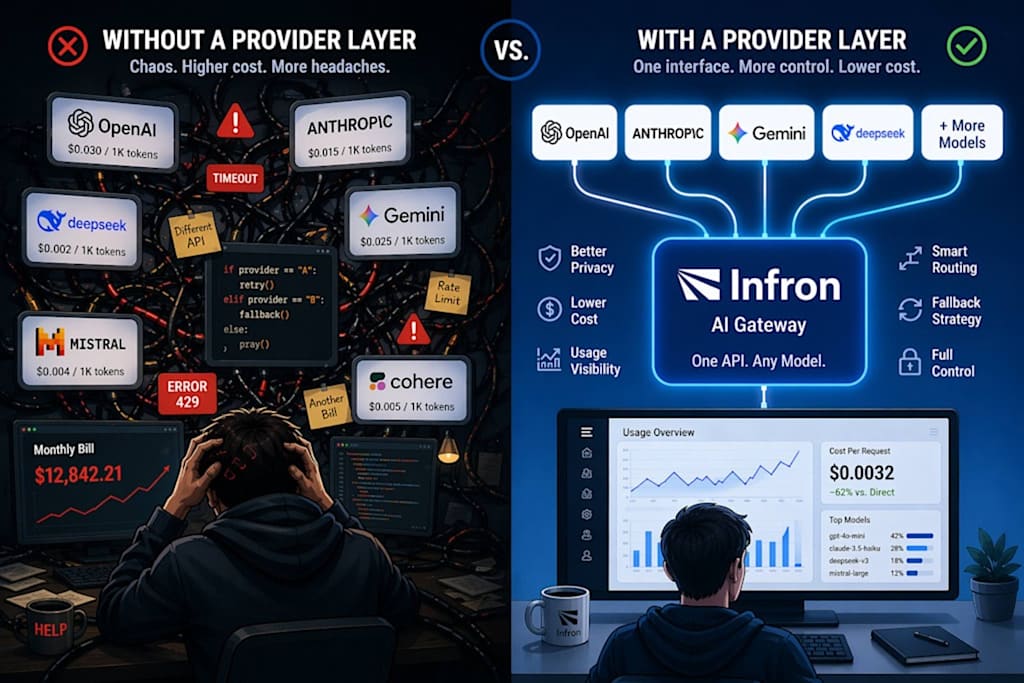
OpenClaw is widely used because it provides a flexible runtime for messaging, tools, and agent orchestration. But once a deployment moves beyond the initial setup, the focus shifts from prompts to the model provider layer.
That is where tradeoffs start to matter. Teams often need to balance between capability, cost efficiency, privacy requirements, and operational simplicity. In practice, achieving all four at the same time is difficult.
This is also why OpenClaw supports multiple providers and model configurations. Real workloads are rarely uniform. One request may be a simple assistant reply. Another may involve coding, document-heavy processing, or multi-step agent workflows. These tasks do not require the same model or the same cost level.
Why OpenClaw Teams Need More Than One Model Provider
OpenClaw’s flexibility is not only a feature but also part of its operational design.
A practical deployment typically needs to handle the following:
• use a strong primary model for important work
• fall back when the primary model is unavailable or costly
• control which models are allowed in the system
• adapt as model offerings evolve over time
OpenClaw’s architecture supports this by allowing teams to define a primary model and configure fallback models. As a result, model selection becomes an ongoing decision involving cost, reliability, and governance rather than a one-time setup.
The OpenClaw Provider Tradeoffs
When evaluating a provider setup, the decision usually comes down to three factors: price, capability, and privacy.
1. Price
The lowest-cost model does not always result in the lowest overall system cost.
If a weaker model leads to retries, poor tool usage, or inaccurate multi-step reasoning, the total cost may increase. On the other hand, using a high-end model for all requests can lead to unnecessary spending.
The more practical goal is to optimize for cost per successful outcome rather than cost per token.
2. Capability
Capability in OpenClaw systems is not just about benchmark scores. It is more about real-world behavior, such as:
• instruction following
• context retention
• code generation quality
• tool usage reliability
• latency under real workloads
A model may perform well in benchmarks but still struggle in agent-based workflows.
3. Privacy
Privacy requirements often influence model selection significantly.
Workloads involving internal code, sensitive data, or regulated environments may require local deployment or restricted processing paths. Because of this, open-source and locally hosted models continue to play an important role in many deployments.
A hybrid approach is also common, where cloud models handle general tasks while local models handle sensitive operations.
OpenClaw Model Provider Pricing
The table below represents general pricing trends across commonly used model categories in OpenClaw-style systems. Actual pricing may vary depending on providers and time.
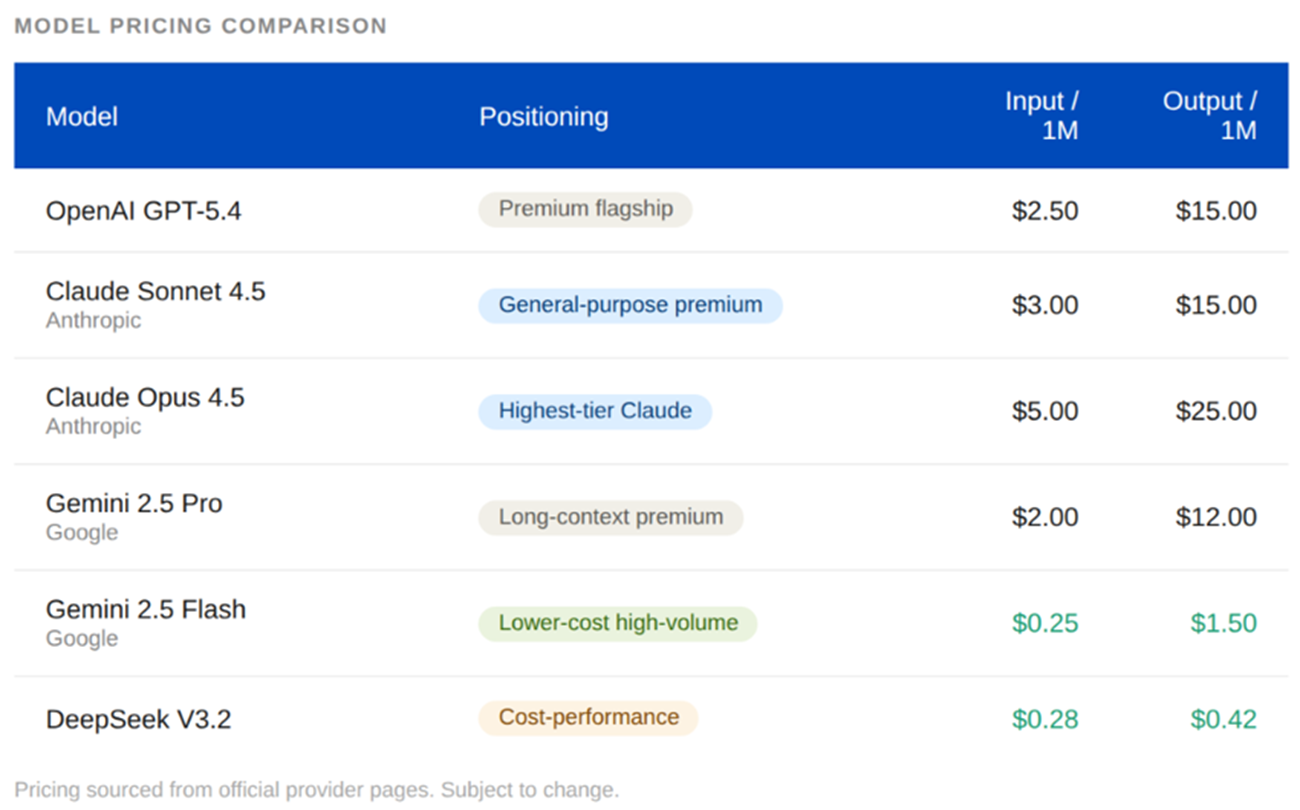
A few patterns are noticeable.
Premium models are priced significantly higher than efficient models. This difference makes provider strategy important, especially when multiple agents, retries, or fallback systems are involved. Even small pricing differences can add up at scale.
OpenRouter
OpenRouter is used by some teams as a multi-model routing layer that provides access to multiple providers through a single API.
Its main advantage is flexibility. It allows access to a wide range of models and reduces dependency on a single vendor.
However, it is important to account for platform-level costs when evaluating total system pricing. Its pay-as-you-go structure includes a platform fee, and BYOK usage may also include additional charges after free usage limits. These factors should be considered in cost planning.
Infron
Infron is often used as a provider abstraction layer rather than just a model endpoint. It provides a single OpenAI-compatible interface and access to multiple upstream models.
This approach can simplify long-term system management, especially when teams frequently switch models or use multiple providers within the same system.
From a cost perspective, pricing depends on usage mode. Prepaid usage includes service fees shown during top-ups, while BYOK usage typically follows provider-level pricing.
Infron vs OpenRouter: The Provider-Layer Difference
The difference between these approaches is less about model access and more about system design over time.
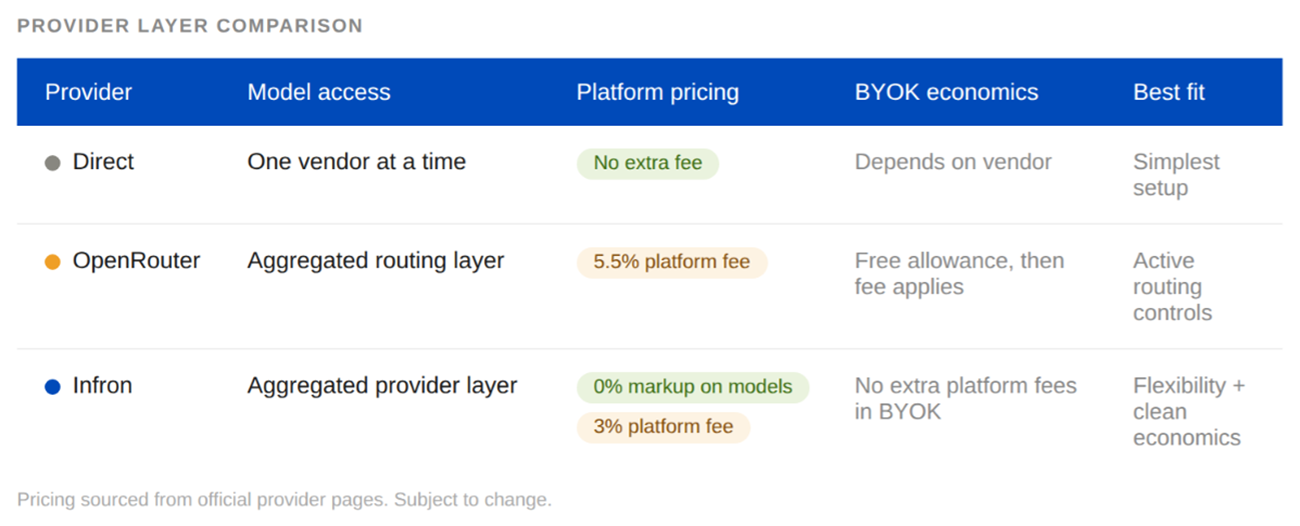
In practice, this comes down to how easily the provider layer can adapt as usage scales and model requirements change. A unified interface can reduce operational complexity when multiple models are involved.
How to Add Infron as an OpenClaw Model Provider
OpenClaw configuration is straightforward once the model structure is understood. The provider is defined under models.providers, while the agent’s primary and fallback models are defined under agents.defaults.
A simplified example:
{
"models": {
"mode": "merge",
"providers": {
"infron": {
"baseUrl": "https://llm.onerouter.pro/v1",
"apiKey": "<API_KEY>",
"api": "openai-completions",
"models": [
{
"id": "openai/gpt-5.2",
"name": "GPT-5.2 via Infron",
"input": ["text", "image"],
"contextWindow": 200000,
"maxTokens": 8192
},
{
"id": "anthropic/claude-sonnet-4.5",
"name": "Claude Sonnet 4.5 via Infron",
"input": ["text", "image"],
"contextWindow": 200000,
"maxTokens": 8192
},
{
"id": "deepseek/deepseek-v3.2",
"name": "DeepSeek Chat via Infron",
"input": ["text"],
"contextWindow": 64000,
"maxTokens": 8192
}
]
}
}
},
"agents": {
"defaults": {
"model": {
"primary": "openai/gpt-5.2",
"fallbacks": ["anthropic/claude-sonnet-4.5"]
},
"models": {
"openai/gpt-5.2": {},
"anthropic/claude-sonnet-4.5": {},
"deepseek/deepseek-v3.2": {}
}
}
}
}
Once configured, the workflow typically remains simple:
• openclaw models list
• openclaw models set <provider/model>
• /model
• openclaw gateway run
This allows the system to remain stable while model choices remain flexible underneath.
Conclusion
If the goal is to get OpenClaw running quickly, a single provider is usually enough.
If the goal is to manage cost, maintain flexibility, and reduce dependency on a single model ecosystem, the provider layer becomes more important.
For teams working at scale, this becomes less about choosing a single model and more about designing a system that can adapt as models, pricing, and capabilities change over time.
About the Creator
Sarah
With an experience of 10 years into blogging I have realised that writing is not just stitching words. It's about connecting the dots of millions & millions of unspoken words in the most creative manner possible.
Enjoyed the story? Support the Creator.
Subscribe for free to receive all their stories in your feed.
Comments
There are no comments for this story
Be the first to respond and start the conversation.