
Bathroom Vanities Market
A quiet transformation reshaping global bathroom living spaces
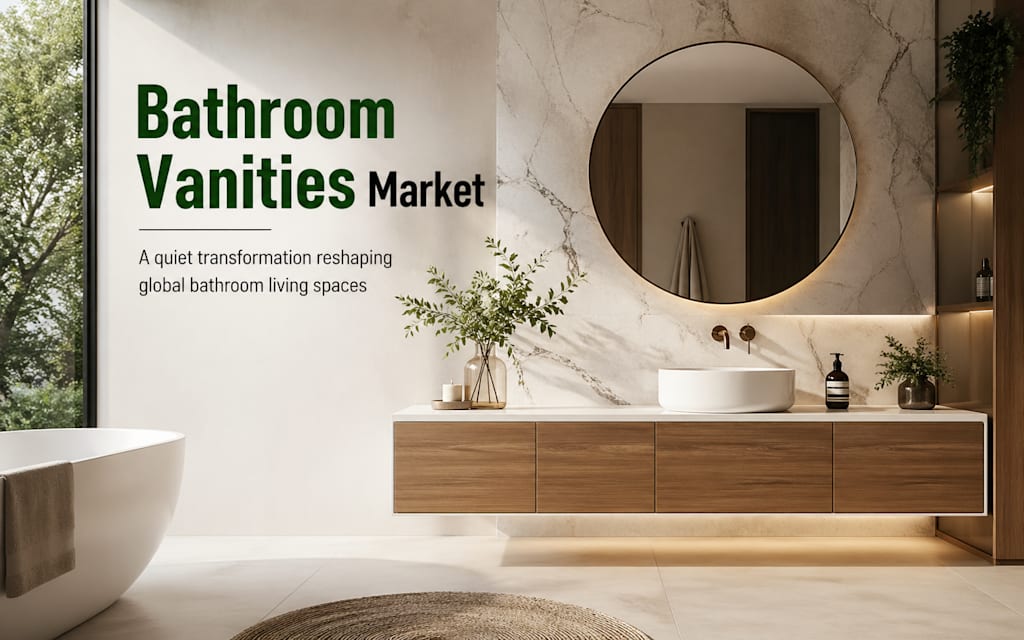
A bathroom is no longer just a functional corner of the home. It has become a personal retreat, a design statement, and in many cases, a reflection of lifestyle identity. And at the center of this transformation sits one understated hero, the vanity.
Walk into a newly renovated home today, and you’ll notice something subtle but powerful: the bathroom vanity is no longer an afterthought. It’s the focal point. The material choice, storage design, lighting integration, and even mirror alignment all reflect a shift in how people experience private spaces.
Across urban apartments, luxury hotels, and suburban homes, bathroom design is being reimagined with emotional intent. And this is where the global Bathroom Vanities Market quietly accelerates behind the scenes, shaping how modern interiors evolve.
Bathroom Vanities Market Share
In recent years, the distribution of demand has shifted significantly across residential and commercial segments. Urban housing expansion and hospitality redesign projects have contributed to a more balanced global landscape of adoption. In many regions, prefabricated and modular designs are increasingly dominating preference, especially where space optimization is critical.
The bathroom vanities market share is being influenced by rising renovation culture, where homeowners prefer upgrading bathrooms as a cost-effective alternative to full remodeling. Designers also report increased demand for compact yet visually premium vanity units that combine storage efficiency with aesthetic minimalism.
This shift is not just architectural, it reflects changing lifestyle psychology. Consumers are prioritizing comfort, personalization, and wellness-driven interiors.
Bathroom Vanities Market Size
The global industry reflects steady expansion driven by housing development cycles, hospitality investments, and rising disposable income in emerging economies. According to Mordor Intelligence, the sector demonstrates structured long-term growth patterns across multiple regions.
According to Mordor Intelligence, the bathroom vanities market size is expected to grow from USD 34.92 billion in 2025 to USD 35.32 billion in 2026 and is forecast to reach USD 48.35 billion by 2031 at 6.48% CAGR over 2026-2031.
This expansion highlights not just volume growth but also value transformation. Premium materials like engineered stone, moisture-resistant wood composites, and integrated smart lighting systems are becoming mainstream rather than luxury exceptions.
Bathroom Vanities Market Growth
Growth in this industry is deeply tied to urban migration and real estate development. As more people move into apartments with limited space, the demand for multifunctional bathroom furniture has surged. The evolution of compact living has made design efficiency a necessity rather than a preference.
The bathroom vanities market growth is also influenced by renovation cycles in developed economies, where homeowners refresh interiors every few years. Digital visualization tools and AI-based interior planning platforms have further accelerated consumer decision-making, making bathroom upgrades more accessible and personalized.
From a narrative perspective, the bathroom is no longer hidden, it is curated. And the vanity is its centerpiece, blending utility with emotional design language.
Bathroom Vanities Industry
Beyond numbers, the broader ecosystem reflects a convergence of design innovation, sustainability goals, and manufacturing efficiency. Modular production techniques and global supply chain integration are enabling faster customization and wider accessibility.
The bathroom vanities industry is increasingly shaped by consumer expectations for durability, water resistance, and aesthetic adaptability. Manufacturers are focusing on hybrid designs that merge traditional craftsmanship with modern engineering.
Material innovation plays a crucial role here, as moisture-resistant composites and recyclable components become standard in product development pipelines. Sustainability is no longer optional, it is becoming a competitive requirement.
Bathroom Vanities (design evolution perspective)
At the heart of this transformation is design evolution. Bathroom vanities now serve as multifunctional anchors that define spatial identity. Floating structures, integrated LED mirrors, hidden storage compartments, and minimalist silhouettes are redefining what bathroom furniture represents.
Designers increasingly treat the vanity as a storytelling element within interiors. It is where material meets mood, and where functionality merges with visual calmness. In luxury developments, vanities are customized to reflect personal taste, often blending stone, wood, and metallic accents in layered compositions.
This evolution is also driven by digital inspiration culture. Platforms showcasing interior aesthetics have made design more accessible, influencing consumer expectations globally.
The bathroom vanity is no longer just a fixture, it is a reflection of how modern life balances utility and emotional comfort. As design continues to evolve, this quiet centerpiece will keep shaping how people experience their most personal spaces.
What do you think defines the perfect bathroom vanity today, function, aesthetics, or emotional comfort?
About the Creator
Enjoyed the story? Support the Creator.
Subscribe for free to receive all their stories in your feed.
Comments
There are no comments for this story
Be the first to respond and start the conversation.