
Bad Food Is the Original Sin
Why restaurants fail—and it's not rent, labor, or the platforms. It's the bowl in front of you.
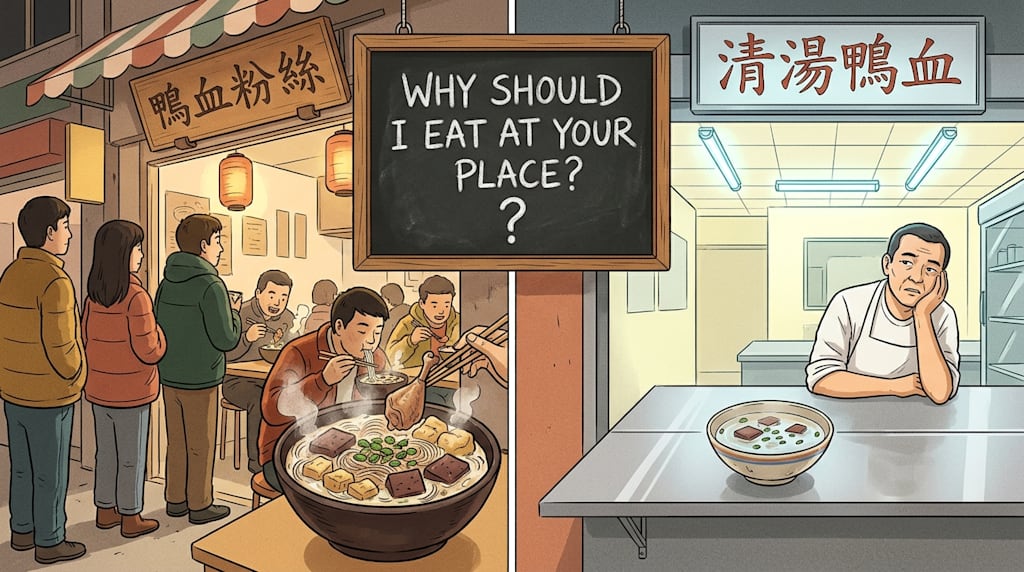
The complaint you hear most in the restaurant business is: rent is too high, labor is too expensive, the platforms take too much, customers are too picky.
All of that is true, but none of it is the real reason a restaurant goes under. The real reason is usually simple to the point of cruelty: the food isn't good, and there's nothing distinctive about it.
Don't give me rent. Don't give me labor costs. Rent and labor are operating constraints, not a fig leaf for flavor. A customer walking into a restaurant is not there to sympathize with how hard the owner has it. He spends ten or twenty yuan, sits down, waits ten or twenty minutes, and what he wants is one bite he'll remember. Tell him rent went up, and he won't suddenly find that watery duck-blood vermicelli soup delicious. Tell him labor is expensive, and he won't forgive that duck leg he can't chew through.
Downstairs from where I used to live, there was a duck-blood vermicelli shop. It sold old-duck vermicelli soup noodles, old-duck vermicelli soup rice, duck legs, and roujiamo. The shop wasn't big, the decor was ordinary. But the food was good.
That bowl of old-duck vermicelli soup—the broth was white and thick, like milk. You could eat to the bottom of the bowl and not find any grit. It wasn't the kind of "freshness" you get from flavor essence. Every time I ate there, I finished the soup. The duck legs were braised all the way through; the meat came off with a light pull. You didn't have to fight the bone, and you didn't have to worry about it getting stuck in your teeth. A small bowl of old-duck soup noodles was twelve yuan, a duck leg seven. Not cheap. And the food came slowly—ten or twenty minutes. Yet the place was always busy. It stayed open six or seven years without going under.
Later I moved away, far enough that it wasn't convenient, but every once in a while I'd still drive back to eat there. I brought coworkers too, and everyone thought highly of it.
The other duck-blood vermicelli shops on the street? You've all eaten at them, I'm sure. A few pieces of duck blood floating in clear soup. Cilantro is cilantro, vermicelli is vermicelli, and the three ingredients look like they've been called into a meeting at the last minute—each one talking to itself, forgotten the moment the meeting ends. You eat there once and never want a second visit. If you don't go under, who will?
People like that just don't use their heads. If you could make money by following a template, would that money be waiting for you? A template can make you "look like a restaurant." It can't make you "a restaurant worth going to." Five duck-blood vermicelli shops on one street, four of them using the same broth base, the same braise, the same serving process. Why should customers remember you? They have no reason to remember you, and therefore no reason to come back.
Put plainly: there's nothing special about your food. Why should I eat at your place? That question should be taped to every restaurant owner's cash register. Not for the customers to see—for the owner. If you have no answer, your shop has no reason to exist. If you have an answer and customers agree, then even if you're slow and a little expensive, people will still come.
There's a theory called the long-board effect. It says a barrel doesn't need every short plank fixed; as long as one plank is longer than everyone else's, you have an advantage. In my words: break the surface at one point. One breakthrough, then a full breakthrough.
In restaurants, as long as one point beats your competitors, customers will remember you. Take duck-blood vermicelli soup—it's sold all over the country. If you study it and make yours taste better than others, customers will think of you. The broth can be that point. The braise can be that point. The chili oil can be that point. Even the rice in a bowl, the bread of a roujiamo, the speed of service, the packing details, the light still on late at night—any of them can be that point. The key isn't quantity; it's sharpness. Not "I have everything," but "this one thing of mine is something others just can't match."
But a long board isn't self-indulgence. The owner thinking his broth is good doesn't count as a long board; a customer finishing the soup and wanting to pack another portion to take home—that counts. The owner thinking his duck leg is braised well doesn't count; a customer willing to detour for that duck leg—that counts. A long board has to be perceptible, memorable, and repeatable. After customers leave, they should be able to tell a friend, "That broth was really rich," "That duck leg came apart with one pull," "That chili oil was especially good." That's what a long board is. If they can't say it, can't remember it, can't pass it on, then it's just the owner's self-congratulation.
Of course, the long-board effect doesn't mean ignoring the short boards entirely. Food safety, hygiene, basic service—those are the passing line. No matter how good the broth is, you can't give people food poisoning. No matter how fragrant the duck leg is, if the shop is too dirty to step into, it doesn't matter. The real meaning of the long-board effect is: short boards pass, the long board goes to the extreme. Not every item at seventy-something, but one item at ninety, so customers remember you for that one thing and then, while they're at it, accept that everything else is ordinary.
Competition in restaurants looks like competition over location, price, and traffic. At bottom, it's competition over "why should the customer choose you?" Traffic can buy the first visit; it can't buy the second. Decor can pull people through the door; it can't keep them at the table. A shop that lasts six or seven years doesn't rely on a fresh batch of customers being fooled every day. It relies on a batch of regulars who come back again and again and bring other people with them. Regulars are the restaurant's moat, and the reason they come back is usually one very concrete long board.
So stop blaming rent and labor for going under. Rent is high, and some people survive. Labor is expensive, and some people survive. A street is crowded with the same category, and still some people survive. Those who survive may not be the best at accounting, may not be the best at marketing, but most of them share one thing: they give customers a reason they have to come.
Bad food, no distinctive feature—customers won't hesitate for a second to abandon you. The reverse is also true: as long as one point of yours clearly beats your competitors, customers will remember you, tolerate you, come back to you, even speak for you. Don't start by trying to be good at everything. First ask yourself: is there one thing I do that others can't, that customers remember, that makes them want to come back?
If not, don't blame customers for being fickle. Customers aren't fickle. Customers just have no reason.
About the Creator
Jin
Writer of reamstories
https://reamstories.com/jin
Enjoyed the story? Support the Creator.
Subscribe for free to receive all their stories in your feed. You could also become a paid subscriber, letting them know you appreciate their work.
Comments
There are no comments for this story
Be the first to respond and start the conversation.