
Back Button Hijacking: Google’s New Spam Policy That Will Reshape User Experience
Why manipulating the browser’s back button is now a punishable SEO violation & how it directly impacts rankings, traffic integrity, and user control

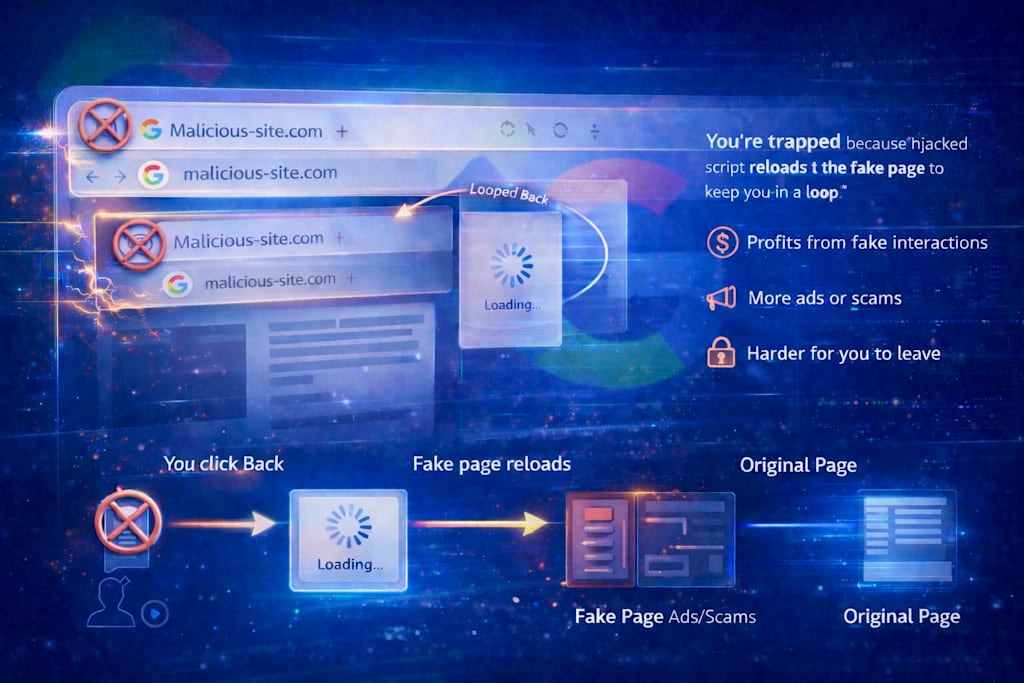
On April 13, 2026, Google formalized a long-standing concern by introducing a new spam policy targeting back button hijacking. This is not a minor guideline update. It is a direct classification of a specific behavior as a malicious practice, placing it in the same enforcement category as deceptive redirects, cloaking, and harmful user manipulation.
The enforcement begins on June 15, 2026. The gap between announcement and enforcement is intentional: it gives site owners time to fix systems that may already be violating the policy knowingly or not.
This update is less about punishing bad actors and more about eliminating a category of manipulation that has quietly distorted user experience and engagement metrics for years.
What Is Back Button Hijacking?
Back button hijacking occurs when a website interferes with a user’s browser navigation. Instead of allowing users to return to the previous page, the site manipulates the experience.
Typical behaviors include:
- Redirecting users to pages they never visited
- Injecting ads or unrelated content into navigation flow
- Preventing the browser’s back button from functioning normally
- Forcing additional page loads through history manipulation
This breaks a fundamental expectation: control over navigation.
Users click “back” with intent. Hijacking overrides that intent.
Why Google Is Taking Action
At its core, this policy is about restoring alignment between user expectation and actual behavior.
Back button hijacking creates:
- Friction in navigation
- Artificial session inflation
- Deceptive engagement signals
- Loss of user trust
Google classifies this under malicious practices because it intentionally manipulates user flow. It is not a design flaw. It is engineered behavior.
The official stance is clear: any method that inserts misleading or manipulative steps into a user’s browsing journey violates search quality standards.
Enforcement Timeline and Impact
The enforcement begins on June 15, 2026, giving site owners a limited window to audit and fix issues.
Consequences include:
- Manual spam actions
- Algorithmic ranking demotions
- Reduced visibility in search results
- Potential long-term trust signals degradation
Unlike minor UX issues, this falls under spam enforcement, meaning recovery may require reconsideration requests and technical proof of fixes.
SEO Implications: Immediate and Long-Term
This update has direct consequences for SEO strategy.
1. Engagement Manipulation Is No Longer Tolerated
Artificial methods of increasing page views or session duration especially via forced navigation are now explicitly penalized.
2. UX Becomes a Ranking Integrity Factor
User experience is no longer just a performance metric; it is a compliance requirement.
3. Third-Party Scripts Become Liability
Many hijacking behaviors originate from:
- Ad networks
- Pop-up plugins
- Redirect scripts
- Analytics overlays
Responsibility still lies with the site owner.
4. Trust Signals Gain More Weight
Sites that respect user control will increasingly outperform those that rely on manipulation.
What Site Owners Must Do
The corrective path is technical, not theoretical.
Audit Navigation Behavior
- Test browser back functionality across devices
- Identify abnormal redirects or page insertions
Remove Manipulative Code
- Disable scripts altering browser history
- Eliminate forced redirects tied to navigation events
Review Third-Party Integrations
- Inspect ad platforms and injected scripts
- Remove any component interfering with navigation
Validate Clean User Flow
- Ensure a direct return path to the previous page
- Maintain predictable browsing behavior
Use Search Console for Recovery
If penalized, submit a reconsideration request only after full remediation.
The Bigger Shift: From Clicks to Consent
This update reflects a broader evolution in search systems.
The web is moving from:
- Click maximization → Intent satisfaction
- Engagement tricks → Experience integrity
- Growth hacks → Trust frameworks
Back button hijacking is not being targeted because it is annoying. It is being targeted because it breaks user autonomy.
My Final Perspective
This policy does not introduce a new philosophy. It enforces an existing one.
Users control navigation.
Websites facilitate not override that control.
Any system built on interference is now structurally incompatible with modern search standards.
About the Creator
Prasad Dhumal
Independent writer exploring ideas across business, technology, SEO & everyday life. I publish sharp, research-driven content designed to inform, challenge assumptions, & deliver practical insight. Expect clarity, depth, & substance.
Enjoyed the story? Support the Creator.
Subscribe for free to receive all their stories in your feed.
Comments
There are no comments for this story
Be the first to respond and start the conversation.