
Automotive Safety Systems Market: Protecting Every Journey Through Smarter Technology
How advanced safety innovations are transforming vehicles from reactive protection to proactive accident prevention
Hook Intro
A fraction of a second can change everything on the road. A distracted glance, a sudden obstacle, or unexpected traffic movement can quickly become dangerous.
Today’s vehicles are designed to do more than simply protect occupants during a crash. They are increasingly capable of detecting risks, warning drivers, and even preventing accidents before they happen. At the center of this evolution is the Automotive Safety Systems Market, where advanced sensors, intelligent software, and connected technologies are redefining vehicle safety.
As consumers prioritize protection and regulators enforce stricter safety standards, automotive safety systems are becoming a core part of modern mobility.
Why Automotive Safety Systems Matter Today
Road safety remains one of the automotive industry's highest priorities. While traditional safety features such as airbags and seatbelts continue to save lives, the industry is rapidly moving toward systems that actively prevent accidents.
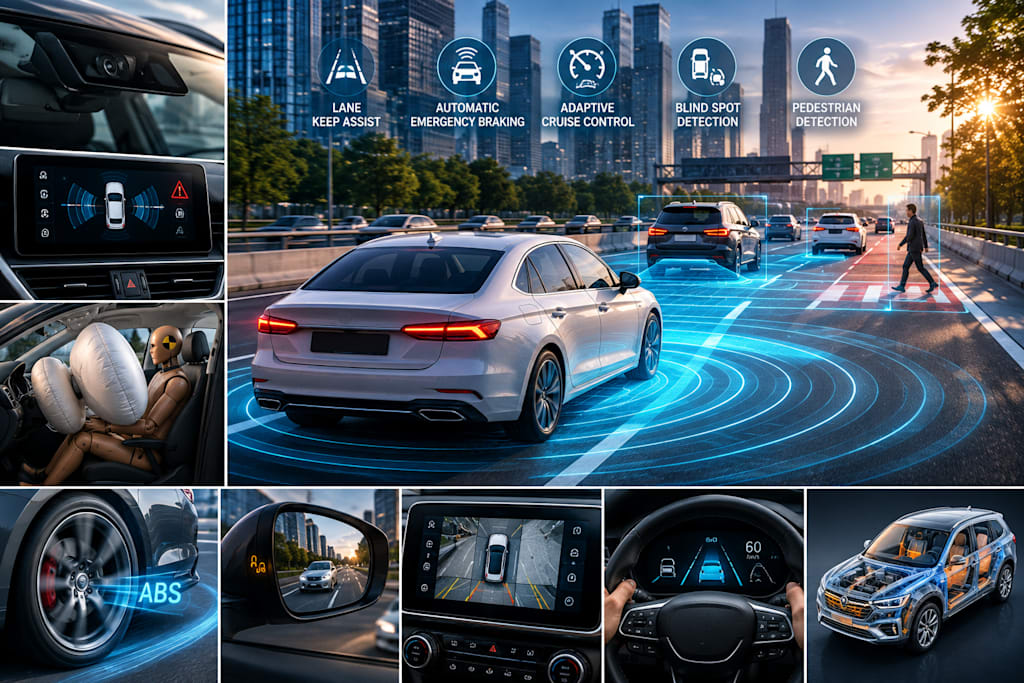
Modern vehicles now integrate technologies such as automatic emergency braking, adaptive cruise control, lane-keeping assistance, blind-spot monitoring, and driver monitoring systems. These solutions help drivers respond faster and reduce the likelihood of collisions.
According to Mordor Intelligence, the Automotive Safety Systems Market is experiencing strong growth as governments strengthen vehicle safety regulations and consumers increasingly demand advanced protection features. Active safety technologies currently represent the largest segment of the industry.
Understanding Automotive Safety Systems Market Size and Share
The Automotive Safety Systems Market size continues to expand as safety technologies become standard equipment across passenger and commercial vehicles.
Automakers are integrating safety features into a wider range of vehicle models, moving beyond luxury segments into mass-market vehicles. Passenger cars account for the largest share of adoption, supported by rising consumer awareness and evolving safety requirements.
The Automotive Safety Systems Market share remains strongest in Asia-Pacific, supported by large-scale vehicle production, growing adoption of advanced driver assistance systems (ADAS), and supportive regulatory frameworks. North America and Europe continue to lead in technology innovation and safety feature deployment.
Automotive Safety Systems Market Trends Driving the Industry
Several Automotive Safety Systems Market trends are shaping the future of vehicle protection.
Advanced Driver Assistance Systems (ADAS) are becoming standard across more vehicle categories.
Radar, camera, and LiDAR technologies are improving vehicle awareness and collision avoidance capabilities.
Driver monitoring systems are helping detect fatigue, distraction, and unsafe driving behavior.
Connected vehicle technologies are enabling real-time safety communication between vehicles and infrastructure.
Software-defined vehicles are allowing safety features to improve through over-the-air updates.
These innovations are transforming safety systems from passive protection mechanisms into intelligent prevention platforms.
The Rise of Active Safety Technologies
One of the most significant developments in recent years is the rapid adoption of active safety systems.
Unlike passive safety features that minimize injury during a crash, active systems continuously monitor the driving environment and intervene when necessary. Technologies such as autonomous emergency braking, lane departure warnings, and adaptive cruise control are helping reduce accident frequency and severity.
As sensor costs decline and software capabilities improve, these technologies are becoming increasingly accessible across vehicle segments. Radar remains one of the most widely deployed safety technologies, while LiDAR adoption is accelerating as costs continue to decrease.
Why Consumers Value Vehicle Safety More Than Ever
Vehicle buyers are placing greater emphasis on safety when making purchasing decisions.
Independent crash-test ratings, advanced driver assistance features, and enhanced occupant protection systems are increasingly influencing consumer preferences. Many drivers view safety technology as an essential feature rather than an optional upgrade.
The growing popularity of ADAS-equipped vehicles reflects this shift. Features that were once limited to premium models are now appearing in mainstream vehicles, making advanced safety more accessible to a broader audience.
Challenges Facing the Automotive Safety Industry
Despite strong growth, the industry faces several challenges.
Advanced safety systems require sophisticated sensors, software integration, and high-performance computing, which can increase vehicle costs. Regulatory requirements vary across regions, creating complexity for manufacturers operating globally.
Cybersecurity is also becoming a critical concern as vehicles become increasingly connected and software-driven. Automakers must ensure that safety systems remain secure and reliable throughout a vehicle's lifecycle.
In addition, integrating multiple safety technologies while maintaining affordability remains a key challenge, particularly in price-sensitive markets.
Automotive Safety Systems Market Forecast and the Road Ahead
The Automotive Safety Systems Market forecast indicates continued expansion as safety regulations become more stringent and vehicle automation advances.
Future safety systems will likely feature greater sensor fusion, enhanced artificial intelligence, predictive risk analysis, and deeper integration with connected mobility ecosystems. Vehicles will increasingly be capable of identifying hazards, communicating with surrounding infrastructure, and taking corrective action before drivers can react.
As the industry moves toward autonomous driving, safety technologies will remain the foundation enabling that transition. The goal is no longer simply surviving accidents but preventing them altogether.
Final Thought
The future of automotive safety is shifting from protection after impact to prevention before danger occurs. Intelligent systems, advanced sensors, and real-time decision-making are helping create safer roads for drivers, passengers, and pedestrians alike.
As vehicles become smarter, safety is evolving from a feature into a defining characteristic of modern mobility.
About the Creator
Enjoyed the story? Support the Creator.
Subscribe for free to receive all their stories in your feed.
Comments
There are no comments for this story
Be the first to respond and start the conversation.