
Are Robotic Pool Cleaners Safe for Saltwater Pools? 7 Things to Know
Are Pool Robots Safe for Saltwater Pools?

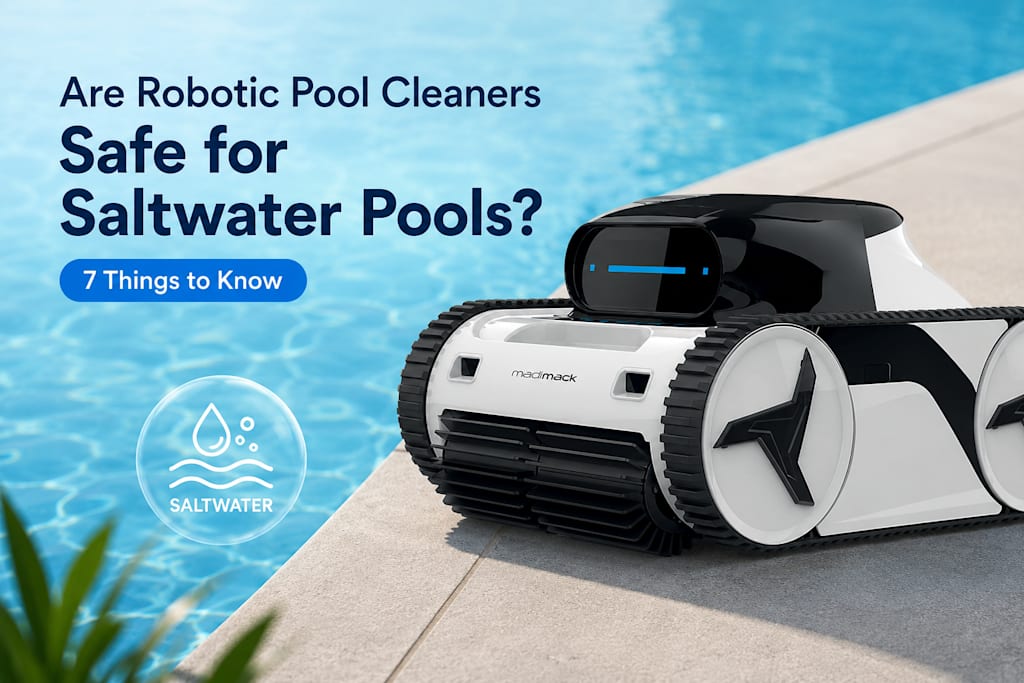
Saltwater pools aren't chlorine-free, their chlorinators generate natural chlorine through electrolysis. While that combination sounds highly corrosive for a pool-cleaning device, many modern cordless robotic pool cleaners are designed to operate safely in saltwater pools.
The catch? You must choose a machine engineered for the job and commit to a simple maintenance routine. Before dropping a high-tech robot into the deep end, here are seven critical facts you should know to protect your investment.
The 7 Things You Must Know Before Buying
1. Saltwater Pools Still Use Chlorine
Because your salt cell actively converts salt into chlorine, your robot isn't just dealing with salinity; it is swimming in a combined chemical environment. This creates a high potential for corrosion. When shopping for a robotic pool cleaner, you cannot just look for something that handles chlorine; it must be specifically engineered to withstand this dual-exposure environment without its plastic housing bleaching or degrading.
2. Look for "SCT" (Salt Chlorine Tolerant) Motors
One of the most important features in a saltwater-safe robotic cleaner is its internal sealing. Standard pool vacuums might rely on basic seals that slowly weep under the pressure of salt-heavy water. You need a machine featuring an IP68 waterproof rating and an explicitly stated "Salt Chlorine Tolerant" (SCT) or marine-grade motor housing. These motors are completely isolated from the external environment, protecting the sensitive electronic control boards inside.
3. Stainless Steel vs. Titanium: Check the Fasteners
Take a close look at the underside and joints of any robot you consider. Standard steel screws or low-grade metal brackets will rust and bleed unsightly brown stains onto your pristine pool surface within a single season. High-quality, saltwater-rated robots exclusively utilize marine-grade stainless steel (like 316-grade) or titanium fasteners. These alloys form a passive oxide layer that resists the harsh combination of salt and oxidizers.
4. Salt Crystallization is the Real "Robot Killer"
The real damage rarely happens while the robot is submerged; it happens on the pool deck.When you pull a cordless robotic pool cleaner out and let it sit in the sun, the water evaporates, leaving behind microscopic, razor-sharp salt crystals. Over time, these crystals work their way into the rubber tracks, jam up the drive gears, and cause friction that can tear the watertight rubber seals surrounding the motor axle.
5. The Golden Rule: The Post-Cycle Fresh Water Rinse
The single most important habit for a saltwater pool owner takes less than a minute. Every time you remove your robotic cleaner from the water, grab your garden hose and give it a thorough spray with fresh tap water. Focus heavily on the intake ports, the wheels, the tracks, and the filter trays. Rinsing dissolves those hidden salt crystals before they can dry and cause mechanical damage, helping reduce long-term wear and extending the lifespan of the machine.
6. Don't Leave the Robot "Living" in Saltwater
Modern robots feature fantastic "set-and-forget" weekly timers, tempting you to leave them underwater permanently. Don't do this in a saltwater pool. Prolonged, continuous submersion accelerates chemical fatigue on the rubber tracks, plastic intake flaps, and internal seals. Drop the robot in, let it run its cycle, and pull it out as soon as the job is done.
7. Mind Your Water Balance (pH and Salinity Limits)
Corrosion can become significantly worse if your pool water chemistry is out of balance. If your pH drops below 7.2, the water becomes acidic, and salt becomes highly aggressive toward metal components. Keep your pH strictly balanced between 7.2 and 7.6, and ensure your overall salinity remains within the manufacturer's recommended limits (typically under 4,000 ppm) to ensure your warranty remains fully protected.
Final Verdict
Investing in a quality robotic pool cleaner can make pool maintenance much easier and more time-efficient. Your saltwater pool will not ruin a quality robot, provided you choose a machine built for the job and give it a quick freshwater rinse after use.
Some manufacturers, including Madimack, offer robotic pool cleaners designed for saltwater pool conditions.
FAQs
Q1. Will saltwater void my warranty?
No, as long as the robotic pool cleaner is specifically rated for saltwater use. However, letting your pool's salinity spike or keeping water too acidic can void coverage.
Q2. How often should I clean the filter basket?
After every cycle. This clears out trapped debris and flushes away lingering saltwater before it dries and crystallizes.
Q3. Can I charge a robotic pool cleaner near the pool?
No. Corrosive salt mist near the water can ruin electrical components. Always charge it in a dry area like a shed or garage.
Q4. Do rubber tracks wear out faster in salt pools?
Only if left unrinsed. Dried salt crystals act like sandpaper on rubber, so a quick freshwater hose-down keeps them spinning smoothly.
About the Creator
Enjoyed the story? Support the Creator.
Subscribe for free to receive all their stories in your feed.
Comments
There are no comments for this story
Be the first to respond and start the conversation.