
🗺️ AMERICA’S ALLIES ARE WATCHING IN HORROR: The Gutting of the U.S. State Department Is America’s Most Dangerous Self-Inflicted Wound Yet
The country navigating the most complex geopolitical moment in decades has just fired 25% of its most experienced diplomats. One expert calls it “unilateral disarmament.” The consequences may last a generation.
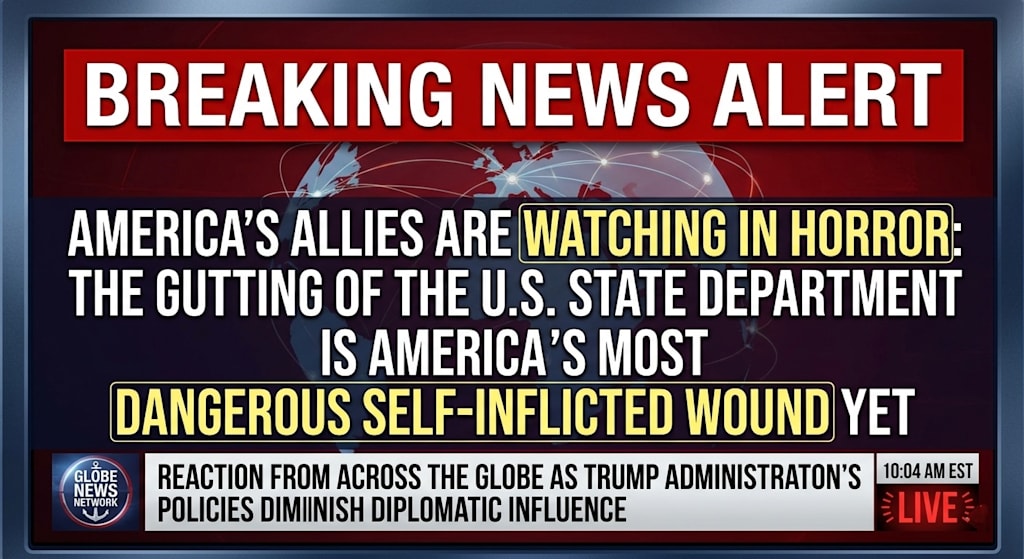
The Gutting of the U.S. State Department Is America’s Most Dangerous Self-Inflicted Wound Yet. AMERICA’S ALLIES ARE WATCHING IN HORROR
The country navigating the most complex geopolitical moment in decades has just fired 25% of its most experienced diplomats. One expert calls it “unilateral disarmament.” The consequences may last a generation.
When military analysts want to describe a nation making itself deliberately weaker without any external enemy forcing the decision, they use the phrase “unilateral disarmament.” It is a phrase that military strategists reserve for the most alarming self-inflicted vulnerabilities. One senior former diplomat has now applied it to something that has received far less public attention than the wars, elections, and crises dominating the headlines: the systematic dismantling of the United States Foreign Service under the Trump administration.
The State Department has finalized layoffs of nearly 250 Foreign Service officers and about 30 civil service employees, alongside a surge of forced retirements among senior career diplomats who are finding it impossible to advance in an administration that has filled more than 90% of ambassador positions with political appointees rather than career professionals.
The numbers tell a devastating story. In recent decades, about 70% of American ambassadors came from the career Foreign Service. Under the Trump administration, that figure has flipped: more than 90% of ambassadors are political appointees. The Foreign Service has lost 20 to 25% of its officers in just 16 months — a hollowing-out that one senior former official estimates will take a decade to repair.
These are not abstract bureaucratic reshuffles. The people departing have rare skills accumulated over decades. They speak Mandarin, Arabic, Russian, Swahili, Farsi — the languages of the countries where American interests are most at stake. They understand local political cultures, have cultivated networks of contacts, and carry institutional knowledge about ongoing negotiations, regional dynamics, and historical precedents that exist nowhere in any government database. When they leave, that knowledge leaves with them.
The acting U.S. ambassador to Ukraine — Julie Davis — is among the recent departures. Thirty career ambassadors were recalled from overseas posts last year. The Diplomats in Residence program, which placed experienced diplomats at universities to recruit the next generation, was eliminated. The American Foreign Service Association president himself received a reduction-in-force notice after the program was shut down.
The administration defends the changes as part of a major reorganization designed to create “a more efficient, faster, and effective America First diplomacy.” But critics in both parties point to a painful irony: at the precise moment the United States is managing a war with Iran, brokering a potential nuclear deal, supporting Ukraine against Russia, managing a delicate relationship with China, and watching instability spread across Africa and Asia, it has gutted the professional corps specifically trained and experienced to handle exactly these situations.
Democrats on the relevant Congressional committee urged the State Department to consider rehiring laid-off diplomats or allowing them to compete for vacancies, noting that these professionals already hold security clearances and have years of field experience — yet the department is now hiring new officers and contractors to fill vacancies, requiring tens of thousands of dollars in additional training.
Daniel Rosenblum, the former U.S. ambassador to Kazakhstan, watches the parade of retirement announcements from former colleagues on social media and asks the question that haunts everyone who cares about American statecraft: “How bad will the damage be, and how long will it take to recover?” The answer, among those most qualified to assess it, is increasingly alarming. America is choosing to go blind in the very moment the world most requires it to see clearly.
About the Creator
Enjoyed the story? Support the Creator.
Subscribe for free to receive all their stories in your feed.
Comments
There are no comments for this story
Be the first to respond and start the conversation.