
🏛️ AMERICA IS LOSING ITS BEST DIPLOMATS — AND NOBODY IS TALKING ABOUT IT: The Quiet Purge Destroying the U.S. Foreign Service
They speak Russian, Arabic, Mandarin. They’ve served for decades in every corner of the world. And the Trump administration is forcing them out the door — one impersonal email at a time.
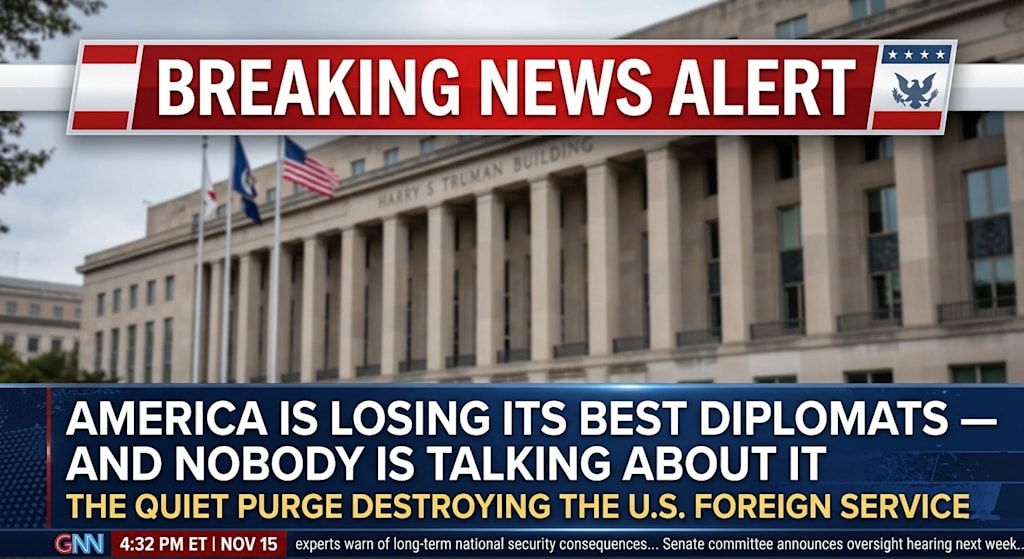
They speak Russian, Arabic, Mandarin. They’ve served for decades in every corner of the world. And the Trump administration is forcing them out the door — one impersonal email at a time.
It is happening quietly, far from the front pages dominated by wars, elections, and viral controversies. But diplomats, analysts, and former officials who watch the U.S. State Department say what is unfolding there is a slow-motion catastrophe for American national security — one that will take a decade or more to repair, if it can be repaired at all.
Senior career diplomats at the U.S. State Department are effectively being forced into retirement. The Foreign Service, like the military, operates on an “up or out” system — diplomats must be promoted to remain in service. Longtime Foreign Service officers are finding it nearly impossible to advance in the Trump administration. The result is a mass exodus of experienced professionals whose skills, language abilities, and institutional knowledge have been built up over decades of taxpayer investment.
Kelly Adams-Smith is one of them. She served for 28 years as an American diplomat, speaks Russian, Romanian, Czech, and other languages, and was on track to become the U.S. Ambassador to Moldova. After Trump returned to office, she received an impersonal email that said, “Dear colleague, you are no longer considered to be a nominee,” and told her to find another position within the State Department. Finding a role proved difficult, and she retired — along with many others who still wanted to serve. Her response to the experience: “It’s heartbreaking, staggering. We had experts on every area of the world going out the door at a very senior level.”
The State Department finalized layoffs of nearly 250 Foreign Service employees and about 30 civil service employees on Tuesday, after they received reduction-in-force notices last summer. The department told them that their separation was effective immediately. The American Foreign Service Association president himself was among those receiving separation notices, after the State Department eliminated its Diplomats in Residence program.
The numbers paint a stark picture. In recent decades, about 70% of American ambassadors were career diplomats. Under the Trump administration, more than 90% of ambassadors are political appointees. The Foreign Service has shrunk by 20 to 25% over the last 16 months. One former senior diplomat estimated it would take a decade to recover “just on the personnel side, not to mention institutional integrity.”
The timing is particularly alarming. The United States is currently engaged in a war with Iran, managing a delicate peace process, navigating complex relationships with China and Russia, supporting Ukraine, and managing crises across Africa, Asia, and Latin America. These are exactly the moments when experienced, language-proficient, regionally expert diplomats are most needed. The acting ambassador to Ukraine — Julie Davis — is among the recent departures. Thirty career ambassadors were recalled from overseas assignments last year.
Congressional Democrats have pointed out the absurdity of the situation: the administration is laying off experienced Foreign Service officers with security clearances and decades of field experience, then hiring new officers and contractors to fill the vacancies — at a cost of tens of thousands of dollars in new training. Rep. Joaquin Castro noted these are people in whom the department invested language training, graduate degrees, and years of field experience — now being replaced by less experienced personnel who require extensive onboarding.
One former diplomat, Daniel Rosenblum, who retired as ambassador to Kazakhstan, described watching the social media feeds fill with retirement announcements from colleagues. His haunting question: “How bad will the damage be, and how long will it take to recover?” The answer, based on what is visible today, is very bad — and very long.
About the Creator
Enjoyed the story? Support the Creator.
Subscribe for free to receive all their stories in your feed.
Comments
There are no comments for this story
Be the first to respond and start the conversation.