
Alibaba Sold 20 Million AI Tokens for a Penny. The Number That Mattered Was Never on the Card
A CEO went on a livestream to explain tokens. The math explains more than the pitch did.
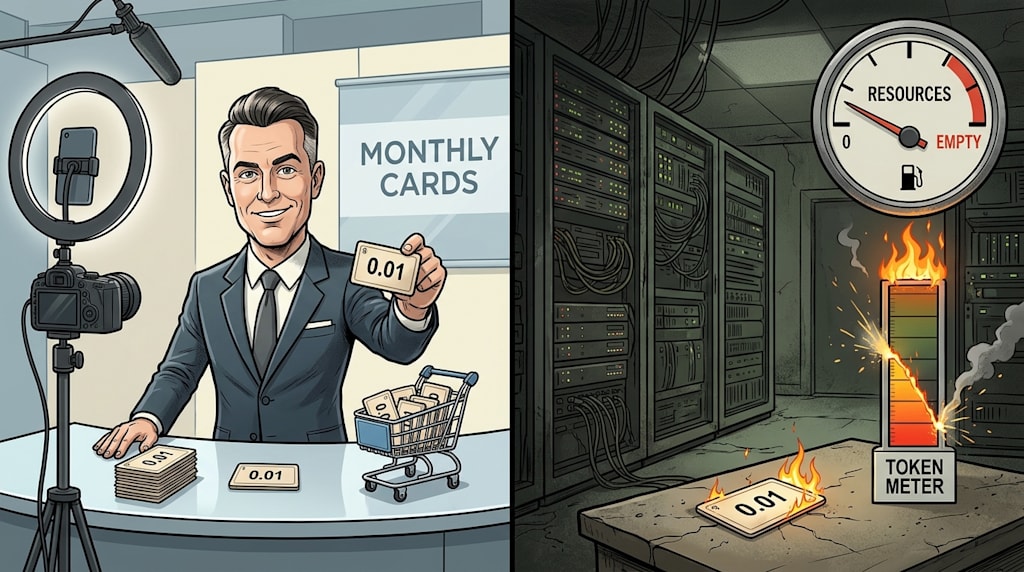
In Li Jiaqi’s livestream, Chen Yusen, CEO of Qwen Office, held up a “20-million-token monthly card.” Price: one cent. Supply: 100,000 copies. The comments flashed “got one.” The press release said “sold out.” Do the math. 100,000 times one cent is RMB 1,000 in sales. An Alibaba vice president spent an evening on camera for revenue that would not cover a meeting-room tea break.
No one expected this to be a profit center. But a stunt still has to survive arithmetic.
The user-acquisition math
The personal basic monthly card normally costs RMB 28. One cent is a new-user welfare price, limited to one per customer. Sell 100,000 copies and you nominally bring in 100,000 registered users. Cash revenue: RMB 1,000. Economist Pan Helin calls it “testing the waters.” One analysis calls tokens “the most conspicuous packaging in this user-acquisition campaign.” The product being sold is a concept, not compute. Market education for a new category has to start somewhere. The problem is the method: a number that cannot withstand scrutiny is being used to manufacture a bargain that cannot withstand follow-up questions.
20 million tokens do not last a day in agentic work
“20 million tokens per person per month” is enough for basic conversation. Simple questions, casual chat, editing a couple of paragraphs. Many users may not finish the allowance. But this livestream sold “AI office work” and “agents,” not a chatbot. Agentic work burns tokens at a different order of magnitude.
Caijing’s survey of frontline enterprise employees gives the range. Sales operations staff often burn tens of millions of tokens per day. Product and R&D staff doing medium-intensity development burn 200 million to 300 million tokens per day. High-intensity work can exceed 500 million. Individual users doing simple document processing and web searches have been recorded burning 50 million tokens in a day. OpenClaw-style automation tasks have publicly documented cases of consuming $100 worth of tokens in two hours.
Selling 20 million tokens as a monthly benefit for “AI office” users is like giving an 80-liter car a coupon for two liters of gasoline per month and calling it a fuel card. Casual users may find it sufficient. Casual users also do not need agentic office work. For people who need an agent to work on their behalf, 20 million tokens is measured in hours, not months. The complaint that this is a beggar’s pittance is harsh. By burn intensity, the number still lacks good faith.
The comparison with Tencent Marvis makes the gap clearer. Marvis gives each user 10 million free tokens per day. Roughly, that is a theoretical monthly allowance of 300 million, fifteen times Qwen’s monthly card. Free allowances have terms and limits. They are not identical to paid allowances. Still, when a paid product’s allowance does not reach the tail end of a competitor’s free allowance, the marketing language has little room to move.
The explanation stops where the pitch needs it to
Chen’s livestream explanation was recorded: “Just as a car needs fuel and everyday appliances need electricity, the fuel for AI work is tokens. With tokens, AI can work for you.”
The metaphor is not false. It is narrow. A token is the smallest discrete unit of information a large model processes. Its “fuel” nature depends on where inference happens. When you pay for a cloud API or subscription, tokens work like gasoline. When you deploy a model locally, the fuel is your own electricity and hardware depreciation. To turn a concept that depends on business model and deployment into “if AI is going to work, you have to buy tokens” is like saying electricity bills can only be paid to the grid. Self-generation and self-deployment disappear from the picture. For a livestream audience with no prior knowledge, the simplification does not invite questions. It reinforces an impression: tokens are consumables issued by the platform, and when you run out, you come back to buy more.
Chen knows real consumption. In the same livestream, he said deep office work, batch creation, complex data analysis, and long-text review “require more AI compute, and the corresponding token consumption will also increase substantially.” He knew the burn rate. He kept it out of the sentence that sold the card. The explanation stopped where marketing needed it to stop.
Tokens are not a good livestream product
Livestream commerce runs on low prices, impulse, and immediate gratification. Viewers decide in tens of seconds whether something is cheap, needed, and worth buying now. Token value is ex post and context-dependent. It depends on the model’s reasoning, the context window, tool-call stability, agent orchestration, and the complexity of the task. The same 20 million tokens can produce very different value on a basic Q&A model and on an agent that orchestrates multi-step workflows. A livestream has no time for that assessment. Viewers see “one cent” and “20 million.” That contrast creates impulse. Understanding does not follow.
Media analyses point to the same conclusion. Token retail is still in market education. Sales are far below mature categories such as beauty and household cleaning. Fast sales of one-cent cards do not prove that consumers will pay for AI over time. Netizens asked how a product sold out before anyone understood what a token is. That question shows what the livestream achieved: attention, not validation of sustainable consumer behavior.
A B2B productivity factor that requires a cognitive threshold to judge was pushed into a consumer sales scene that rewards impulse and ignorance. The warmer the CEO’s explanation, the stronger the displacement. He was using consumer language to discuss a B2B matter. Chen’s appearance shows real user-acquisition anxiety at Alibaba. Anxiety is not strategy. If the goal is market education, explain real token consumption, model differences, and agentic workflow value. Do not use a number that collapses next to a competitor’s free allowance to manufacture a bargain illusion. If the goal is user acquisition, one-cent cards can buy registrations. How many users renew at RMB 28 in month two depends on whether the product still feels worth it after 20 million tokens are gone. A livestream stunt can buy a click. It cannot buy retention.
After the excitement of a livestream with RMB 1,000 in revenue fades, the viewer who was teased by “one cent” and “20 million” will not understand tokens more deeply. They will carry a vague impression: this seems cheap and not quite enough. A category that cold-starts on that impression lacks a solid foundation for repeat purchase.
Expecting tokens to become a hot livestream product is like livestreaming yourself biting a lighter until it explodes in your pants. At least that stunt does not pretend to be market education.
About the Creator
Jin
Writer of reamstories
https://reamstories.com/jin
Enjoyed the story? Support the Creator.
Subscribe for free to receive all their stories in your feed. You could also become a paid subscriber, letting them know you appreciate their work.
Comments
There are no comments for this story
Be the first to respond and start the conversation.