
Air Freight Market Signals a Silent Global Shift
Global Air freight reshapes supply chains beneath the surface
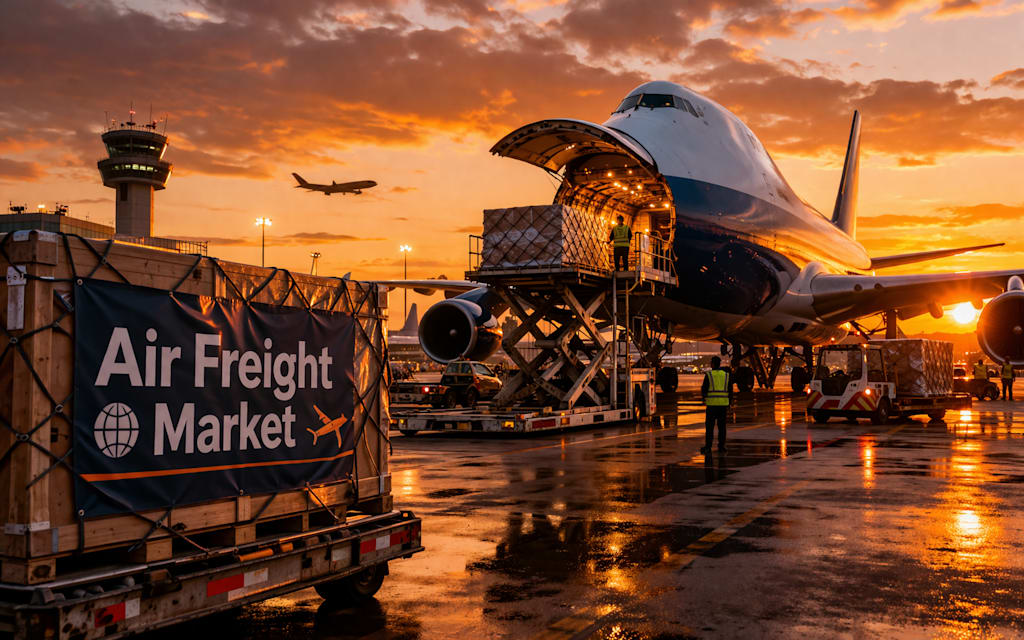
The runway hums before sunrise. Floodlights stretch across steel containers as workers move with practiced urgency, each motion synchronized with the ticking clock of global demand. Somewhere across the world, a product is already late, and this aircraft is its only chance to arrive on time.
Air cargo doesn’t just move goods; it moves expectations. In a world built on instant gratification and precision logistics, the invisible threads of air freight quietly hold together economies, industries, and everyday lives.
The Invisible Engine of Global Commerce
The Air Freight Market has evolved into one of the most critical backbones of international trade. From pharmaceuticals requiring strict temperature control to high-value electronics and time-sensitive e-commerce deliveries, air cargo bridges continents in hours instead of weeks.
After decades of steady evolution, the sector has entered a new era defined by resilience and adaptation. Disruptions in maritime shipping, geopolitical tensions, and shifting consumer behavior have amplified the importance of air logistics. This transformation is not just operational—it’s strategic.
According to Mordor Intelligence, the Air Freight Market was valued at USD 160.17 billion in 2025 and estimated to grow from USD 169.53 billion in 2026 to reach USD 225.26 billion by 2031, at a CAGR of 5.85%.
This trajectory signals more than expansion, it reflects a recalibration of global priorities.
Shifting Dynamics Beneath the Surface
The modern air freight industry operates in a delicate balance between speed, cost, and sustainability. Airlines, freight forwarders, and logistics providers are constantly adjusting to fluctuating fuel prices, regulatory changes, and evolving trade routes.
Digital transformation has begun to redefine operations. Real-time tracking, predictive analytics, and AI-powered demand forecasting are no longer optional, they’re expected. Businesses now search for answers like “real-time cargo tracking reliability” or “fastest global shipping methods,” and air freight consistently rises to the top.
At the same time, sustainability pressures are reshaping decisions. Carriers are investing in fuel-efficient aircraft and exploring alternative fuels, while customers increasingly factor carbon impact into logistics choices.
Within this evolving landscape, competition intensifies. The distribution of air freight market share reflects not only capacity but also technological leadership, route optimization, and customer trust.
Growth Fueled by Urgency and Innovation
E-commerce has become one of the most powerful accelerators of air freight market growth. The expectation of rapid delivery, sometimes within 24 to 48 hours across continents, has redefined logistics strategies for global retailers.
But it’s not just online shopping driving demand. Industries like healthcare, automotive, and aerospace rely heavily on air cargo for critical components and life-saving supplies. During crises, such as pandemics or natural disasters, air freight becomes the lifeline that sustains essential services.
Another key driver is globalization’s next phase: regional diversification. Companies are restructuring supply chains to reduce dependency on single regions, increasing the need for flexible and rapid transport solutions.
This shift creates a surge in demand patterns that are less predictable but more frequent, requiring agility that only air freight can provide.
The Expanding Scale of Opportunity
The rising air freight market size reflects a broader transformation in global trade behavior. Emerging markets are contributing more significantly to demand, while established economies continue to innovate in logistics efficiency.
Infrastructure investments are also playing a pivotal role. Airports are expanding cargo terminals, integrating automation, and enhancing cold-chain capabilities to handle specialized goods. These improvements are not just upgrades, they are strategic moves to capture future growth.
Meanwhile, partnerships between airlines and logistics companies are becoming more integrated. The lines between carriers, forwarders, and e-commerce platforms are blurring, creating ecosystems rather than isolated services.
This interconnected approach ensures faster delivery cycles, reduced bottlenecks, and improved customer experiences, key factors in a highly competitive environment.
A Future Defined by Speed and Precision
The story of air freight is no longer just about moving goods, it’s about enabling possibilities. From supporting global health systems to powering digital commerce, its role continues to expand in ways that were once unimaginable.
As technology advances and global demands evolve, the sector stands at a crossroads of innovation and responsibility. Efficiency must align with sustainability, and growth must balance with resilience.
The runway lights are still on. The cargo still moves. But the stakes have never been higher.
What role do you think air freight will play in shaping the future of global trade, and how might it impact your everyday life?
About the Creator
Enjoyed the story? Support the Creator.
Subscribe for free to receive all their stories in your feed.
Comments
There are no comments for this story
Be the first to respond and start the conversation.