
AI Data Centers Are Moving In. Residents Are Getting the Bill.
The industry promises a smarter future. In Virginia, Texas, and Illinois, the local costs look a lot like higher power bills, drained reservoirs, noisy generators, and tax breaks for almost no jobs.
1. Start With an Electricity Bill
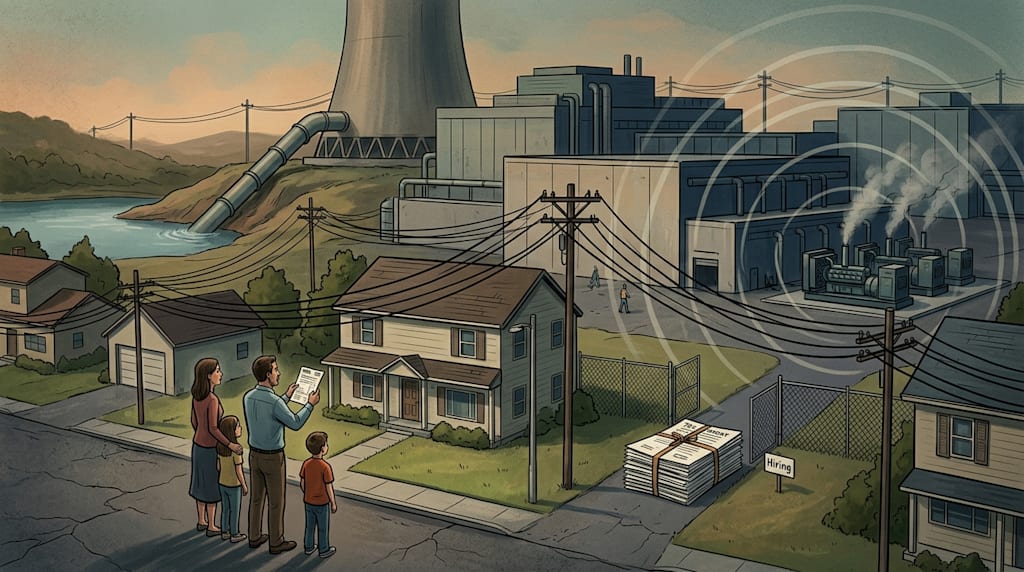
Loudoun County, Virginia, summer 2026. A typical family of four opens its July electricity bill: $180. Last year at the same time: $164. A 10% increase, $16 more.
That $16 will not appear as a separate line item called “AI data center surcharge.” It is buried in transmission and distribution rates, in capacity charges, and in the rate case the utility files with the state regulator. Data centers sign long-term, low-price power purchase agreements. The money for grid expansion is spread across residential bills under the regulatory rules.
In Loudoun County, one out of every six kilowatt-hours goes to data centers. Nationwide, data centers are projected to account for 5.3% of U.S. electricity generation in 2026 and at least 8.5% in 2027. These figures come from industry estimates, and definitions can be debated. The direction is not in dispute: new load is rising, the grid is being expanded, and the bill is being shifted.
Residents are not rejecting the judgment that “AI has a future.” They are rejecting this: the future goes to the company, the bill goes to them.
2. Water: The Cooling Tower Is Not on Your Water Meter, but It Draws From the Same Reservoir
A large data center cooling tower can evaporate hundreds of thousands of gallons of water per day. To prevent scaling, pipe corrosion, and the growth of Legionella and other microorganisms, operators add water-treatment chemicals: corrosion inhibitors, scale inhibitors, and biocides. They also periodically blow down and replace the water to control concentration.
More hidden still is “upstream embodied water.” A Ceres analysis of seven major data-center states (Virginia, Texas, California, Illinois, Georgia, Ohio, and Arizona) found that power plants supporting data-center electricity use in those states withdraw a combined 3.4 trillion gallons of freshwater per year. Sixty-six percent of that electricity comes from plants in moderately to extremely water-stressed basins. The data center campus’s own water meter may look good. The water bill of the power chain is not posted at the campus gate.
A HARC estimate for Texas puts data-center water use in 2030 at up to 399 billion gallons under the highest scenario. In dry periods, municipal drinking-water reservoirs, groundwater aquifers, and agricultural allocations all draw from the same pool. Low water pressure for residents, falling groundwater levels, and municipal water-system expansion costs passed into water bills are each a concrete cost of daily life.
In Oregon, Amazon settled a class action over groundwater nitrate contamination for $20.5 million. It paid the money but admitted no liability. Residents had little recourse beyond the settlement.
3. Noise and Emissions: Backup Generators Must Not Become Continuously Running Generators
Loudoun County has roughly 10,500 diesel generators associated with data centers. Texas regulators have approved more than 2,100 diesel units for dozens of data centers. A backup unit that is tested occasionally and a unit that runs continuously 24/7 are two different things.
The Colossus campus runs a large number of gas turbines day and night. The low-frequency hum carries half a mile. Nearby residents report insomnia, headaches, and worsening respiratory illness. The local cancer rate is already four times the national average. xAI’s response was to add trailer-mounted temporary gas turbines. When long-term permits are not approved, the company uses temporary units to skirt the rules.
In September 2026, U.S. diesel retail prices reached $6.29 a gallon, and natural gas prices jumped 81%. Residents feel the pain every time they fill up. Next door, the campus’s gas turbines burn around the clock. The contrast is hard to miss.
4. Jobs: Twenty Jobs, Exactly at the Threshold, and Hundreds of Millions in Incentives
Data centers are highly automated. The industry median for permanent steady-state jobs is about 50. Large campuses run 30 to 150. Facility operations, network, and security roles require professional qualifications. Core staff are often transferred from other states or hired externally. Local residents can often compete only for outsourced security and cleaning jobs.
Illinois requires data centers receiving tax incentives to create 20 full-time jobs as a hard threshold. By the end of 2025, 29 of the 34 projects receiving incentives had exactly 20 jobs, not one more. Across 34 projects, fewer than 700 local residents were hired. The public cost was hundreds of millions of dollars in subsidies, cheap land, billions of dollars in project tax abatements, a 20-year abatement period, and utility expansion costs passed on to residents.
Data centers should automate. The problem is incentive design. When incentives are handed out based on hitting a job-count threshold, the company’s best strategy is to hit it exactly. Incentives should be paid for performance: incremental tax revenue, job quality, energy and water thresholds, and community agreements. They should be clawed back when not met.
5. Why Not Build in Remote Areas?
Remote areas do not have a grid. The United States does not lack high-voltage transmission technology. Interstate transmission permitting, land acquisition, rate regulation, and community consent are extremely costly to coordinate. Companies choose sites on their own convenience, then scramble for water and power after landing. Conflicts erupt in concentrated form.
Communities lack bargaining power. Siting, tax incentives, water-rights approvals, and emissions permits are transactions among companies, local governments, and state regulators. Residents can only object at hearings. Without community agreements, cost-sharing clauses, or real-time emissions and noise data, residents are left with political backlash as their only path.
6. China’s East Data, West Computing: Planning First, but Not a Panacea
Ulanqab sits on the Mengxi grid. The delivered electricity price for data-center campuses there is about 0.32 to 0.36 yuan/kWh, compared with 0.6 to 0.7 yuan for industrial electricity in many eastern regions. Power comes mainly from local wind and solar, and the cluster target is 80% green electricity. The climate is cold and dry, allowing nearly 10 months of natural air cooling per year. Cooling-tower evaporation is very low. Cooling makeup water uses reclaimed municipal wastewater, not drinking water. Water withdrawal permits require approval by water-resources authorities and a water-resources assessment. Residential water use is legally prioritized over industrial projects.
Gui’an has cave data centers with stable underground temperatures. Zhongwei and Ulanqab are in the water-scarce northwest, and the policy direction is to avoid using residential freshwater as much as possible. The eight major hubs (Horinger, Gui’an, Zhongwei, Qingyang, Zhangjiakou, Wuhu, Shaoguan, and the Chengdu-Chongqing cluster) coordinate grid, water supply, sewage, environmental assessment, and noise reduction at the planning stage and avoid dense residential areas.
This is called planning first. Calling it simply “the planned economy, so it is good” is not accurate. China also faces water scarcity in the west, green-power consumption, data-center utilization rates, local subsidy competition, the sustainability of electricity discounts, and ecological carrying-capacity assessment. Planning is not omnipotent. Bad planning also wastes resources. The United States does not lack technology. It has difficulty coordinating institutions. The two countries face different problems and should not simply disparage each other.
Conclusion: The Objection Is Not to AI, but to Socialized Costs and Privatized Benefits
If I were a local resident, I would oppose unconstrained data-center projects. I would support projects that meet these conditions:
Incremental grid and water-system costs are borne by the data center, not spread to residents. Water-rights approval is done in advance, residential water use has priority, and drought-scenario carrying capacity is made public. Emissions and noise are disclosed in real time and enforceable, and backup generators may not become de facto continuous generators. Tax incentives are performance-based, and jobs and community agreements are enforceable and subject to clawback. Siting avoids residential areas and water-stressed regions, and communities have bargaining power and compensation mechanisms.
AI computing has public benefits, and there are alternative siting and cooling options. The question is who benefits, who pays, and who has a voice.
Residents are not fools. They just saw the bill first.
About the Creator
Jin
Writer of reamstories
https://reamstories.com/jin
Enjoyed the story? Support the Creator.
Subscribe for free to receive all their stories in your feed. You could also become a paid subscriber, letting them know you appreciate their work.
Comments
There are no comments for this story
Be the first to respond and start the conversation.