
AI Backyard Design With AI Yard Design Studio: What the Backyard Generator Actually Does
AI Yard Design Simplified


If you are researching AI backyard design, you have probably noticed two very different promises. One leans toward fantasy, with perfect visuals that ignore real constraints like property lines, slope, or existing trees. The other is more grounded, offering tools that help you think through your actual space faster, so decisions are clearer before any money is spent. AI Yard Design Studio sits firmly in the second category.
This article breaks down what the Backyard Generator actually does, including what you provide, how the system responds, and where its usefulness begins and ends.
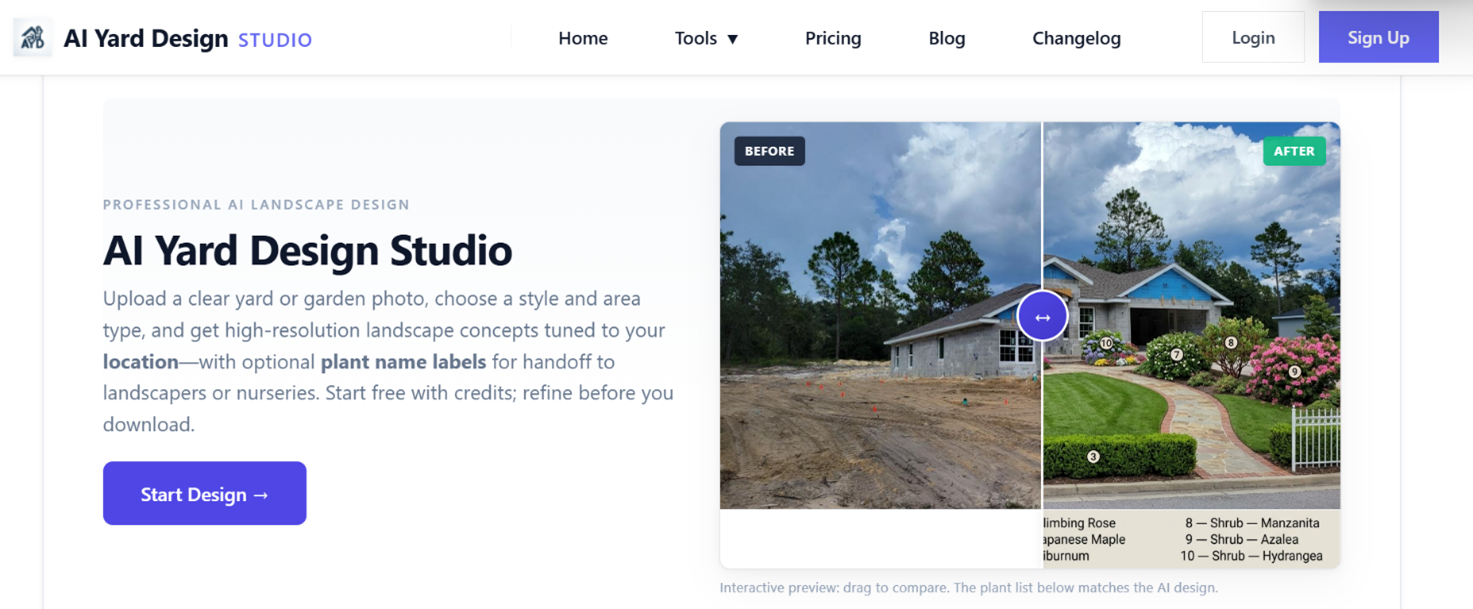
What problem this workflow is trying to solve
Backyard design often fails long before construction starts. Most discussions happen in vague terms such as “cozy,” “modern,” or “lush,” without agreement on how the space will actually be used. Contractors then step in and ask practical questions that reveal missing priorities.
The Backyard Generator aims to reduce that gap. Instead of starting with abstract inspiration, it anchors ideas to a real image of your yard. More importantly, it reframes the key question. Not “What looks good?” but “What is this space for?” Whether that is dining, relaxing, hosting, play, pets, or gardening, the tool builds concepts around use rather than style alone.
Starting point: your backyard photo
The process begins with an uploaded image. Supported formats typically include JPG, PNG, and HEIC, with a file size limit around 20MB.
The quality of your input matters more than most people expect. If your photo hides edges, removes key features, or excludes elements you plan to keep, the output may look impressive but unrealistic. On the other hand, a clear, honest image showing boundaries, structures, and existing conditions leads to concepts that are easier to evaluate and discuss.
If you are just exploring, sample images can help you understand the interface before committing to your own space.
Function-first design instead of style-first
One of the more useful aspects of AI Yard Design Studio is its emphasis on function. A backyard designed for children, for example, will differ significantly from one built around entertaining or quiet relaxation.
These differences affect layout, circulation, materials, and planting. A pet-friendly yard might prioritize durability and open movement. A gathering space might center around seating clusters and focal features like a fire pit. By focusing on how the space is used, the generator produces ideas that can actually be compared in a meaningful way.
Adding elements and context
Users can guide the output by selecting optional features and writing simple notes. These might include requests like privacy screening, low-maintenance planting, or preserving an existing tree.
Location can also be included. While optional, it helps steer plant choices and materials toward something that feels more regionally appropriate. Still, it is important to treat this as guidance rather than certainty. Climate context improves realism, but it does not replace local knowledge, availability checks, or professional advice.
Iteration is the real strength
The Backyard Generator is not designed for a single perfect result. Its value comes from iteration.
After generating an initial concept, users can refine specific elements such as pathways, planting emphasis, or features like lighting and seating. This mirrors how real projects evolve, starting with layout and structure, then moving toward detail and finishing touches.
Instead of restarting from scratch, you adjust and compare. Over time, this helps narrow down what actually works for your space and lifestyle.
What the tool does not do
It is important to be clear about limitations. The Backyard Generator is not a substitute for technical planning.
It does not handle drainage, permits, utility mapping, or structural considerations. It cannot guarantee plant suitability or construction feasibility. These boundaries are not weaknesses. They define the tool’s role as a planning aid rather than a complete solution.
Using the right tool for the job
Not every outdoor project fits a backyard model. If the focus is a front yard, patio, side path, or larger landscape, it makes sense to use tools designed for those specific contexts within AI Yard Design Studio.
Matching the tool to the scale and purpose of the project leads to more relevant results.
A simple way to start
A typical first session might look like this:
• Take a clear, honest photo of your backyard
• Define how you want to use the space
• Add a few practical notes or constraints
• Include location if plant realism matters
• Generate a preview, then refine in steps
The goal is not perfection in one attempt, but clarity through comparison.
Conclusion: clarity over illusion
The Backyard Generator is best understood as a decision-making tool. It helps translate vague ideas into visible, testable concepts grounded in your actual space.
By combining real images, function-first thinking, and iterative refinement, AI Yard Design Studio offers something more useful than idealized renders. It offers direction. With clear expectations and honest inputs, it can turn early-stage uncertainty into a plan that is easier to discuss, refine, and eventually build.
About the Creator
Sarah
With an experience of 10 years into blogging I have realised that writing is not just stitching words. It's about connecting the dots of millions & millions of unspoken words in the most creative manner possible.
Enjoyed the story? Support the Creator.
Subscribe for free to receive all their stories in your feed.
Comments
There are no comments for this story
Be the first to respond and start the conversation.