
AI and the End of Traditional Careers
#How Artificial Intelligence Is Redefining Jobs, Skills, and Professional Success in the Twenty-First Century

For generations, career success followed a relatively predictable path.
People attended school, earned qualifications, found employment, developed expertise within a profession, and often remained in similar industries for decades. Stability was considered one of the most desirable features of a successful career.
Today, that model is beginning to change.
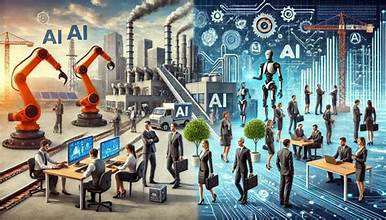
Artificial intelligence is transforming the nature of work at a speed rarely seen in economic history. Jobs are evolving, industries are being reshaped, and entirely new opportunities are emerging. At the same time, some traditional career paths are becoming less secure as automation expands into activities once considered uniquely human.
The future does not necessarily mean the disappearance of work. Instead, it means the transformation of work.
The careers that thrive in the coming decades may look very different from those that dominated the past century.
Understanding these changes is becoming increasingly important for workers, employers, students, and entrepreneurs alike.
## The Historical Evolution of Work
Human work has always evolved alongside technology.
Agricultural societies relied on physical labor.
Industrial economies created factory jobs.
The information age introduced knowledge work.
Each technological revolution eliminated certain occupations while creating new ones.
The introduction of automobiles reduced demand for horse-related industries.
Computers automated countless administrative processes.
The internet created entirely new sectors.
Artificial intelligence represents the next stage in this progression.
Unlike previous technologies, AI affects both physical and cognitive work.
It can analyze information, generate content, recognize patterns, and support decision-making.
This broader capability explains why its impact may be especially significant.
## Why Traditional Career Models Are Changing
Several factors are contributing to the decline of traditional career structures.
### Rapid Technological Change
Skills become outdated more quickly than before.
Professionals must continuously learn and adapt.
### Automation
Routine and repetitive activities are increasingly performed by software and intelligent systems.
### Global Competition
Digital connectivity allows organizations to access talent worldwide.
Competition for opportunities becomes more international.
### New Business Models
Freelancing, remote work, digital entrepreneurship, and creator economies offer alternatives to conventional employment.
As a result, career development becomes less linear and more dynamic.
## AI as a Workplace Partner
Many discussions about AI focus on replacement.
However, augmentation may be equally important.
AI can support professionals by handling repetitive activities and providing valuable insights.
Examples include:
* Drafting reports
* Summarizing information
* Conducting research
* Generating ideas
* Analyzing data
This allows individuals to spend more time on high-value activities.
In many professions, AI functions less as a replacement and more as an assistant.
The most productive workers increasingly combine human expertise with machine intelligence.
## The Rise of Skill-Based Careers
Historically, credentials often served as primary indicators of competence.
Degrees, certifications, and formal qualifications played major roles in hiring decisions.
While these remain important, employers increasingly value practical skills.
Organizations want individuals who can:
* Solve problems
* Adapt quickly
* Use technology effectively
* Communicate clearly
* Learn continuously
AI accelerates this shift because information becomes more accessible.
Success increasingly depends on the ability to apply knowledge rather than simply possess it.
## Careers Most Likely to Change
Many occupations will experience significant transformation.
### Administrative Roles
Scheduling, documentation, data entry, and reporting are becoming increasingly automated.
### Customer Support
AI assistants can answer many routine questions.
Human representatives focus on complex situations.
### Marketing
Content creation and campaign analysis are increasingly supported by AI tools.
### Finance
Risk assessment, forecasting, and reporting benefit from intelligent systems.
### Software Development
AI coding assistants improve productivity and reduce development time.
These changes do not eliminate the need for professionals.
Instead, they redefine their responsibilities.
## New Opportunities Emerging
While some roles change, new opportunities appear.
Examples include:
* AI Consultants
* Prompt Engineers
* AI Product Managers
* Automation Specialists
* AI Researchers
* Data Strategists
* AI Ethics Advisors
Many of these positions barely existed a few years ago.
As AI adoption expands, demand for these skills may continue growing.
## Entrepreneurship in the AI Era
One of the most exciting developments is the rise of AI-powered entrepreneurship.
Individuals can now access capabilities previously available only to large organizations.
AI assists with:
* Marketing
* Design
* Content creation
* Research
* Customer support
This reduces barriers to starting businesses.
Entrepreneurs can operate more efficiently and reach larger audiences.
The result is a growing number of small but highly productive companies.
## The Importance of Lifelong Learning
Perhaps the most important career skill of the future is learning itself.
Technologies evolve.
Industries change.
New opportunities emerge.
Individuals who embrace continuous learning gain significant advantages.
Lifelong learning may include:
* Online courses
* Certifications
* Workshops
* Self-directed study
* Practical experimentation
Those who remain curious and adaptable will be better positioned for long-term success.
## Human Skills Become More Valuable
As AI automates technical tasks, uniquely human capabilities become increasingly important.
These include:
### Creativity
Generating original ideas and innovative solutions.
### Emotional Intelligence
Understanding people, relationships, and communication.
### Leadership
Guiding teams through uncertainty and change.
### Critical Thinking
Evaluating information and making sound judgments.
### Ethics
Ensuring technology is used responsibly.
These qualities remain difficult to automate.
They may become key differentiators in future labor markets.
## The Future Workplace
Workplaces themselves are evolving.
Remote work, digital collaboration, and AI-powered tools are becoming commonplace.
Future organizations may feature:
* Smaller teams
* Higher productivity
* Greater flexibility
* Increased automation
* Continuous learning cultures
Employees will likely work alongside intelligent systems daily.
Understanding how to collaborate effectively with AI may become as important as understanding computers today.
## Challenges and Concerns
The transition will not be without difficulties.
### Job Displacement
Certain roles may disappear faster than new opportunities emerge.
### Inequality
Access to education and technology may influence outcomes.
### Skills Gaps
Many workers will require retraining.
### Psychological Adjustment
Career identities may shift as occupations evolve.
Addressing these challenges will require cooperation between governments, educational institutions, employers, and individuals.
## Preparing for the Future
Several practical strategies can help individuals prepare.
### Learn AI Fundamentals
Understanding AI concepts provides a valuable foundation.
### Develop Digital Skills
Technology literacy is increasingly important.
### Build Adaptability
Flexibility supports long-term career resilience.
### Strengthen Human Skills
Communication, leadership, and creativity remain essential.
### Experiment with New Tools
Practical experience often creates opportunities.
The goal is not to predict every future change.
The goal is to become capable of adapting to change.
## Final Thoughts
Artificial intelligence is not simply introducing new tools.
It is reshaping the structure of careers themselves.
Traditional models based on predictable progression and long-term stability are giving way to more dynamic forms of work.
While uncertainty accompanies this transformation, opportunity does as well.
Individuals who embrace learning, adaptability, and collaboration with intelligent systems may discover new levels of productivity and professional success.
The future of work is not solely about technology.
It is about how people use technology to create value, solve problems, and improve lives.
Traditional careers may be changing, but meaningful work is not disappearing.
It is evolving.
Those who evolve alongside it will be best positioned to thrive in the decades ahead.
About the Creator
Sam Siamak Callimi
Writer focused on AI, online income, digital tools, and real-world solutions. Publishing helpful, practical content weekly.
Enjoyed the story? Support the Creator.
Subscribe for free to receive all their stories in your feed.
Comments
There are no comments for this story
Be the first to respond and start the conversation.