
Adhesives Industry will hit USD 106.78 Billion - What’s Driving it?
A 6.03% CAGR fuels explosive growth across packaging, construction, and electronics
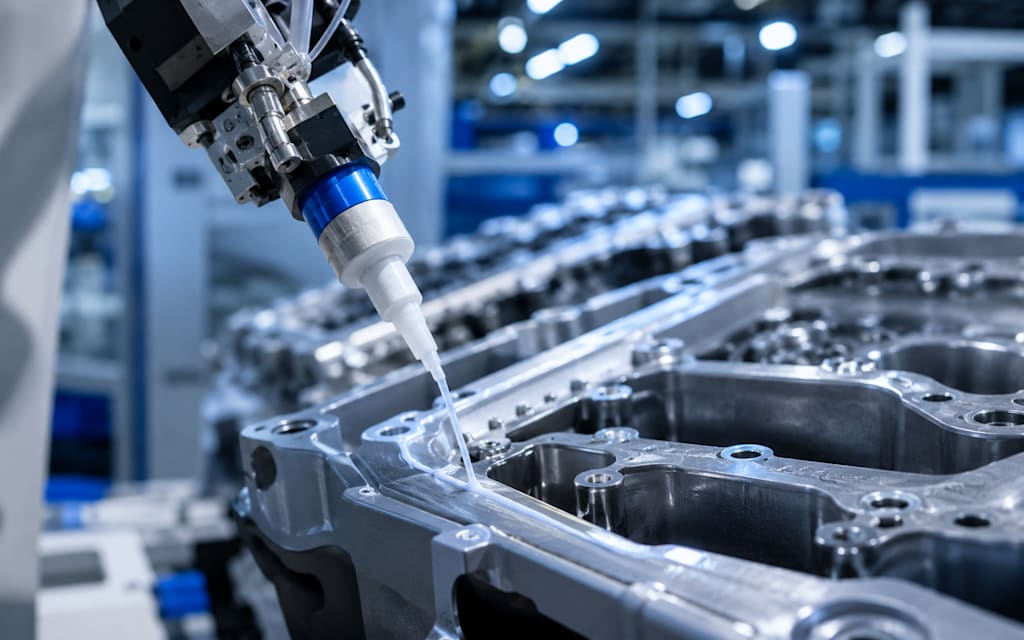
Imagine a single drop of glue holding together a $50,000 car engine. That’s the invisible power of the adhesives market—a $79.68 billion industry reshaping how we build, package, and connect the world.
By 2031, this sector will skyrocket to $106.78 billion, growing at a 6.03% CAGR, But what’s behind this surge? Why are companies investing billions in adhesive technology?
The Packaging Push: Why 40% of Adhesives Stick to Boxes
Packaging dominates the adhesives landscape, consuming nearly 40% of global output. As e-commerce floods streets with delivery trucks, demand for lightweight, secure bonding grows exponentially.
Water-borne adhesives—low in VOCs and high in sustainability—now lead this segment. Environmental regulations in Europe and North America are pushing manufacturers to eliminate solvent-based adhesives, replacing them with water-based alternatives that bond just as strongly while emitting near-zero harmful compounds.
The rise of flexible packaging—think pouches, wraps, and resealable bags—has accelerated adhesive demand. Traditional rigid containers require less bonding, but flexible packaging needs precise adhesive application to maintain seal integrity while remaining lightweight.
Construction & Electronics: The Double Engine
Building and construction snag 35% of market share, driven by green building standards favoring low-emission adhesives. Modern construction doesn’t just nail things together; it bonds them. Insulation panels, flooring, window frames, and even structural components rely on adhesives for superior performance and energy efficiency.
In Europe, the adhesives and sealants market reached $20.27 billion in 2026, growing at a 5.42% CAGR to reach $26.37 billion by 2031. Acrylic resins captured 36.55% of 2025 share, curing in seconds versus epoxy’s hours. Waterborne platforms hold 42.70% share, meeting strict EU emissions laws.
Meanwhile, electronics adhesives are booming at 8.63% CAGR, with Asia-Pacific commanding 58.21% share thanks to semiconductor hubs in China and Taiwan. In a factory in Shenzhen, a robot arm precisely applies epoxy adhesive to a $200 chip. This isn’t sci-fi—it’s Asia-Pacific’s $4.14 billion electronics adhesives empire, controlling 58.21% of global revenue.
Epoxy resins held 29.74% of 2025 revenue, resisting heat and vibration better than acrylics. But acrylics are surging at 10.78% CAGR, perfect for flexible displays in smartphones. China’s “Semiconductor Self-Reliance” policy poured $150B into local chipmakers, directly boosting adhesives demand. India’s adhesives market, worth $3.28 billion in 2026, is growing at 6.88% CAGR to reach $4.58 billion by 2031.
Asia-Pacific: The Global Adhesive Market Powerhouse
Asia-Pacific isn’t just participating in the adhesives market—it’s dominating it. The region holds massive shares across packaging, electronics, and construction segments. China alone accounts for nearly 40% of global adhesive consumption, driven by its manufacturing bounty and export economy.
The wood adhesives market, worth $7.21 billion in 2026, is growing at 6.63% CAGR to reach $9.94 billion by 2031. Asia-Pacific holds 41.70% of wood adhesives revenue, fueled by China’s furniture exports and India’s booming interior design sector. Synthetic resins dominate with 56.25% share, outperforming natural options in moisture resistance. Water-based systems hold 37.90% of market share, aligning with EU VOC regulations.
India is emerging as a secondary powerhouse. Top industry leaders like 3M, H.B. Fuller, Henkel AG, Pidilite Industries, and Arkema are expanding operations across the country. Packaging dominates with 38% share, driven by e-commerce and FMCG growth.
The Sustainability Revolution: Why Eco-Friendly Adhesives Are Winning
The adhesives industry is undergoing a sustainability revolution. Governments worldwide are imposing stricter VOC regulations, forcing manufacturers to abandon solvent-based formulas. Water-borne adhesives now hold 40%+ of global market share, emitting near-zero VOCs while maintaining bonding strength.
This isn’t just about compliance—it’s about consumer demand. Modern buyers prefer eco-friendly products, and companies using sustainable adhesives are capturing premium market segments. The adhesives & sealants market hit $90.45B in 2026, climbing to $120.67B by 2031 at 6.03% CAGR—with water-borne tech leading due to VOC laws.
What’s Next for the Adhesives Market?
The future is bright for adhesives. Engineering adhesives, used in automotive and aerospace applications, are growing at 3% CAGR, driven by lightweight EVs and jet engines requiring high-strength bonding. A Boeing 787 uses 30% less adhesive-bonded composites than welds, saving 2,000 lbs per plane. Will adhesives replace 50% of welds in EVs by 2035? Will solvent-borne adhesives vanish completely by 2035? The industry is betting on yes.
About the Creator
efingutthomas
My expertise is custom research across industries such as aerospace & defense, agriculture, animal wellness, automation, automotive, chemicals, consumer goods, electronics, energy, finance, food & beverages, healthcare, hospitality and ICT
Enjoyed the story? Support the Creator.
Subscribe for free to receive all their stories in your feed.
Comments
There are no comments for this story
Be the first to respond and start the conversation.