
Adaptive Insurance Coverage: How AI Solutions Help Adjusters Deliver a Dynamic, Continuous Service
Smarter Claims Support Through AI-Driven Adaptive Solutions.

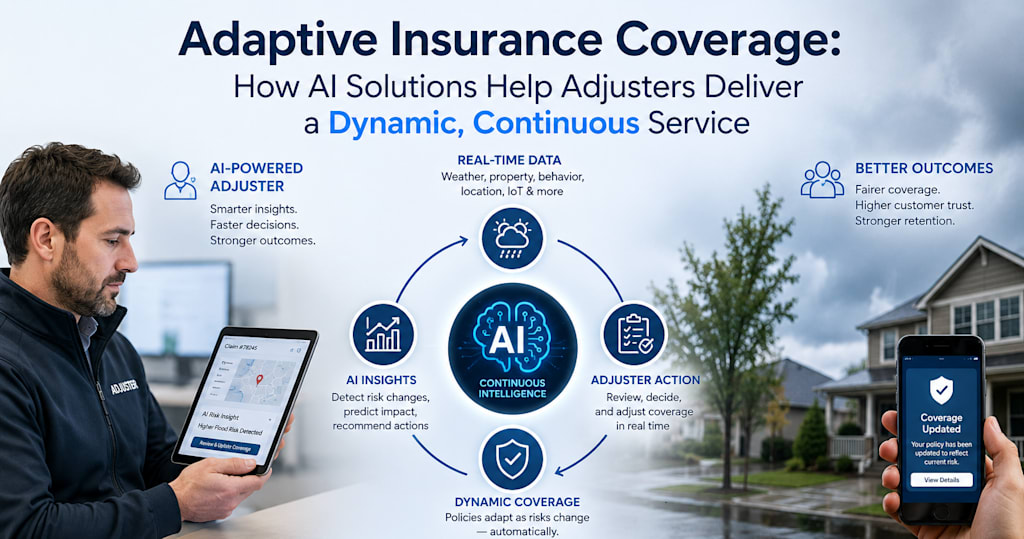
The insurance industry faces a turning point. The traditional methods of managing claims are breaking under the weight of modern demands. The adjusters in insurance firms, who once had time to meticulously review each file, now struggle with competing pressures. Insurance adjusting speed and precision matters. Customer expectations have climbed higher. Considering this challenging ecosystem, AI solutions for insurance adjusters are built and launched by insurance software vendors. Smart adjuster solutions are emerging not as alternatives, but as capable partners that help insurance professionals manage operations smarter.
This shift is restructuring what it means to be an insurance claims adjuster. The profession is not disappearing. It is evolving. Digital insurance adjuster platforms are fundamentally changing how professionals spend their days, what tasks demand their attention, and where their true value lies.
The Claim Lifecycle Today: Why Flexibility Matters
Today’s policyholders expect immediate filing acknowledgment and claim status updates without days of waiting. Insurance enterprises face pressure to shrink claims processing times from weeks to hours. Simultaneously, fraudulent claims demand careful analysis. Adjusters must maintain speed without sacrificing accuracy.
The real challenge lies in claim diversity. A simple auto collision differs significantly from commercial property losses or workers compensation injuries. Each scenario requires different information, expertise, and decisioning support. Generic workflows fail to adapt to these variances, frustrating both adjusters and policyholders.
Adaptive insurance coverage addresses this problem. The term describes claims systems responding dynamically to claim characteristics rather than following predetermined rigid paths. Adaptive systems recognize claim type, complexity, and risk profile, then allocate resources appropriately.
What Adaptive Coverage Means for Your Work
For claims adjusters working in insurance enterprises or startups, adaptive coverage translates into tangible shifts in daily workflow. It means your morning might look different depending on what claims land in your queue.
Consider a straightforward auto collision claim with clear liability and moderate damages. The adaptive digital solutions for insurance adjusters recognize these factors and route the claim toward faster processing. Preliminary damage assessments happen through computer vision analysis of submitted photos. Initial documentation gets extracted automatically. The claim moves quickly toward settlement without requiring hands-on involvement in every routine step.
Now imagine a commercial property claim from a hurricane. This scenario carries high complexity, significant financial exposure, and elevated fraud risk. The smart insurance adjuster solutions flag this accordingly. It prioritizes human review, routes the claim to experienced adjusters with property expertise, and provides comprehensive analytical support. The same system that accelerated the auto claim now protects against costly errors on the property claim.
The practical effect reshapes your responsibilities. Rather than treating all claims uniformly, smart insurance adjuster solutions help you focus your judgment where it matters most:
- Complex scenarios requiring negotiation and nuanced decision-making.
- Unusual claim patterns that warrant investigation.
- High-value claims where accuracy directly impacts profitability.
- Situations demanding empathy and relationship-building with claimants.
- Cases requiring legal expertise or regulatory compliance consideration.
This is not automation replacing adjusters. This is automation freeing adjusters to practice their profession at its highest level. The role of adjuster shifts from typical claim handlers to analytical experts focused on claims cases demanding real professional expertise.
From Routine Processing to Judgment-Driven Work: The Role AI Plays
Here lies the practical heart of the transition. Claims adjusters devote most of their work on repetitive tasks. These tasks consume time without delivering real business value. They include:
Manually reviewing lengthy accident declarations searching for key details.
- Extracting and re-entering information across multiple systems.
- Sorting and organizing claim documents.
- Performing initial data entry and verification.
- Generating preliminary summaries.
AI-powered claims adjuster solutions handle these tasks with remarkable efficiency. Optical character recognition technology reads accident declarations in seconds, extracting critical information with high accuracy. The language processing models assess claims documents, discover relevant details, and flag potential concerns. Smart machine learning algorithms assess claim patterns, highlighting fraud indicators that human reviewers might overlook.
The outcome is freeing up adjusters to focus on investigative and judgmental works. Instead of spending two hours reviewing documents manually, an adjuster receives a structured summary prepared by AI systems. Instead of performing repetitive data entry, the adjuster applies professional expertise to complex decisions.
This represents a fundamental profession upgrade. Lower-level administrative duties shift to digital systems. Higher-level professional judgment remains firmly in human hands. Insurance adjuster services evolve from transaction-oriented to relationship-oriented, from routine-handling to problem-solving.
Continuous Service in Action: Where Digital Solutions Make a Difference
The benefits of digital solutions for insurance adjusters manifest across multiple claim types, each showing how AI enables faster, smarter decisions.
1. Automotive Claims and Computer Vision
Computer vision models in insurance solutions for adjusters analyze vehicle damage photos instantly, identifying damage type, severity, and likely repair costs. Telematics data from vehicles provides impact force and collision dynamics context. This comprehensive view reaches adjusters in minutes. Fraud detection systems simultaneously cross-reference claims against historical patterns and known fraud schemes.
Adjusters review this AI-prepared analysis, apply professional judgment to unusual factors, and move toward resolution without requiring physical inspection appointments.
2. Property Claims and Remote Assessment
Catastrophic incidents like hurricanes generate massive volume of claim requests. Traditional approaches make it difficult for adjusters to process simultaneous claim requests. Drone technology enables rapid remote damage assessment. Adjusters validate high-resolution aerial pictures highlighting roof damage, structural impact, and neighboring property situations. AI systems process images at scale, categorizing damage severity across hundreds of claims. This speed matters enormously to policyholders facing temporary housing, uncertainty about rebuilding, and financial stress.
3. Customer Intake and AI-Powered Communication
Digital insurance adjuster platforms now handle initial claim filing. When claimants call to report losses, the system asks clarifying questions, captures basic information, and routes claims appropriately. Adjusters receive organized information packages rather than fragmented details, reducing routine intake work while ensuring consistent, complete initial information gathering.
4. Fraud Detection at Scale
Machine learning models in insurance solutions for adjusters excel at pattern recognition across large datasets. The models assess thousands of claims, discovering subtle patterns correlating with fraudulent incidents. Adjusters validate flagged claims and gain analytical insights through data-driven indicators rather than following intuition. This approach helps adjusters discover fraud incidents more effectively while minimizing false positives that waste investigative resources.
The Balance Between Automation and Human Judgment
Intelligent technologies complement insurance adjuster's expertise rather than replacing it. Effective claims operations comprise humans in the loop, guaranteeing critical decisions remain under professional control.
The relationship works best when adjusters and AI systems function as collaborative partners. AI models manage data analysis, pattern recognition, and administrative processes. Adjusters make professional decisions, demonstrate empathy toward claimants, and deliver nuanced judgements based on experience and context.
Fraud investigation exemplifies this partnership. AI systems flag claims based on pattern analysis, but only humans can investigate whether patterns indicate fraud or legitimate variance. Only adjusters can negotiate settlements, balance policy requirements with compassionate response, and demonstrate empathy toward genuine hardship.
Insurance adjuster services become more valuable when AI handles routine components. The profession transforms from document processing toward consultation and problem-solving.
Choosing Solutions Built for Adjusters
Not all AI solutions serve adjusters equally well. Effective digital solutions for insurance adjusters share specific characteristics that matter operationally.
I. Integration Without Disruption
Solutions that require completely replacing existing systems create enormous operational friction. The best claims adjuster solutions integrate with platforms adjusters already use. They plug into existing claims management software, document repositories, and communication platforms. This approach minimizes training burden and workflow disruption while delivering AI benefits immediately.
II. Transparency and Trust
Adjusters need to understand why AI systems make recommendations. Solutions providing clear explanations for algorithmic outputs build professional confidence. When an AI system recommends a fraud investigation, the adjuster should understand which factors triggered that recommendation. When a damages estimate emerges from computer vision analysis, the adjuster should see the underlying assessment. This transparency enables adjusters to apply their own expertise as override when appropriate.
III. Comprehensive Audit Trails
Insurance operates under regulatory scrutiny. Every claim decision creates documentation requirements. Solutions designed for insurance maintain complete audit trails showing what data informed each decision, which systems processed information, and which humans approved actions. This documentation protects adjusters, supports compliance, and enables quality improvement.
IV. Real Results That Matter
Implementation of AI solutions for insurance adjusters should deliver measurable outcomes. Look for solutions demonstrating:
Faster claim processing without quality reduction.
Improved accuracy in damage assessment and settlement calculations.
Reduced fraud leakage and overpayment.
Enhanced customer satisfaction and response times.
Lower operational costs through efficiency gains.
Insurance enterprises and startups both benefit from these improvements, though startups often gain competitive advantage through faster technology adoption.
Moving Forward: Building Your Adaptive Future
The insurance industry is evolving, not replacing adjusters. Claims professionals who master adaptive systems and AI-assisted workflows will lead their organizations.
The positive reality: adjusters have never been more valuable. Complex claims demand experienced professional judgment. Catastrophic events require skilled decision-makers. Frustrated claimants need empathetic advocates understanding their situations.
AI solutions for insurance adjusters are tools enabling professionals to work at higher capability levels. They eliminate tedium, accelerate routine processing, and provide analytical support. They free adjusters to practice their profession with expertise, judgment, and care.
The path forward combines smart technology adoption with human-centered process design. It requires viewing AI as collaborative capability rather than replacement technology.
About the Creator
Surya C.
Surya Choudhary is a Project and Software Delivery Manager at Damco Solutions with demonstrated experience in streamlining processes for insurance companies.
Website: https://www.damcogroup.com/insurance/
Enjoyed the story? Support the Creator.
Subscribe for free to receive all their stories in your feed.
Comments
There are no comments for this story
Be the first to respond and start the conversation.