
Acetyl Tributyl Citrate and the Quiet Shift Toward Flexible, Safer-Feeling Materials
Why this citrate ester matters in plastics, packaging, coatings, toys, and modern material design

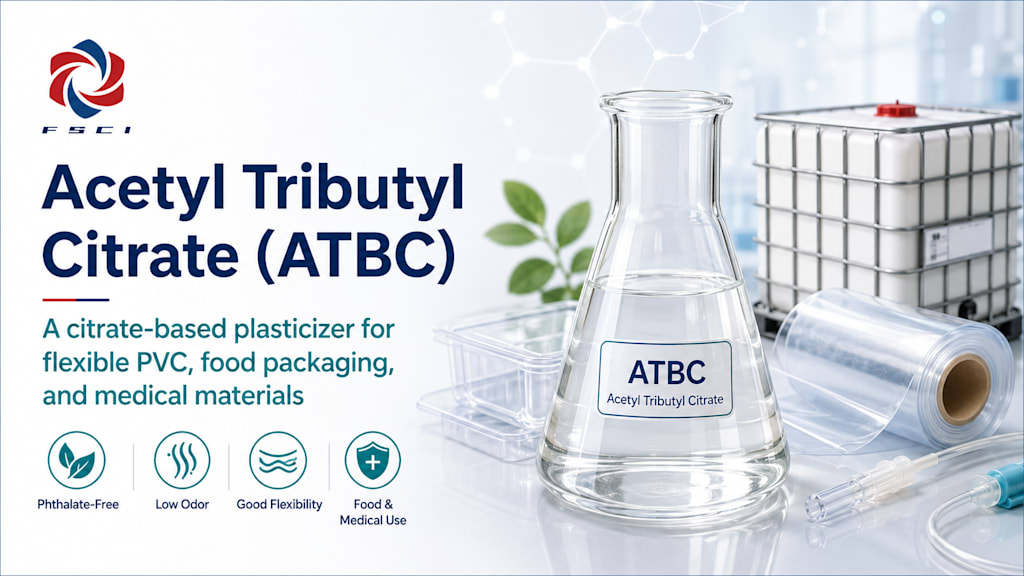
Acetyl Tributyl Citrate is not a material most people recognize by name, but it is connected to something almost everyone touches: flexible plastic. From soft films and coated surfaces to toys, packaging, and certain medical-related materials, flexibility is often the result of careful chemical design. A rigid polymer does not automatically become soft, bendable, or comfortable to handle. It needs help at the molecular level, and that is where plasticizers enter the picture.
A plasticizer is a substance added to a polymer to make it more flexible, less brittle, and easier to shape. Without plasticizers, many plastics would feel hard, stiff, or prone to cracking. This may sound like a small adjustment, but it can completely change how a material behaves. A plastic film that wraps smoothly, a tube that bends without splitting, or a coating that stays intact after repeated movement all depend on this kind of internal flexibility.
Acetyl Tributyl Citrate, often known as ATBC, belongs to the family of citrate ester plasticizers. Citrate esters are derived from citric acid chemistry, which gives them a different identity from traditional phthalate-based plasticizers. Over the past two decades, public and industrial attention has increasingly turned toward alternatives that can meet performance needs while fitting better with changing expectations around material safety, consumer products, and environmental awareness. ATBC has become part of that wider conversation.
One reason Acetyl Tributyl Citrate is interesting is that it reflects a larger movement in material science. In the past, plastic performance was often the main concern. A material had to be flexible, durable, affordable, and easy to process. Those requirements still matter, but they are no longer the whole story. Today, people also ask what substances are used to create those properties, how they behave over time, and whether they are appropriate for sensitive applications. This shift has changed how chemists, product designers, and manufacturers think about additives.
Flexible PVC is one of the most common areas where plasticizers are discussed. PVC in its basic form is naturally rigid. To make it soft enough for films, sheets, tubing, synthetic leather, flooring, or coated fabrics, plasticizers are added. Acetyl Tributyl Citrate can help improve flexibility and workability in such systems. Its role is not dramatic from the outside, because the finished product simply feels softer or bends more easily. But inside the material, the plasticizer helps polymer chains move with less resistance.
This molecular movement is what gives flexible plastic its character. When polymer chains are packed tightly together, the material feels stiff. When a plasticizer fits between those chains, it reduces internal friction and allows the structure to move more freely. The result can be softness, elasticity, improved low-temperature flexibility, or better handling during processing. The effect depends on the full formulation, but the principle is central to why plasticizers matter.
Food packaging is another area where citrate ester plasticizers are often discussed. Packaging materials have to balance several demands at once. They must protect contents, maintain appearance, resist tearing, and sometimes remain transparent or printable. For flexible films and coatings, the choice of additive can influence not only performance but also how the material is perceived by regulators, brands, and consumers. ATBC is often associated with applications where a non-phthalate plasticizer profile is preferred.
This does not mean any single additive automatically solves every packaging challenge. Materials used around food require careful testing, compliance review, and application-specific evaluation. Still, the interest in Acetyl Tributyl Citrate shows how packaging has become more chemistry-aware. A package is no longer seen only as a container. It is a designed material system, and every ingredient contributes to how that system performs.
Toys and child-related products offer a similar example. Soft plastic toys need flexibility, color stability, surface feel, and durability. At the same time, these products are closely watched because they may be handled frequently and used in unpredictable ways. This has encouraged broader interest in plasticizers that are viewed as alternatives to older categories. ATBC has become one of the citrate ester names that appears in these discussions because it can provide softness while fitting into a more modern additive conversation.
Medical-related materials also help explain why plasticizer selection matters. Tubing, films, and flexible components may need to remain soft without losing mechanical integrity. A material that is too rigid can be uncomfortable or difficult to use, while a material that is too weak may fail under stress. Plasticizers help create the balance. In these settings, the chemical identity of each additive is especially important, because performance must be considered together with cleanliness, stability, and suitability for the intended environment.
Beyond PVC, Acetyl Tributyl Citrate can also appear in coatings, inks, adhesives, and other polymer systems where flexibility and film formation are important. A coating that cracks too easily may fail even if it looks good at first. An ink or adhesive may need enough softness to stay stable on a moving or bending surface. These are not always visible details, but they influence how long a finished material remains useful.
From a broader perspective, Acetyl Tributyl Citrate represents the kind of additive that rarely receives public attention but quietly shapes product experience. People notice whether a package tears, whether a film bends cleanly, whether a coated surface stays smooth, or whether a soft plastic item feels pleasant to handle. They may never know which plasticizer was used, but they experience the result.
For readers who want to understand this material more directly, Acetyl Tributyl Citrate is commonly introduced as a citrate ester plasticizer connected with flexible PVC, packaging materials, coatings, and polymer applications. Broader chemical references from Fscichem also show how specialty additives fit into the larger world of functional materials.
The continued interest in Acetyl Tributyl Citrate is not only about replacing one chemical category with another. It is about rethinking how everyday materials are designed. Modern plastics are expected to perform well, feel right, process efficiently, and align with changing expectations around safer-feeling formulations. That is a difficult balance, and it depends on small chemical decisions made long before a product reaches the user.
In that sense, ATBC is a quiet but meaningful part of the material world. It helps turn rigid polymers into flexible surfaces, supports applications where comfort and movement matter, and reflects a larger shift toward more thoughtful additive chemistry. The finished product may look simple, but behind that flexibility is a carefully chosen molecule doing its work in the background.
About the Creator
Enjoyed the story? Support the Creator.
Subscribe for free to receive all their stories in your feed.
Comments
There are no comments for this story
Be the first to respond and start the conversation.