
A Rare and Deadly Virus Is Killing Passengers on a Cruise Ship Stranded in the Atlantic. 149 People Are Trapped. No Port Will Let Them In.
Three people are dead. One is in critical care in a Johannesburg ICU. Two crew members need urgent evacuation. The hantavirus has no cure. And the MV Hondius — refused entry by Cape Verde — sits off the African coast with 149 people and nowhere to go.
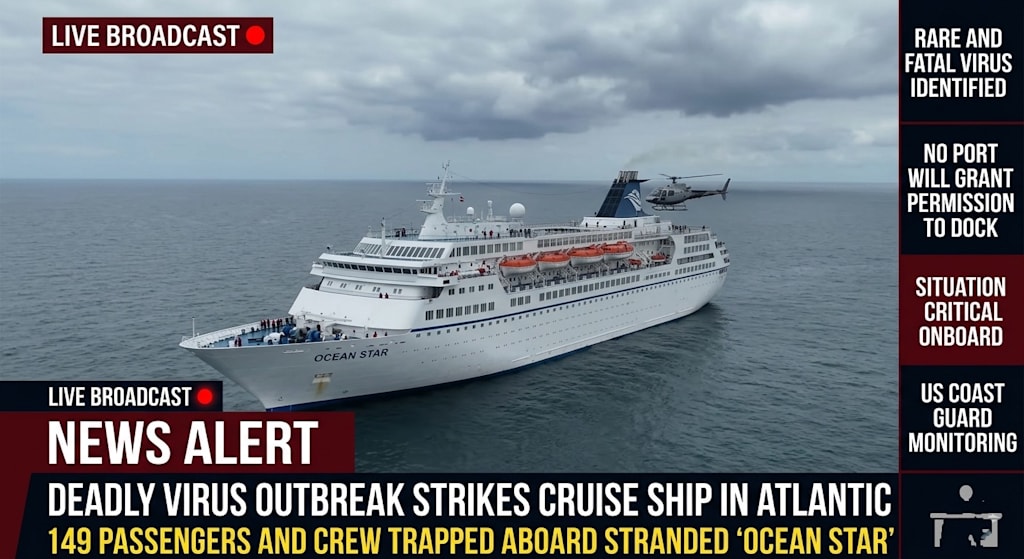
It began with a fever. A 70-year-old Dutch man felt unwell while aboard the MV Hondius, a Dutch expedition cruise ship on a polar voyage from Ushuaia, Argentina, through Antarctica and the remote islands of the South Atlantic Ocean. By April 11, he was dead — the first suspected victim of what the World Health Organization would later confirm was hantavirus, a rare rodent-borne pathogen with no specific treatment and a potentially lethal course. His 69-year-old wife, who had been at his side throughout, left the ship at Saint Helena on April 24 and collapsed at Johannesburg's international airport. She was taken to a nearby hospital, tested posthumously positive for hantavirus, and died.
By the time the ship reached the waters off Cape Verde — an archipelago off the west coast of Africa — the outbreak had killed a German national aboard on May 2 and left a British passenger in critical condition in intensive care in Johannesburg, having been evacuated from the ship on April 27. As of Monday, May 4, the WHO confirmed seven cases: two confirmed and five suspected. Two crew members on board are symptomatic and require urgent evacuation — one with mild symptoms and one in severe condition. Seventeen of the 149 people remaining on the ship are American nationals. The passengers represent 23 different nationalities in total.
"We're not just a story. We're people. People with families, with lives, with people waiting for us at home." — Passenger Jake Rosmarin, MV Hondius, May 4, 2026
Cape Verde has refused to allow the ship to dock. The country's Health Ministry, citing the obligation to protect its own population from a highly unusual pathogen outbreak, has kept the MV Hondius in open waters off the capital city of Praia. Medical teams from Cape Verde — two doctors, a nurse, and a lab specialist — have visited the ship three times by boat to assess the situation. Evacuations are being planned in which sick passengers and crew would be transported by ambulance from the ship to an airport and flown out of Cape Verde for specialist care. But even those arrangements remain uncertain. The Dutch Foreign Ministry confirmed it is actively preparing evacuation flights equipped with full medical equipment and trained crews.
Hantavirus is not a household name, but it became more widely known after the late actor Gene Hackman's wife, Betsy Arakawa, died from a hantavirus infection in New Mexico in 2025. Hackman died shortly after from heart disease. The virus is spread primarily through contact with infected rodents — their urine, saliva, or droppings — and causes two severe clinical syndromes: hantavirus pulmonary syndrome, which attacks the lungs with acute respiratory distress, and hemorrhagic fever with renal syndrome, which attacks the kidneys. Symptoms include fever, headache, gastrointestinal distress, and rapid progression to pneumonia and shock. There is no antiviral treatment. Early intensive care can improve survival odds, but once the disease advances, the mortality rate is high.
How an outbreak began on a cruise ship is the question authorities are urgently trying to answer. The WHO says hantavirus is endemic in parts of Argentina and Chile — the ship's route — particularly in Patagonia, where a 2019 outbreak in the town of Epuyén killed at least nine people. Whether a rodent contaminated food, water, or cargo at some point along the journey is under active investigation. The WHO noted that while rare, human-to-human transmission of some hantavirus strains has been documented. That possibility is making both the passengers still aboard and the authorities ashore increasingly anxious.
Travel blogger Jake Rosmarin, one of the Americans still on the ship, posted an emotional video to social media asking for "kindness and understanding." His words were both composed and heartbreaking. "What's happening right now is very real for all of us here. We're not just a story. We're not just headlines. We're people, people with families, with lives, with people waiting for us at home. There's a lot of uncertainty, and that's the hardest part."
The ship is now considering sailing to the Spanish Canary Islands — Tenerife or Las Palmas — if evacuations cannot be completed off Cape Verde. For the 149 people on board, every hour brings more uncertainty, more fear, and fewer answers. The ocean around them has never felt more vast or more indifferent.
This story needs wider attention. Share it. Every read helps bring visibility to the people stranded aboard the Hondius.
About the Creator
Enjoyed the story? Support the Creator.
Subscribe for free to receive all their stories in your feed.
Comments
There are no comments for this story
Be the first to respond and start the conversation.