
A Deadly Virus Is Loose on a Cruise Ship — and Passengers Are Scattered Across Four Continents
The MV Hondius Antarctic expedition has become a global health emergency. Three people are dead, cases have appeared in Switzerland, South Africa, and Spain, and the WHO is tracking dozens of passengers who left the ship before anyone knew what was happening.
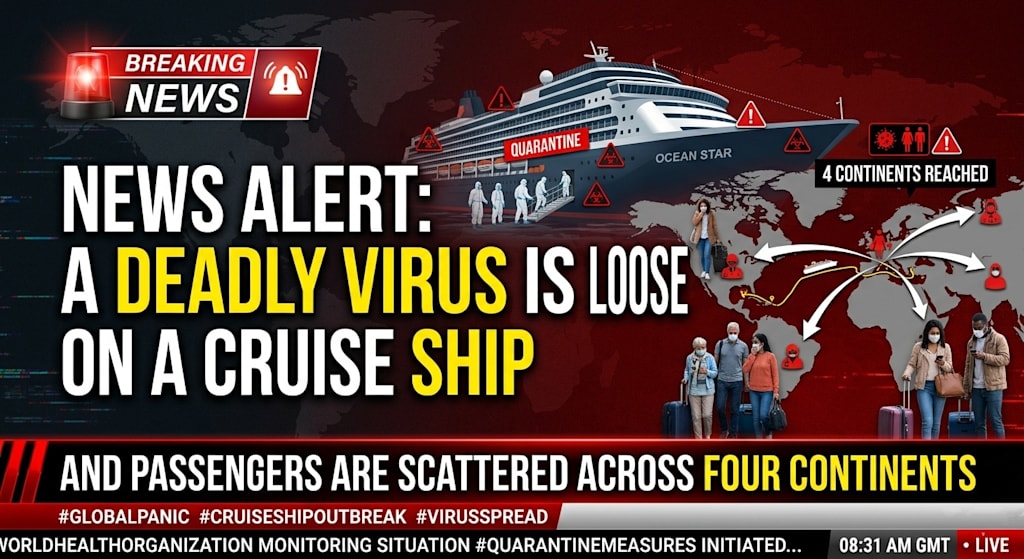
A Deadly Virus Is Loose on a Cruise Ship — and Passengers Are Scattered Across Four Continents
The MV Hondius Antarctic expedition has become a global health emergency. Three people are dead, cases have appeared in Switzerland, South Africa, and Spain, and the WHO is tracking dozens of passengers who left the ship before anyone knew what was happening.
It started as the trip of a lifetime.
A luxury Antarctic expedition aboard the Dutch-flagged MV Hondius, departing Ushuaia, Argentina on April 1, 2026. Eighty-eight passengers and 59 crew from 23 countries. The itinerary included the Antarctic Peninsula, South Georgia, the remote island of Tristan da Cunha, and the island nation of Cape Verde. Berths ranged from €14,000 to €22,000. The kind of voyage that ends up in travel memoirs.
Instead, it has become a global health emergency — and the race to contain it is happening right now.
The Virus Nobody Expected
Three people have died. At least eight confirmed or suspected cases have been identified across multiple continents. The culprit is hantavirus — specifically the Andes strain, a variant known in rare cases to spread between humans.
The first victim, a Dutch man, died on April 11. His wife later fell too ill to complete an evacuation flight and died in Johannesburg. A German national also died aboard the ship. Since then, cases have been confirmed in Switzerland, the Netherlands, and South Africa. A new suspected case has emerged in Alicante, Spain — a woman who shared a flight with the Dutch woman before she died.
And here is the detail that makes public health officials most nervous: more than two dozen passengers disembarked the ship on April 24 — nearly two weeks after the first death — without any contact tracing in place. They came from at least 12 different countries. Health authorities across four continents are now in a scramble to find them all.
Where the Ship Is Now
As of today, the MV Hondius is en route to Tenerife in Spain’s Canary Islands, expected to arrive Sunday. Spanish authorities have confirmed they will receive the vessel, but with extraordinary precautions: passengers will be evacuated in small groups directly onto isolated buses, transported through cordoned-off sections of the airport, and flown to their home countries without contact with the general public.
Both the United States and United Kingdom have dispatched evacuation planes for their citizens aboard.
The WHO has confirmed the Andes strain — which can cause human-to-human transmission in close contact situations, such as between cabin-mates or couples — was involved. A flight attendant who briefly boarded a plane with an infected passenger has since tested negative, providing some reassurance.
“The risk remains absolutely low,” said WHO spokesperson Christian Lindmeier. “This is not a new COVID.”
Why This Is Still Alarming
Hantavirus is not easily transmissible. Under normal circumstances, it spreads through contact with infected rodent urine, droppings, or saliva — not casual human contact. The Andes strain’s capacity for limited human spread is rare and not fully understood.
But with an incubation period of one to eight weeks, and passengers now dispersed across the globe for weeks before the outbreak was confirmed, the window for containment is tight.
The WHO and European health agencies continue to monitor the situation carefully. For now, authorities say the public faces minimal risk. But this is exactly the kind of story — a slow-moving outbreak, a delayed response, passengers scattered across continents — that public health agencies train for, and the world watches closely.
The ship reaches Tenerife this Sunday. We will know more then.
Health stories like this deserve attention before they become crises.
About the Creator
Enjoyed the story? Support the Creator.
Subscribe for free to receive all their stories in your feed.
Comments
There are no comments for this story
Be the first to respond and start the conversation.