
A Bollywood Star Just Won an Election and Could Become Chief Minister Today — If a Governor Doesn’t Stop Him
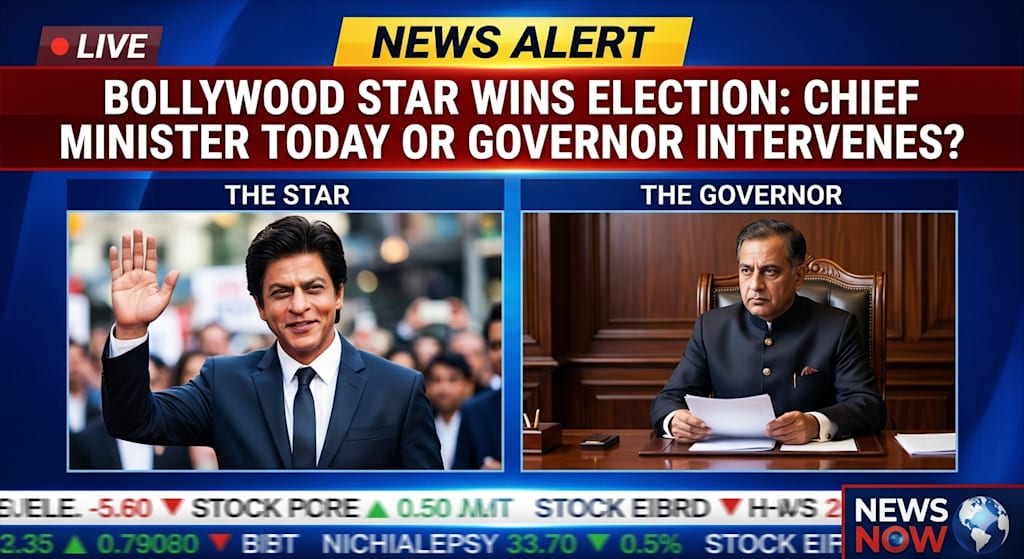
Tamil actor Vijay made history by ending a 60-year political duopoly in India’s Tamil Nadu state. But as he prepares to take oath as Chief Minister, a constitutional standoff is threatening to derail everything.
In most countries, an actor entering politics is a punchline.
Not in Tamil Nadu.
India’s southernmost major state has a long and proud tradition of film stars crossing into politics — M.G. Ramachandran, Jayalalithaa, Kamal Haasan. But what happened in Tamil Nadu on May 4, 2026, when the election results were declared, was something none of those predecessors ever managed.
Actor Vijay — in his very first election, with a party less than two years old — shattered a 59-year political duopoly and emerged as the single largest party in the state assembly.
Today, he may take oath as Chief Minister. Or he may not. And the reason it is still uncertain reveals something deeply important about Indian democracy, power, and the complicated relationship between elected politicians and the governors appointed to oversee them.
Who Is Vijay?
For those outside India, a brief introduction.
Vijay — full name Joseph Vijay — is one of Tamil cinema’s biggest superstars. He has starred in dozens of blockbuster films over a three-decade career, commanding a fanbase that stretches across South Asia, Southeast Asia, and the Tamil diaspora worldwide. His screen presence is enormous. His social influence is even larger.
On February 2, 2024, he announced the formation of his political party: Tamilaga Vettri Kazhagam — TVK, meaning “Tamil Victory Party.” He declared it would contest the 2026 state elections, running in all 234 constituencies. Political observers were sceptical. The DMK and AIADMK had dominated Tamil Nadu politics since the 1960s. Breaking that duopoly seemed almost impossible.
Then the election happened.
The Historic Result
Voting took place on April 23, 2026, in what turned out to be the highest voter turnout in Tamil Nadu’s history — 85.1%.
When results came in on May 4, TVK had won 108 seats — making it the single largest party in the 234-seat assembly. In a stunning personal blow, sitting Chief Minister M.K. Stalin of the rival DMK lost his own constituency — Kolathur — a seat he had won three times in a row. Vijay himself won in two constituencies simultaneously.
The result was historic on multiple levels. It was the first time since the 1960s that a non-Dravidian party had emerged as the largest force in the state. It ended decades of the DMK and AIADMK trading power back and forth. And it did it in the party’s very first election.
The Problem: He Doesn’t Have a Majority — Yet
Tamil Nadu’s assembly has 234 seats. A majority requires 118 seats. TVK won 108. That means Vijay needs at least 10 more MLAs to back him before he can form a government.
After the results, he moved quickly. The Congress party (5 seats) extended support. The Communist Party of India and Communist Party of India (Marxist), with 2 seats each, also backed him. That brought the count to 117 — one seat short of the magic number.
All eyes turned to the Viduthalai Chiruthaigal Katchi (VCK), a Dalit political party with sufficient seats to push Vijay over the line. This morning, VCK announced it was extending unconditional support. The count appears to have crossed 118.
The Governor’s Standoff
And yet, as of this morning, Vijay has not been sworn in.
The reason is Tamil Nadu’s Governor, Rajendra Vishwanath Arlekar, who has asked Vijay to produce letters of support from 118 MLAs before he will invite him to form the government. This is constitutionally unusual. Governors in India’s parliamentary system are typically expected to invite the leader of the single largest party to form government and prove their majority on the floor of the house — not before being sworn in.
Critics, including opposition politicians, have accused the BJP-appointed governor of using his constitutional role to obstruct a government that is ideologically opposed to Prime Minister Narendra Modi’s party. The BJP has no meaningful presence in Tamil Nadu.
Whether Vijay takes oath today — or whether this becomes a prolonged constitutional battle — will be known within hours.
The people of Tamil Nadu are waiting. So is the rest of India.
About the Creator
Enjoyed the story? Support the Creator.
Subscribe for free to receive all their stories in your feed.
Comments
There are no comments for this story
Be the first to respond and start the conversation.