
A Birthday Child Can Choose the Theme Without Planning Every Activity
Keep the favourite idea with the child and the practical commitments with the adults.

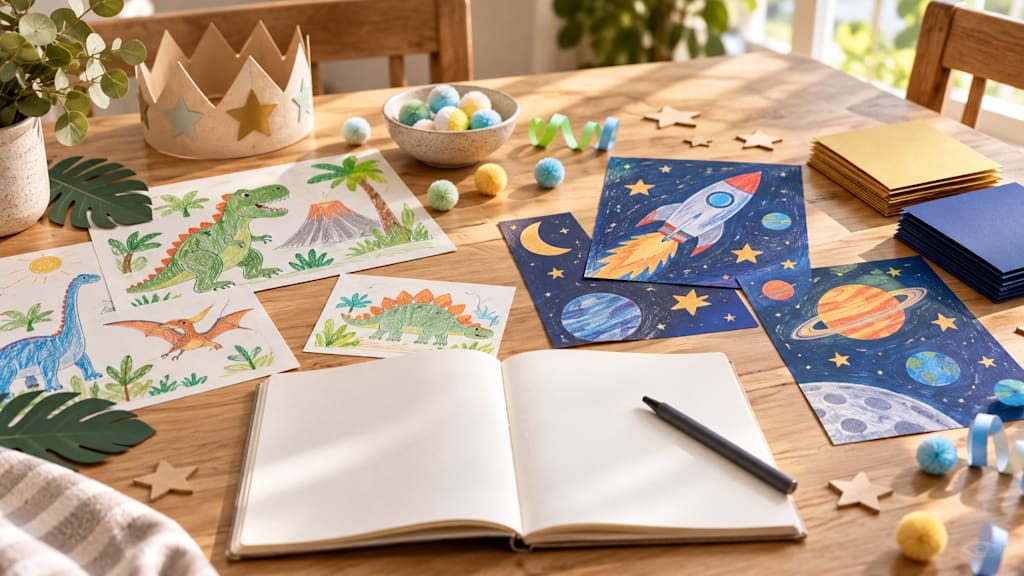
“What would you like for your birthday?” sounds like an easy question. A child might answer with a favourite animal, a colour, a story world or one activity they recently enjoyed. An adult may hear the beginning of a complete event brief: decorations, entertainment, timings, costumes and a plan for every guest.
Those are not the same conversation. A birthday child can have a meaningful say without becoming responsible for designing a workable afternoon. The useful distinction is between choosing what the celebration should feel like and arranging how it will actually happen.
Ask about the moment, not the whole programme
Instead of asking a child to invent a schedule, ask what they would most like to remember. Perhaps it is finding a pretend treasure, making something to take home or having everyone join a favourite game. That answer gives the adults a direction while leaving room to plan.
A theme can also be much smaller than a fully decorated world. A child who likes space might enjoy an imaginative mission and a paper badge. They may not want every snack, activity and conversation to be about planets. Ask which part matters rather than assuming the word “space” defines everything.
There is no need to turn this into a long interview. A short conversation with one or two concrete options can be enough to identify a preference. If the child is unsure, uncertainty is a valid answer. Adults can keep the plan simple instead of repeatedly asking for a decision.
Separate wishes from practical commitments
Write the child's wishes in one part of a note. In another, put the practical information that adults must confirm: date, location, available room, approximate guest ages and the time reserved for the programme. Keep any promise to a service provider separate from a child's suggestion.
For example, “I would love a treasure hunt” is a preference. “The room is available from the agreed start time” is a logistical statement. “The entertainer has confirmed a treasure-hunt activity suitable for this event” is a separate confirmation. Combining the three too early can create a promise that nobody has actually made.
The same applies to a requested character, craft or special effect. A picture saved from the internet does not establish that a provider offers it. Ask about the actual programme before presenting an idea to the child as something that will definitely happen.
A fictional planning conversation
Imagine a child who asks for a dinosaur party and a very long treasure hunt. The adults already know that the venue is a small indoor room and that some guests will be younger than others.
Rather than saying yes to an invented schedule, they ask: “Is finding the dinosaur clues the important part, or would you rather make something dinosaur-themed?” The child chooses clues. The adults then discuss a suitable version with the provider, including the room and guest information.
They might return with a confirmed plan that preserves the favourite idea without promising the exact activity seen in a video. Or the provider may explain that a different format fits the space better. Either outcome is more honest than treating the child's first description as a finished booking specification.
This is an invented example, not an account of a customer event or a claim about a particular provider's programme.
Leave room for the other children
The birthday child's preference matters, but it does not tell you everything about the group. Different ages, familiarity with one another and willingness to join in can affect how an activity is organised. Adults should share relevant group information with the person planning the programme instead of asking the child to anticipate every guest's needs.
A useful question is what participation can look like. Can a child watch first? Is there a quieter way to take part? Which activities are actually available for this group? The answers need to come from the agreed programme and responsible adults, not from assumptions about a theme.
Avoid turning a party preference into a performance obligation. Wanting a magic theme does not necessarily mean wanting to stand in front of everyone. Ask the child whether a central role sounds enjoyable, and confirm any planned involvement with the organiser.
Give the provider a clear, modest brief
For a regional reference, ShakeParty's children's entertainment in Germany (https://shakeparty.de/de) provides information about its services and the route to an enquiry. The project is part of our team's business network; this is not an independent recommendation or a review of an event.
Before enquiring, distinguish the favourite theme from a requested activity, and mark anything that is merely an idea. Then add the practical details the provider needs to assess the request. Do not assume that a theme name includes a costume, a particular character or every activity associated with it.
The adult organiser should also clarify who is the contact person during the event and which responsibilities remain with the host or other adults. Entertainment arrangements should not be silently expanded into an assumption about childcare or supervision. The relevant roles need explicit agreement.
A one-page note for the adults
A useful brief can be shorter than the message thread that usually develops around a party. Keep the following headings together:
The child's favourite theme or idea.
The one moment that matters most to them.
Things the child would rather avoid, including an unwanted central role.
Date, location, available time and relevant room information.
Approximate guest ages and information needed to plan participation.
Requested activities that still need the provider's confirmation.
The adult contact person and the responsibilities that need clarification.
The note is not a promise of what will be delivered. It is a shared starting point. Once an arrangement is confirmed, update the note rather than keeping an old wish list beside a different booking confirmation.
Tell the child what is settled, not every open question
After the practical conversation, return to the child with a simple description of what has been agreed. Explain the part connected to their wish and avoid presenting unresolved details as certain. If an idea changed, say so plainly rather than hoping nobody notices on the day.
There is also no need to make the child approve the transport plan, room access or the order of every transition. Those are adult tasks. Children can be included without carrying the burden of keeping the event on schedule.
The aim is not to remove their choice. It is to protect the useful part of that choice: a celebration that reflects something they enjoy, supported by adults who have checked what can actually be arranged.
About the Creator
Vladyslav Yanchenko
Marketer at Salestudia in Idstein, Germany. I write about websites, SEO, digital marketing and e-commerce, plus how people choose services and products.
Enjoyed the story? Support the Creator.
Subscribe for free to receive all their stories in your feed.
Comments
There are no comments for this story
Be the first to respond and start the conversation.