
74-Year-Old Father’s Funeral Watched on Video Call: A Sonipat Story That Raises Questions About Elder Care
A heartbreaking account involving an elderly father, an old-age home, and a funeral attended through a phone screen has started a larger conversation about ageing parents, family responsibility, and loneliness.

Parents spend decades helping their children take their first steps in life. They take them to school, support their education, celebrate their achievements, and often sacrifice their own comfort to give their children a better future.
But what happens when those same parents grow old and need someone beside them?
A disturbing story from Sonipat, Haryana, raises exactly that question.
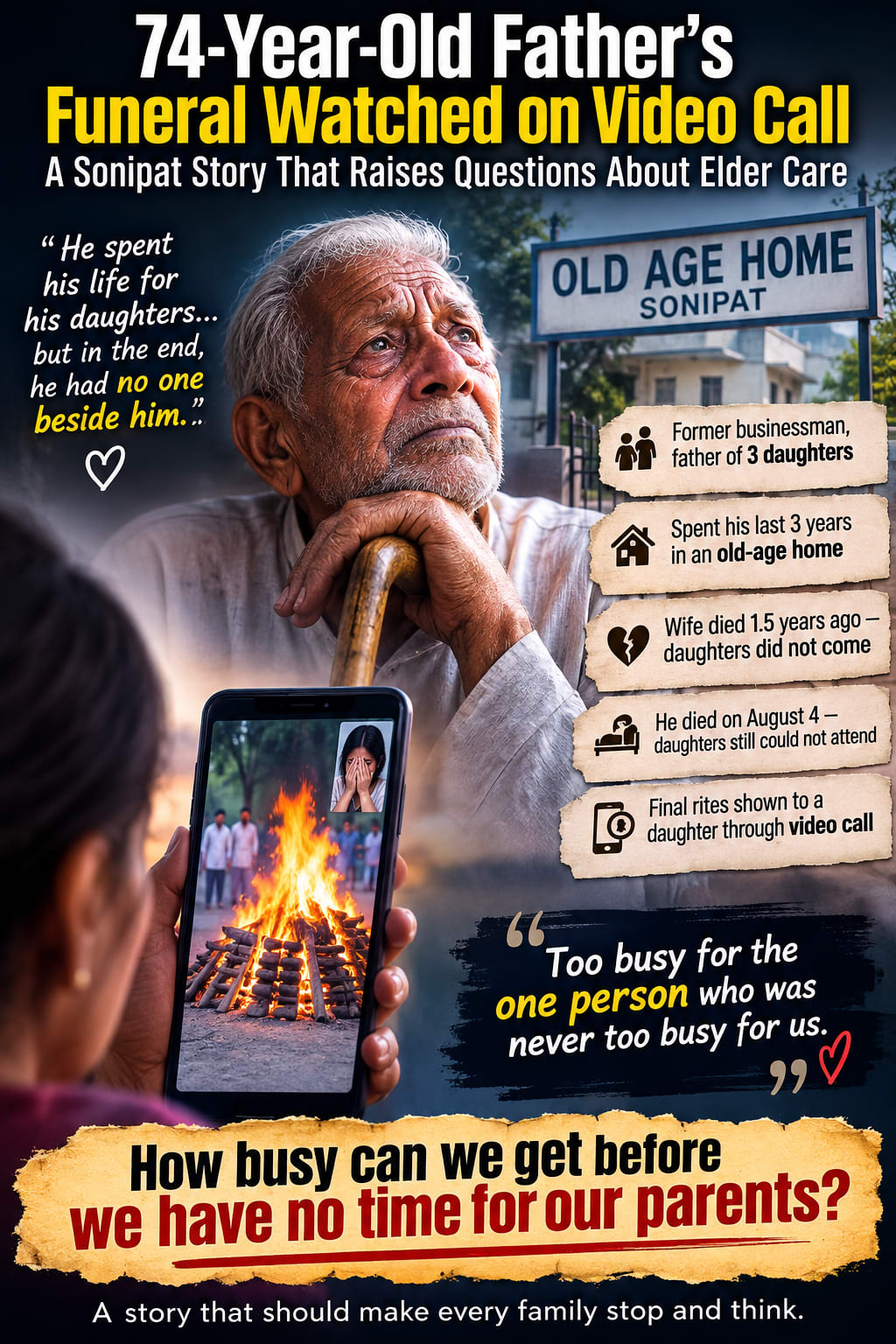
According to the account circulated about the incident, 74-year-old Ram Ratan Gupta, a former businessman, spent the final years of his life in an old-age home. When he died, his daughters reportedly could not attend his funeral in person. Instead, his final rites were shown to one of them through a video call.
The incident is not simply a story about one family. It has become a painful reminder of the loneliness experienced by many elderly parents.
Who Was Ram Ratan Gupta?
According to the reported account, Ram Ratan Gupta had once lived in Mumbai and operated a clothing business.
He was a father of three daughters.
During better financial years, he reportedly provided his daughters with a good education, supported them through college and arranged their marriages.
Life, however, changed after his business suffered losses.
His financial situation gradually deteriorated, and eventually he and his wife moved away from Mumbai. With limited resources and nowhere permanent to live, the elderly couple reportedly reached an old-age home in Sonipat.
Despite having children, they began spending their later years among other elderly residents.
His Wife Reportedly Died in the Old-Age Home
The situation became even more tragic when Gupta's wife became ill.
According to the account, she died roughly a year and a half before her husband.
The family was informed about her condition, but the daughters reportedly did not attend her final rites.
Gupta therefore performed his wife's funeral with the assistance of people from the old-age home.
After losing the person who had accompanied him through most of his life, his loneliness reportedly became even more difficult.
He later moved to another old-age home in Sonipat because memories of his wife surrounded him at the first facility.
His Health Began to Deteriorate
In the weeks before his death, Gupta's health reportedly worsened.
Staff members at the old-age home contacted family members and informed them that their father's condition was serious.
According to the account, they were told that he had been taken for medical treatment and that visiting him would be advisable.
The daughters reportedly said they were unable to come.
His condition improved temporarily, but he later suffered severe abdominal pain.
On August 4, according to the account, his health deteriorated again and he died before he could be taken to hospital.
The old-age home then contacted his daughters once more.
This time, it was not to tell them that their father was sick.
It was to tell them that he had died.
The Funeral That Took Place Without His Daughters
The old-age home reportedly offered to preserve Gupta's body temporarily so that family members would have time to reach Sonipat.
However, according to the story, none of his three daughters was able to attend.
They reportedly asked staff members at the old-age home to arrange the funeral instead.
Around ₹5,100 was reportedly sent toward the funeral expenses, while members of the old-age home accompanied Gupta on his final journey.
But there was another request.
The family wanted the funeral to be recorded, and when the time came for the final rites, a video call was made.
A daughter reportedly watched her father's cremation through the phone.
That image—a father's final journey being viewed through a mobile screen—has become the most emotionally disturbing part of the story.
The Most Painful Question: Can We Really Be Too Busy?
Modern life is demanding.
People move to different cities and countries for jobs, education, marriage and financial opportunities. Sometimes genuine emergencies make travelling immediately impossible.
That reality should not be ignored.
But this story raises a much deeper question:
How busy can a person become before family relationships begin disappearing altogether?
Parents rarely calculate how many hours they spend caring for their children.
They do not normally send an invoice for sleepless nights, school fees, hospital visits, food or emotional support.
Yet old age often reverses those roles.
The people who once provided care become the people who need it.
And sometimes, unfortunately, they discover that nobody has enough time.
Gupta Reportedly Wanted to Donate His Organs
Another emotional element of the story involves Gupta's final wish.
According to the account, he had expressed a desire to donate his organs after his death.
Because of the circumstances surrounding the donation process, a complete organ donation reportedly could not take place.
However, his eyes were donated.
They reportedly helped restore vision to two people.
Even at the end of a life marked by loneliness, something meaningful remained behind: the possibility that another person could see the world through the gift he left.
The Larger Issue of Elderly Loneliness in India
India often celebrates the idea of strong family bonds.
Traditionally, several generations have lived under the same roof, with younger family members caring for parents as they age.
But changing lifestyles, migration, smaller households, demanding careers and complicated family relationships are transforming that structure.
Old-age homes themselves are not necessarily a sign of abandonment. Some provide essential healthcare, companionship and professional support that families may not be equipped to provide.
The deeper problem is emotional abandonment.
An elderly parent may live in a care facility and still receive frequent visits, phone calls, affection and involvement from family.
Another person may technically live with relatives and still feel completely alone.
The address is not always what matters.
Presence does.
One Story, One Important Reminder
It is impossible for outsiders to know every private circumstance inside a family.
Stories involving family relationships usually have complexities that are not visible in a viral video or news report.
For that reason, this incident should not simply become an opportunity to attack individuals online.
It can instead become an opportunity for self-reflection.
When was the last time you called your parents without needing anything?
When did you last sit beside them and simply listen?
If you live far away, when did you last plan meaningful time together?
Career, money and responsibilities matter. But some moments cannot be postponed indefinitely.
A missed phone call can be returned tomorrow.
A postponed visit can sometimes happen next month.
But there is one journey after which there is no next meeting.
The story of Ram Ratan Gupta is heartbreaking not because technology was used during a funeral. Technology can connect families separated by thousands of kilometres.
It is heartbreaking because it reminds us of something much more fundamental:
Parents spend years making time for their children. We should hope that when their time begins running out, their children can make time for them too.
About the Creator
parwinder singh
🎬 Movie & Entertainment Writer sharing reviews, ending explanations, story breakdowns, plot twists and hidden details from Bollywood, Hollywood, South Indian cinema, Korean dramas and OTT releases.
Enjoyed the story? Support the Creator.
Subscribe for free to receive all their stories in your feed.
Comments
There are no comments for this story
Be the first to respond and start the conversation.