
7-Eleven Left India. The Deal Made Sure It Never Had a Chance.
A master franchise, 13 million corner shops, and five years of learning that ended in empty shelves.
On September 30, 2026, workers in Mumbai and Pune took down the last red-and-orange 7-Eleven signs. They cleared shelves, unplugged refrigerators, packed the remaining bento boxes and onigiri into crates, and returned the keys. By the next morning, all 31 remaining stores were dark. The chain had opened its first Indian outlet in Mumbai in October 2021 with promises of a convenience revolution. Less than five years later, it left the country.
Seven & i Holdings confirmed the closure in a statement on October 6. The company gave no reason. Japanese media said 7-Eleven had lost to local competitors. That is true, but incomplete. 7-Eleven never controlled its Indian fate. Its operating rights arrived as a side contract in a merger between two Indian giants. Its stores were run by a partner that wanted to learn, not to build the brand. Its competitors were 13 million family shops with deep community ties and a quick-commerce sector that delivers in minutes. Its core product, cold prepared food, did not fit the culture. Its target customer did not exist in sufficient numbers. The exit ended an experiment that had failed at the design stage.
Nine hundred million rupees in losses
For the fiscal year ending March 2026, the entity operating 7-Eleven in India reported revenue of about 920 million rupees. Its net loss was nearly 900 million rupees. For every 100 rupees that came in, almost 98 went out. Across 31 stores, each location carried an annual loss of roughly 29 million rupees, about $330,000.
The numbers were a multi-year pattern. From 2021 to 2026, the business never crossed break-even. At its peak, it had about 60 stores. By late 2025, that number had been cut in half. Less than a year later, it was zero.
The losses mattered because 7-Eleven’s global model depends on density. In Japan, a single delivery route serves dozens of stores. The cost of cold-chain logistics is spread across a tight network. In India, the stores were concentrated in two cities. The network was thin. As stores closed, the cost per delivery rose. The business could not burn cash to reach scale because the scale never arrived.
The partner that learned everything
To understand the exit, look at the partner. In 2019, 7-Eleven signed a licensing agreement with Future Group, an Indian retail giant. Future Group ran into a cash crisis. In 2021, Reliance Retail, owned by India’s richest man, Mukesh Ambani, swallowed Future Group’s retail business. The 7-Eleven contract came along as part of the deal. The contract was a piece of paper attached to a larger acquisition.
Reliance Retail signed a master franchise agreement. Under that agreement, Seven & i Holdings supplied the brand and the operating system. Reliance supplied everything else: store openings, investment, supply chain, hiring, real estate, licenses, and political capital.
For five years, Reliance employees ran 7-Eleven stores. They built a cold-chain supply network for prepared food, arranged SKUs by shelf velocity, and calculated footfall for a site. They also scheduled shifts to match hourly sales, negotiated supplier payment terms, and managed waste in a category with thin margins.
When the learning was done, Reliance closed the stores. The leases remained. Employees were reassigned to Reliance Fresh, Smart Bazaar, or JioMart. The supply chain kept moving, and trucks kept delivering. Only the brand name changed. The Japanese company paid for the education.
Industry insiders in India have a phrase for this: the India investment pig-butchering scheme. The foreign brand is lured in. The local partner extracts the operating knowledge. The foreign brand is then discarded. The local partner keeps the assets and the capabilities. Other multinationals have experienced the same treatment. More will.
13 million Kirana stores
7-Eleven’s first competitor was the Kirana.
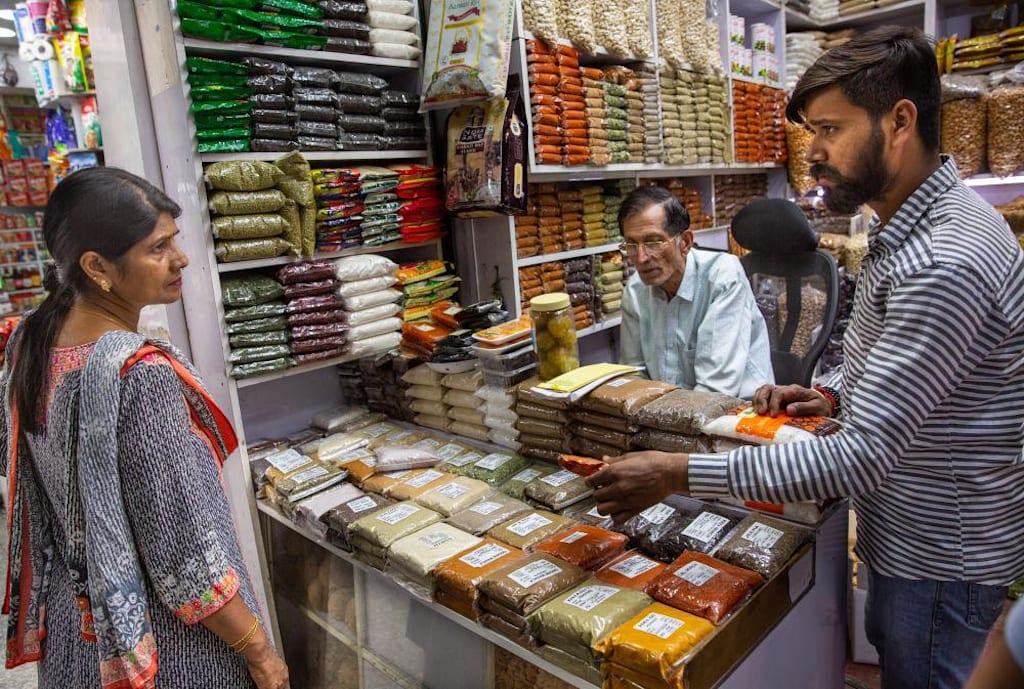
India has between 12 million and 13 million Kirana stores. They account for about 91% of food and grocery transactions. Even by 2030, projections put them at 86%. A Kirana is often a family-run shop. The owner lives in the neighborhood. He knows which family buys which brand of milk. He knows how much rice a household consumes in a month. He knows whether a customer prefers mustard oil or sunflower oil. He offers credit. He delivers. He breaks a pack of biscuits into two. His rent is low or zero. His labor is his own. His logistics cost is under 0.5%. His average ticket is 100 to 200 rupees.
7-Eleven prices are 5% to 10% higher than local shops. Its hot food is often double. In a market where price sensitivity is extreme, air conditioning and clean floors do not justify the premium. A customer who needs one onion, two eggs, and a single cigarette does not go to a convenience store with bright lights and a cash register. He goes to the man who knows his name and lets him pay next week.
The Kirana is a highly efficient distribution network built on trust, credit, and proximity. It has survived organized retail, e-commerce, and demonetization. It will survive 7-Eleven.
Ten-minute delivery
If the Kirana is the physical competitor, quick commerce is the digital one.
In Mumbai and Pune, Blinkit, Zepto, and Swiggy Instamart deliver in five to twelve minutes. A single bottle of cola can be delivered. The fee is near zero. India’s quick commerce GMV reached $10 to $11 billion in 2025, about 16 to 17% of total e-commerce GMV. Redseer and Google project $70 to $90 billion by 2031, growing at 41 to 48% annually. Quick commerce is becoming the default way urban Indians buy small items.
The convenience store’s core promise is near and fast. Quick commerce delivers faster. It also delivers to the door. The customer does not need to leave the house. The physical store becomes unnecessary. There is little reason to walk to a 7-Eleven when a rider brings the same item in ten minutes.
7-Eleven built its global business on the idea that physical proximity beats online shopping for urgent needs. In India, the online players solved the urgency problem. They removed the reason for the store to exist.
Cold rice against hot food
7-Eleven’s profit engine is fresh food. In Japan, prepared food accounts for more than half of sales and the largest share of profit. The company’s supply chain, store layout, and employee training are all built around bento boxes, onigiri, sandwiches, and hot snacks.
In India, the engine stalled.
Indian consumers prefer hot food made in front of them. Refrigerated bento boxes, microwaved onigiri, and chilled sandwiches do not match daily eating patterns. Vegetarian restrictions, religious rules about meat, garlic, and onion make a national standardized menu impossible. Street food is cheap and fresh. A cold box of rice is neither.
The cold chain is expensive. Waste is high. The stores tried local snacks and drinks. None became a repeat-purchase hit. Without fresh food, 7-Eleven becomes a small, expensive grocery store. It loses on price to Kirana, on speed to quick commerce, and on freshness to street food. The main profit category never worked.
The missing middle class
Global retail capital looks at 1.4 billion people and sees a middle class. The data says something else.
By international standards, only about 5% to 6% of Indians can afford convenience-store prices. The share of total wealth held by the middle class fell from 25% in 2013 to 13% in 2025. GDP grew. The top 1% captured the gains. The middle and bottom fell further behind. Urban housing costs eight to ten times annual income. Private school fees and medical costs rise 10% to 12% a year. Household debt grows faster than financial assets.
The customer 7-Eleven needed, a salaried urban professional willing to pay for speed, is a shrinking group. The consulting decks promised a middle-class explosion. The explosion did not happen.
A convenience store cannot survive on 5% of the population. The business needs density and repeat customers. It also needs a broad base of people who value time over money. In India, that base is thin. In Mumbai and Pune, it is thin enough to fit into 31 stores.
What remains
In Mumbai, the red-and-orange signs are gone. The shelves are empty. The keys have been returned.
But the supply chain that Reliance built while running 7-Eleven still moves. Trucks still deliver, and warehouses still hum. Employees still clock in. The only difference is the name on the invoice. It says JioMart.
Seven & i Holdings says it will explore other possibilities for India. The possibilities are hard to see. The local partner has learned everything. The Kirana has not moved. Quick commerce is growing at 40% a year. The middle class is not expanding. The fresh food does not sell. The brand is gone.
7-Eleven lost India because it arrived without control. It competed without an edge. It sold a product the market did not want. The exit was quiet. The empty shelves explain why.
About the Creator
Jin
Writer of reamstories
https://reamstories.com/jin
Enjoyed the story? Support the Creator.
Subscribe for free to receive all their stories in your feed. You could also become a paid subscriber, letting them know you appreciate their work.
Comments
There are no comments for this story
Be the first to respond and start the conversation.