
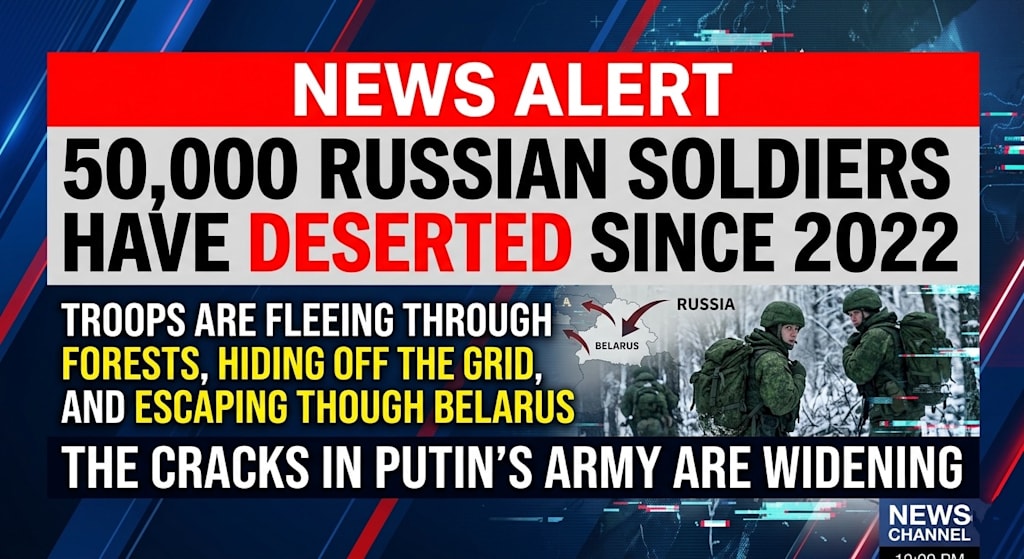
50,000 Russian Soldiers Have Deserted Since 2022. Now They're Fleeing Through Forests, Hiding Off the Grid, and Escaping Through Belarus. The Cracks in Putin's Army Are Widening.
Russia's military is fighting a desertion crisis it officially refuses to acknowledge. New reports reveal an underground network helping soldiers escape. In Ukraine, the problem is even worse — 200,000 Ukrainian troops are AWOL. The invisible war within the war is accelerating.
Oleg was 24 years old when he thought he was signing up for a security guard job at the Zaporizhzhia nuclear power plant. The salary — 200,000 rubles a month, roughly $2,660 — was too good to pass up. He took a train from Moscow to a conscription office in Ryazan, knowing the work was somehow arranged through the military but not imagining he would end up on a frontline. He arrived at the office "sleepy and with a splitting headache." Within weeks, he was being sent toward a combat zone. Within months, he had deserted — and was hiding off the grid somewhere in Europe, awaiting a humanitarian visa and waiting for a war he never agreed to fight to end without him.
Oleg's story is not exceptional. According to the United Nations' special rapporteur on human rights, at least 50,000 Russian soldiers — roughly one in ten servicemen fighting in Ukraine — had deserted since 2022 as of last year. Russia's independent Mediazona publication reported that nearly 21,000 Russian servicemen had been convicted for refusing to serve, while far more were returned to their units without prosecution. Research from the Frontelligence Insight group, based on tens of thousands of personal military records, found that the typical Russian deserter is a 37-year-old male under contract, and that his chance of desertion in 2025 doubled compared to 2024. In some units heavily engaged in combat in Donetsk Oblast, the monthly rate of battlefield desertion rose nearly tenfold in the first half of 2025.
"You either get killed, or you get killed — there is no other option." — Ukrainian soldier Illia, 30, who deserted in 2024 after seven missions he described as "one-way"
The network helping Russian soldiers escape is known as "Idite Lesom" — Russian for "go through the forest," used idiomatically as "get lost." The group, which operates covertly, has helped at least 3,000 soldiers desert and flee Russia. Its instructions are precise and sobering: stop using your bank card. Stop using your SIM card. Rent an apartment with cash. Sixty percent of deserters, the group says, remain inside Russia — living entirely off the grid, invisible to military and civilian authorities. The rest attempt to leave the country through gaps in border control, the most common route being an overland journey to Minsk, Belarus — whose border with Russia is largely unguarded — followed by a flight to Armenia, one of the few countries accessible from Russia with no extradition agreement for deserters.
Ukraine's desertion crisis is, by every available measure, even more severe. In January, newly appointed Ukrainian Defense Minister Mykhailo Fyodorov stated publicly that more than 200,000 Ukrainian soldiers — over 20 percent of active servicemen — had gone AWOL or deserted, and that more than two million draft-eligible men were evading mobilisation. In October 2025 alone, a record 21,602 AWOL and desertion cases were recorded. Soldiers tell interviewers similar stories: Soviet-style top-down command structures that order men to "hold positions at all costs" without regard for conditions on the ground; indefinite rotations with no relief date; and a deep sense that individual lives are treated as expendable by leadership. "If the commanders valued these people," one deserter told the Kyiv Independent, "we would have had enough guys in the army."
The structural disparity between the two sides matters enormously. Russia, with its larger population, can rotate soldiers every three to six months. Ukrainian troops are deployed indefinitely. Russia recruits an estimated 30,000 soldiers per month; Ukraine recruits 17,000 to 24,000, while also losing more to desertion. The gap compounds with every passing month.
Neither army is close to collapse. But both are showing the internal fractures that emerge when states send young men into an industrial-scale attritional war with no clear end in sight. Putin's army wages the war it has — not the war it wants. So does Zelensky's. And the men walking away from both are making a calculation that no government can legislate away: that survival is worth more than obedience to an order that means death.
The men who voted with their feet — Russian and Ukrainian alike — are, in their own quiet way, casting the most honest vote of all about this war. They are voting to be alive. You cannot fault them for it.
About the Creator
Enjoyed the story? Support the Creator.
Subscribe for free to receive all their stories in your feed.
Comments
There are no comments for this story
Be the first to respond and start the conversation.