
5 Websites That Actually Pay Writers Well in 2026
From Medium's revenue share to a flat $500 for one short story — here's what each platform really pays, how many readers you'd reach, and how I'd pitch each one
From Medium's revenue share to a flat $500 for one short story — here's what each platform really pays, how many readers you'd reach, and how I'd pitch each one
I spent an embarrassing number of hours this month doing something most writers never bother to do: I actually went and checked. Not "someone on Reddit said," not "a 2022 blog post claimed" — I dug into current contributor guidelines, payment pages, and traffic data for five sites that regularly get recommended to writers looking to earn something real from their words. A couple of the numbers I found matched what's commonly repeated online. A couple didn't, and one platform has quietly shrunk so much that I don't think it belongs on most "best paying sites" lists anymore, even though it still gets recommended constantly.
So here's my honest, freshly checked breakdown. I'll tell you what each site pays, roughly how many readers you'd actually be writing for, and where I think the real opportunity is versus where it's mostly nostalgia.
1. Medium — the one with no ceiling, and no floor either
Medium isn't a "pay per article" site, and I think that's the single most misunderstood thing about it. You don't get $50 for writing a post. You get paid based on how many minutes paying members actually spend reading your work, funded by Medium's $5/month (or $50/year) membership fee. No engaged reading time from paying members, no earnings — it doesn't matter how many total views you rack up.
That model has been tweaked constantly through late 2025 and into 2026: a bonus for traffic you bring in from outside Medium, a bigger cut for readers who find you through Google search, an extra boost for email notifications, and, as of February 2026, a new "member growth" bonus that pays you a small amount when a non-member becomes a paying subscriber because of your story. Writers on the platform have mixed feelings about all this tinkering — I've seen plenty of "my earnings per read just quietly dropped" complaints alongside genuine excitement about the new bonuses.
What can you realistically expect? Most engaged reads pay somewhere between one and fifteen cents. That sounds tiny, but consistent writers with a real following commonly report $50–$200 a month, some push past $500, and a genuinely viral story can bring in anywhere from $100 to well over $1,000. I don't think that's a myth — I think it's simply a much wider range than most "how to make money on Medium" posts admit.
Cost to join: none to publish; the $5/month or $50/year fee is what readers pay, not writers, though you typically need an active membership yourself to enroll in the Partner Program
Best for: personal essays, how-to guides, tech, productivity, business, and niche expertise
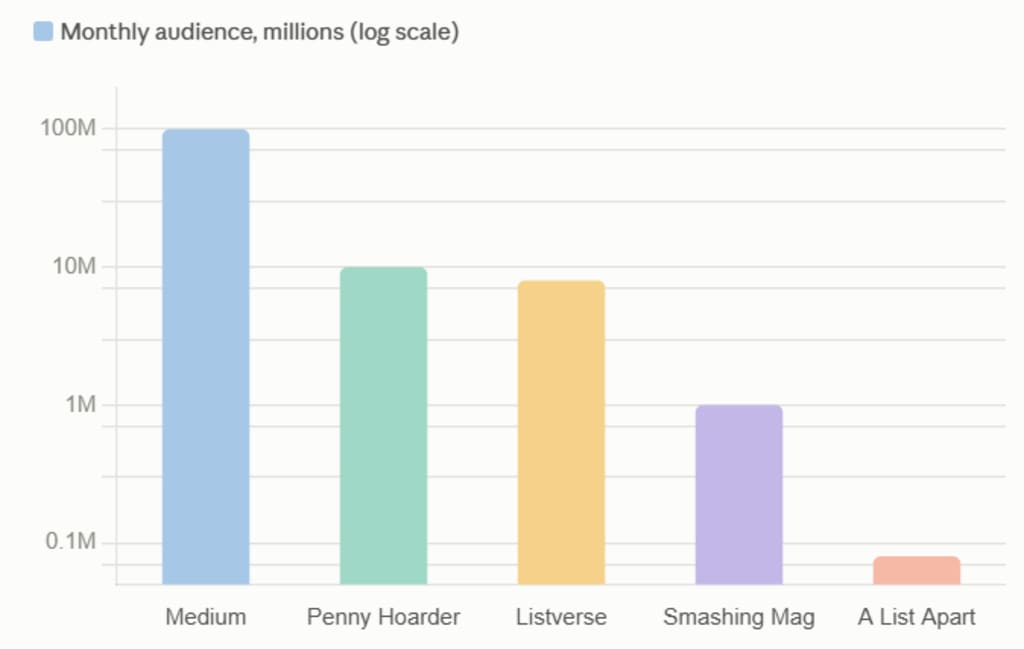
Reach: Medium pulls in roughly 100 million visits a month platform-wide, which is a bigger stage than every other site on this list combined
"Medium doesn't pay for views. What matters are the reading minutes from paying members."
That's the one sentence I'd want every new Medium writer to actually absorb before publishing their first post.
2. Listverse — the fastest $100 on this list
If you want proof that you don't need a portfolio to get paid for writing, Listverse is it. Submit a list-style article — minimum 10 items, usually 1,500 to 2,000 words, on something genuinely odd, obscure, or unsettling — and if it's accepted, you get a flat $100 via PayPal. No pitching required first. No experience required either.
The catch is that "accepted" is doing a lot of work in that sentence. Your English needs to read as close to native-level as possible, the idea has to feel fresh rather than recycled, and Listverse is explicit about what it doesn't want: no sports, no self-help, no personal essays, no straight opinion pieces. It wants weird, well-researched, and genuinely entertaining.
Payout: a flat $100 per accepted list, paid through PayPal
Best for: beginners who want a real byline and real payment without needing clips first
Reach: around 8 million monthly readers, which is a surprisingly large audience for a site most people outside the "get paid to write" niche have never heard of
My honest take: this is one of the best low-barrier entry points into paid writing that still exists. I'd genuinely recommend it to someone who's never been paid for an article before.
3. Smashing Magazine — where technical writers actually get respected
Smashing Magazine has been one of the most consistent names in web design and front-end development publishing for close to two decades, and in 2026 it's still publishing new, dense, genuinely useful articles multiple times a week — I checked, and their most recent pieces were covering everything from AI labeling rules under new EU guidelines to dependency auditing for modern browsers.
They pay contributors an honorarium, commonly cited around $200 per article, though the exact figure isn't posted publicly and can vary by piece. What is public is the bar: they want first-person accounts backed by real code, real statistics, and real project experience, not surface-level "10 tips" content. Every article needs two positive internal reviews before it gets published, so this isn't a fast or casual process.
Payout: an honorarium per article, typically cited around $200
Best for: developers, designers, and UX writers with genuine hands-on experience to share
Reach: over a million monthly pageviews, plus a large newsletter and RSS audience on top of that
If you can write with real technical depth, I think this is one of the more prestigious bylines a developer-writer can add to their name.
4. A List Apart — a legendary name that's shrunk a lot
I want to be honest about this one, because I think it gets recommended out of habit more than current reality. A List Apart was, for a long time, one of the most influential web design publications on the internet, and it historically paid around $150–$200 per article. It's technically still alive in 2026 — I found new pieces published as recently as June — but it now publishes only a handful of articles a year, has been "reimagined" as a more community-volunteer-driven magazine, and its current traffic sits at roughly 77,000 monthly visitors, a tiny fraction of what it once commanded.
That doesn't mean it's worthless to pitch. The prestige and the editorial polish are still real, and having your name on A List Apart still means something to people in the web design world. But I wouldn't count on it as reliable income in 2026, and I'd confirm current payment terms directly before investing serious time in a pitch.
Payout: historically $150–$200 per article; confirm current terms before pitching
Best for: in-depth, expert-level design and UX analysis — not surface-level tips
Reach: a much smaller, niche audience now, down from its earlier heyday
5. The Penny Hoarder — the biggest audience on this list, after Medium
The Penny Hoarder is a personal finance site that genuinely reaches millions of people every month — think somewhere around 5 million readers and 10 million monthly pageviews. For freelance contributors, typical accepted articles pay somewhere in the $75–$200 range, though stronger feature pitches with real reporting have reportedly paid as much as $800.
What actually gets accepted here isn't generic "10 ways to save money" content. Editors consistently favor pieces anchored in a real, specific personal example — an actual budgeting decision, an actual side hustle, an actual mistake you made and fixed — over generic advice.
Payout: roughly $75–$200 typically, up to $800 for standout feature pitches
Best for: saving, earning, budgeting, and side-hustle writing grounded in real experience
Reach: around 5 million readers and 10 million-plus monthly pageviews
"Real-life example se start karo. Generic top 10 avoid karo."
Honestly, that instinct applies far beyond just this one site — it's the difference between a forgettable pitch and one an editor actually remembers.
How the numbers actually compare
The chart above shows roughly how far each platform's audience reaches every month — Medium dwarfs everything else here, which is exactly why "no fixed payout" doesn't mean "no potential."
And here's the payout side: for the sites that pay a flat rate per accepted piece (Medium doesn't, since it runs on reading-time revenue share instead), here's what a single accepted article is typically worth.
Bonus options worth knowing about
A few more names worth having on your radar, even though they didn't make my main five:
Creative Circle isn't a pitch-a-story site — it's a staffing agency that places copywriters and technical writers into contract gigs, commonly around $60–$70 an hour. Different model entirely, but worth knowing if you want steadier work.
One Story pays a flat $500 plus 25 contributor copies for a single piece of literary short fiction (3,000–8,000 words). It's a small, prestigious literary magazine with a circulation of around 15,000, and a genuinely high proportion of its published stories go on to win awards.
Copyblogger has shifted more toward being a resource and community for copywriters than a straightforward paid-contributor pipeline these days. I couldn't find current public rates for outside contributors, so I'd check their latest guidelines directly rather than assume a number.
My actual advice before you pitch anywhere
Check each site's current contributor or "write for us" page yourself. Every rate in this article was accurate as of when I checked, but these things shift constantly, especially Medium's.
You don't need a portfolio to start. Listverse and Medium both prove that a strong idea, written cleanly, gets you in the door.
Be wary of anything offering "exposure" instead of payment. Every site on this list pays real money, and that's exactly why I picked them.
If I had to start from zero tomorrow with no clips and no following, I'd open a Medium account the same day and submit a Listverse list the same week. Everything else on this list is worth building toward, not necessarily where I'd start.
What do you write, or want to write — tech, personal stories, finance, or lists? I'm happy to go deeper on a pitch angle for whichever one fits you.
About the Creator
Enjoyed the story? Support the Creator.
Subscribe for free to receive all their stories in your feed.
Comments
There are no comments for this story
Be the first to respond and start the conversation.