
4-Vinylphenol: A Practical Guide to a Small Molecule in Polymer and Photoresist Chemistry
Why this phenolic monomer matters in functional resins, electronic materials, coatings, and advanced chemical research

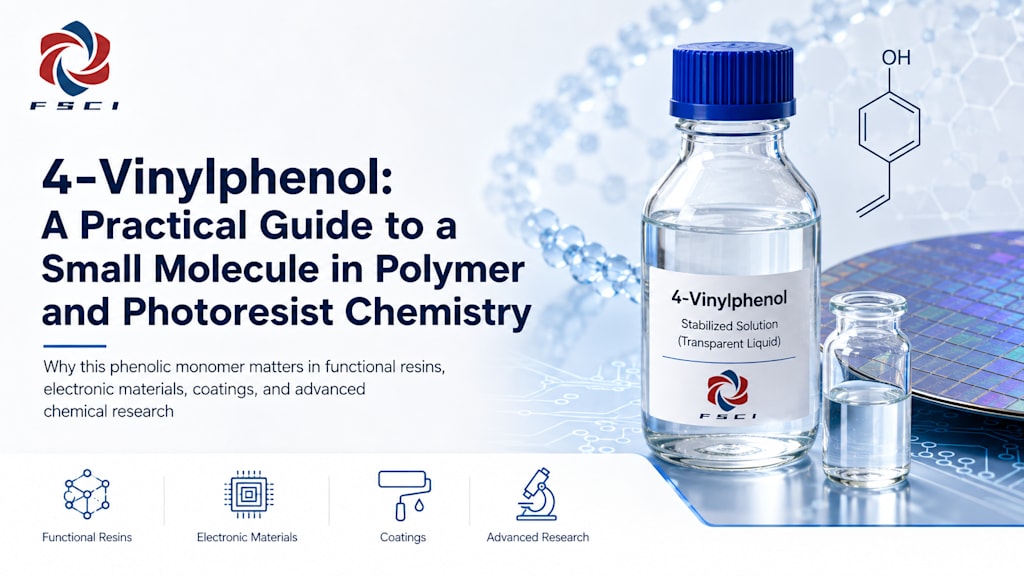
4-Vinylphenol is one of those chemical names that may seem unfamiliar outside a laboratory, yet it belongs to a very important corner of modern material science. Also known as p-hydroxystyrene, this molecule combines two useful structural features: a vinyl group and a phenolic hydroxyl group. That combination makes it valuable in polymer chemistry, electronic materials, specialty resins, coatings, and research related to photoresist systems.
To understand why 4-Vinylphenol matters, it helps to look at its structure. The vinyl group gives the molecule the ability to participate in polymerization, while the phenolic group adds chemical functionality that can influence solubility, adhesion, reactivity, and interaction with other materials. In simple terms, this molecule is not only something that can become part of a polymer chain. It also brings a functional surface character into that polymer.
This is one reason 4-Vinylphenol has long been discussed in relation to functional polymers. Many ordinary polymers are valued for strength, flexibility, or processability, but advanced polymers often need more than basic mechanical behavior. They may need to respond to light, bond to surfaces, resist certain chemicals, or interact with other components in a controlled way. Phenolic monomers can help create these more specialized properties.
One of the most important areas connected with 4-Vinylphenol is photoresist chemistry. Photoresists are light-sensitive materials used in microfabrication, including semiconductor and electronic component manufacturing. They are designed to change their solubility or structure when exposed to light through a patterned mask. This allows tiny patterns to be transferred onto surfaces. The public usually sees only the finished electronic device, but behind that device is a long chain of materials that must behave with extraordinary precision.
In many photoresist-related systems, polymer design is critical. The polymer must form a smooth film, respond predictably during exposure, and develop cleanly in the next step. A small change in polymer structure can affect sensitivity, resolution, adhesion, or processing window. Because 4-Vinylphenol contains a phenolic group, it can contribute to polymers that interact with developers, crosslinkers, or other formulation components. This makes it interesting for research and specialized resin design.
However, it would be too simple to describe 4-Vinylphenol only as a photoresist material. Its value is broader than that. In polymer science, it can be used to create poly(4-vinylphenol) and related copolymers. These materials may be studied for coatings, adhesives, electronic interfaces, ion-binding behavior, and functional surfaces. The phenolic group gives researchers a chemical handle that can be modified, protected, deprotected, or used to form interactions with other substances.
Coatings are another field where this kind of chemistry can matter. A coating is not only a layer of material placed on a surface. It must spread properly, adhere well, resist damage, and sometimes interact with light, heat, or chemicals. Functional phenolic polymers can help improve surface behavior or provide reactive sites within the coating. In this sense, 4-Vinylphenol acts less like a finished product and more like a building block for designing a better material.
The same idea applies to adhesives and interfacial materials. Many modern devices and products rely on controlled interfaces. Two surfaces may need to bond, repel moisture, conduct signals, or remain stable under heat. The chemistry at that boundary can determine whether a material system performs well or fails. Since phenolic groups can form hydrogen bonds and interact with different surfaces, polymers derived from 4-Vinylphenol can be useful in studies of adhesion and compatibility.
Another reason this molecule attracts attention is its relationship with protected derivatives. In some synthetic routes, the phenolic hydroxyl group may be temporarily protected to improve handling or control polymerization behavior. Later, the protective group can be removed to reveal the phenolic function. This strategy is common in fine chemical and polymer design, where timing matters. Chemists often need a molecule to behave one way during synthesis and another way after the final structure is formed.
From a practical selection perspective, 4-Vinylphenol should be understood as a reactive monomer rather than an ordinary stable additive. Monomers can polymerize under certain conditions, especially when exposed to heat, light, oxygen, or unsuitable storage environments. This means stability, inhibitor content, storage temperature, and handling conditions can all influence how the material performs. A material that looks correct by name may behave differently if it has partly polymerized or degraded during storage.
This is why careful evaluation matters in real laboratory use. Researchers usually pay attention to appearance, purity, inhibitor level, moisture content, and storage history. For polymerization work, consistency is especially important. A small variation in monomer quality may affect molecular weight, conversion, color, or final polymer performance. In advanced materials, these details are not minor. They can shape the entire result of an experiment or formulation.
Handling practices are also part of the story. Like many phenolic and vinyl compounds, 4-Vinylphenol should be treated with proper laboratory care. Clean containers, controlled exposure, suitable temperature, and attention to ventilation are all important. This does not make the material unusual; it simply reflects the reality of working with reactive fine chemicals. Useful chemistry often requires respectful handling.
The broader lesson of 4-Vinylphenol is that small molecules can shape very advanced technologies. A single monomer may help define how a polymer dissolves, adheres, reacts, or forms a film. Those properties may later influence coatings, electronic materials, photoresists, or specialty resins. The final product may look like a smooth film, a patterned surface, or a stable coating, but its behavior begins at the molecular level.
For readers who want a focused material reference, 4-Vinylphenol is commonly introduced as a phenolic monomer used in functional polymers, photoresist-related resins, coatings, and advanced chemical research. Its importance comes from the combination of polymerizable vinyl chemistry and reactive phenolic functionality.
What makes 4-Vinylphenol especially interesting is that it sits between simple organic chemistry and highly engineered materials. It is not the final electronic device, the final coating, or the final resin system. Instead, it helps create the molecular framework that allows those materials to exist. In modern chemistry, this kind of supporting role is often where the real value begins.
As industries continue to demand materials that are thinner, cleaner, more precise, and more functional, monomers like 4-Vinylphenol remain relevant. They give chemists a way to build polymers with more intentional behavior. They connect the structure of a small molecule with the performance of a finished material. That quiet connection is why 4-Vinylphenol continues to matter in polymer science and advanced material design.
About the Creator
Enjoyed the story? Support the Creator.
Subscribe for free to receive all their stories in your feed.
Comments
There are no comments for this story
Be the first to respond and start the conversation.