
💥 26 DEAD, 61 INJURED: A Massive Explosion Rips Through China’s Fireworks Capital — And the Investigation Is Just Beginning
In the city where firecrackers were invented over 1,000 years ago, an explosion so powerful it leveled the factory has left a nation in shock and its president demanding answers.
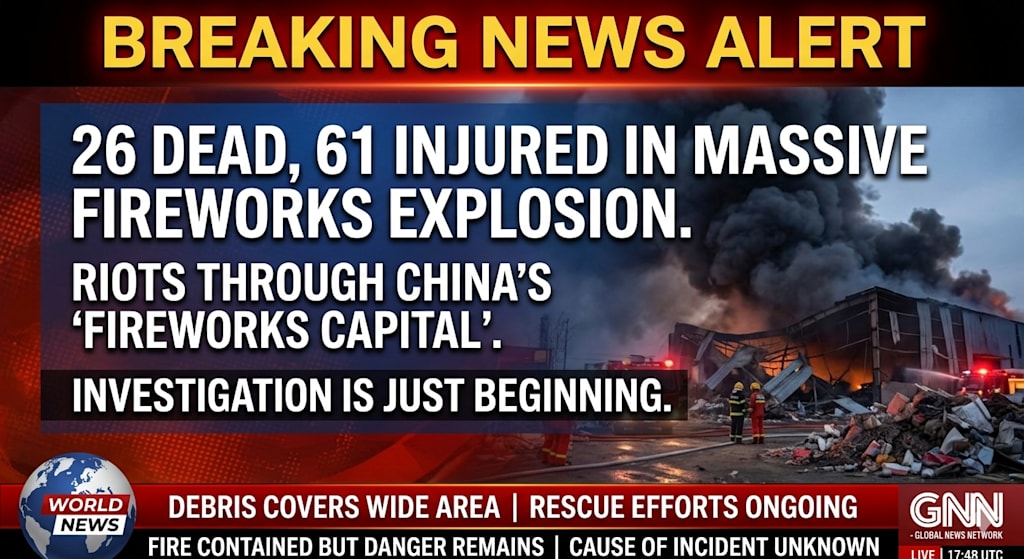
A Massive Explosion Rips Through China’s Fireworks Capital, Killing 26, Leaving 61 Injured — And the Investigation Is Just Beginning
In the city where firecrackers were invented over 1,000 years ago, an explosion so powerful it leveled the factory has left a nation in shock and its president demanding answers.
At 4:43 p.m. on Monday afternoon in Liuyang — a county-level city in China’s Hunan Province that is the undisputed global capital of fireworks production — a fireworks plant exploded. Not with a pop or a crackle, but with a blast so powerful it collapsed walls, columns, and the factory roof, trapping workers beneath tonnes of rubble. Semi-finished products and raw gunpowder ignited in a chain of continuous, sporadic secondary explosions that hampered rescue efforts for hours. Hundreds of rescuers deployed. Three bomb-disposal robots were brought in. Spraying and humidification systems were activated to suppress additional ignition risks.
The blast occurred at the Huasheng Fireworks Manufacturing and Display Co., killing at least 26 people and injuring 61 others — prompting a halt to all firework manufacturing near the site.
A State Council investigative team will be established to thoroughly examine the causes of the explosion. Zhang Guoqing, a member of the Politburo of the Communist Party of China and vice premier, traveled to Liuyang on Tuesday to oversee emergency rescue and response operations in person. Chinese President Xi Jinping called for a thorough investigation and strict accountability. The Changsha mayor personally appeared at a media briefing, expressed condolences, and apologized to society — a remarkable, public act of governmental contrition.
Ding Weiming, the Changsha Emergency Management Bureau’s party secretary, said the site had a large amount of products and semi-finished products catching fire, causing continuous, sporadic blasts. Large quantities of gunpowder in the warehouse area also threatened the safety of rescue teams, while the collapse of walls, columns, and the factory roof created ruins with people trapped and routes blocked.
Liuyang’s significance to global fireworks cannot be overstated. The Guinness World Records organization attributes the invention of the Chinese firecracker to Li Tian, a monk who lived near Liuyang during the Tang dynasty, around 618–907 CE. In the millennium-plus since, Liuyang has grown into an industry that supplies the world. Last year, China exported $1.14 billion worth of fireworks — more than two-thirds of global sales. Liuyang accounts for the overwhelming majority of that output. The city’s factories line the surrounding hills; its workers have spent generations mastering the volatile chemistry of controlled explosions.
That mastery has limits. This was not the first disaster in Liuyang’s recent history. In February 2026 alone, two deadly explosions struck fireworks shops around the Lunar New Year period across China. The industry’s extraordinary scale — and the inherent volatility of its raw materials — creates persistent, systemic risk. All fireworks and firecracker manufacturers in Liuyang have been ordered to halt production as the investigation continues. Aerial footage from state broadcaster CCTV showed white smoke still billowing from areas of the collapsed site on Tuesday, with rescue robots navigating the ruins while families waited outside for news.
The State Council investigation will examine compliance records, safety protocols, storage regulations, and whether local authorities had overlooked warning signs. Xi Jinping’s explicit demand for “strict accountability” signals that prosecutions of factory management and potentially local officials are likely. China’s industrial safety record has improved over recent decades, but the fireworks sector — given its fundamental reliance on explosive materials — remains one of the most dangerous in the country. For the 26 families now mourning, and the 61 injured workers in hospitals across Hunan, those statistics provide cold comfort.
About the Creator
Enjoyed the story? Support the Creator.
Subscribe for free to receive all their stories in your feed.
Comments
There are no comments for this story
Be the first to respond and start the conversation.