
26 Dead. 61 Injured. A Massive Explosion Just Destroyed China's Fireworks Capital — and Xi Jinping Is Demanding Answers
At 4:43 p.m. on Monday, a blast ripped through the world's most famous fireworks factory in Liuyang, Hunan — a city that has made fireworks since the Tang dynasty. The shockwave shattered windows for kilometres. Robots are searching the rubble. The death toll is still rising.
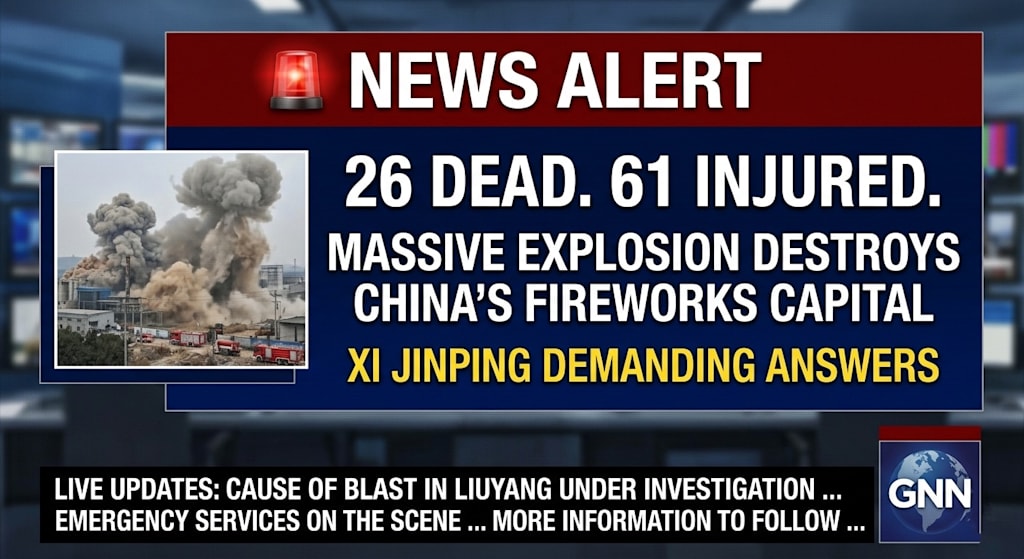
Liuyang, a county-level city in Hunan Province, central China, is not just a place where fireworks are made. It is the place where fireworks were born. According to Guinness World Records, the Chinese firecracker was invented by a Buddhist monk named Li Tian near Liuyang during the Tang dynasty, around 618 to 907 CE. For over a thousand years, the city has been synonymous with explosive artistry — producing the pyrotechnics that light up Olympic ceremonies, New Year celebrations, and national spectacles around the world. On Monday afternoon, May 4, 2026, at precisely 4:43 p.m. local time, an explosion at a Liuyang fireworks factory killed at least 26 people, injured 61 others, and reduced a major production facility to rubble visible from aerial drones.
The blast occurred at the Huasheng Fireworks Manufacturing and Display Company, located in Guandu Township on the outskirts of Liuyang. The explosion's shockwave was powerful enough to shatter windows in buildings for a significant radius around the plant and cause structural damage to nearby facilities. State broadcaster CCTV's aerial footage on Tuesday morning showed white smoke still billowing from multiple locations across the destroyed site, with production buildings collapsed inward and perimeter walls blown outward. Nearly 500 rescue workers were deployed to the scene within hours of the blast, joined by three search-and-rescue robots designed to navigate dangerous rubble that human teams cannot safely enter. Residents within a three-kilometre radius of the facility were evacuated.
"All-out efforts must be made to search for the missing and save the injured." — Chinese President Xi Jinping, May 5, 2026
Chinese President Xi Jinping responded swiftly and publicly, demanding "all-out efforts" to search for those still unaccounted for and to save the injured. He ordered authorities to investigate the cause of the blast swiftly and pursue "serious accountability," and called for effective risk screening and hazard control across key industries nationwide. Police moved quickly to detain the person in charge of the Huasheng company. Changsha Mayor Chen Bozhang — Liuyang is administered by Changsha — said search and rescue had been largely completed, but that casualty verification and victim identification remained ongoing. A second round of searches raised the confirmed death toll from 21 to 26 before noon Tuesday.
The cause of the explosion is under active investigation. Fireworks manufacturing is inherently dangerous — facilities store massive quantities of black powder, oxidisers, metallic compounds, and assembled pyrotechnic devices in conditions that must meet strict safety protocols to prevent chain-reaction ignition. Authorities cited concern about two black powder warehouses adjacent to the primary explosion site and took special precautions during rescue operations, including spraying and humidification measures to prevent secondary detonations. Whether a human error, equipment failure, or safety violation triggered the initial blast had not been confirmed as of Tuesday morning.
China has a long and troubled history of industrial accidents in hazardous manufacturing sectors, including fireworks. The country has experienced numerous deadly explosions at fireworks factories over the decades, prompting periodic rounds of regulatory tightening and enforcement campaigns. In 2015, a chemical plant explosion in Tianjin killed 173 people and exposed severe failures in industrial safety oversight. Xi's call for "serious accountability" echoes the language used after every major industrial disaster — language that typically results in prosecutions at the managerial level but rarely addresses the systemic pressures of production targets, cost-cutting, and regulatory capture that create the conditions for such accidents.
For the families of Liuyang — a city of approximately 1.4 million people whose entire economic identity is bound to the fireworks industry — the explosion is both a tragedy and an existential question about the industry's future. Liuyang produces a significant share of all fireworks used globally; its products have been exported to over 100 countries. The Huasheng company specifically handled both manufacturing and display work, meaning the people who died on Monday were likely the same artisans who created the shows that made international audiences gasp in wonder. The irony is almost too painful to state: the people who made the world's celebrations happen cannot celebrate anything tonight.
Xi Jinping's call for accountability will be watched carefully, but the deeper question — how many more workers must die before China's hazardous industries are reformed from the ground up — remains unanswered, as it has been after every explosion that came before.
About the Creator
Enjoyed the story? Support the Creator.
Subscribe for free to receive all their stories in your feed.
Comments
There are no comments for this story
Be the first to respond and start the conversation.