
163 Yen: When a Nation Stops Pretending Everything Is Fine
At a forty-year low, Japan’s currency isn’t just a number — it’s the quiet unraveling of a system that forgot how to feel pain.
(July 2026 · In‑Depth Analysis)
I. The Dawn When No One Read from the Script
In 2026, the yen fell below 163 against the dollar. The headlines called it a “40‑year low,” but when that number was actually spoken aloud, in an office near Nihonbashi in Tokyo, a central bank official turned off his screen, walked to the window, and stood there for about thirty seconds. He didn’t sigh. He didn’t slam the desk. He came back, picked up the next document, and kept reading. That evening, he left work eleven minutes earlier than usual, the only time in the past three months that had happened.
That detail matters as much as the exchange rate itself. Because when you ask “what’s wrong with Japan,” what you’re really asking is: what happens to a system that has been chronically overloaded for so long that its people start reacting like ordinary human beings again? A system doesn’t collapse from a number. It collapses from the moment people stop pretending everything is normal.
In July 2026, the yen hit 163.17 against the dollar. That was the same figure reached in 1986, after the Plaza Accord. But Japan in 1986 had a higher GDP per capita than the United States, produced half the world’s semiconductors, and exported nearly 7 million cars a year. Japan in 2026 ranks last in G7 GDP per capita, has lost its semiconductor lead to Taiwan and South Korea, and for the first time exports fewer cars than China—which is now exporting electric vehicles.
Same number, forty years apart. Forty years is long enough for a newborn to reach middle age. And long enough for a manufacturing empire to turn into a debt laboratory.
II. Six Gears, None of Them Stopped
If you want to understand how 163 happened, don’t look at “market sentiment” in the headlines. Look at six interlocking gears.
Gear One: The Interest Rate Gap. The Federal Reserve’s rate is above 5%. Japan raised to 1%. The remaining 400 basis points are the profit margin on carry trades. Global funds borrow yen, buy dollars, and pocket the spread. This isn’t speculation. This is arithmetic. At an internal meeting in May 2026, Bank of Japan Governor Ueda Kazuo said something that later leaked out through “informal channels.” He said: “Nothing we do now changes that gap.” The remark never made it into the minutes. But it circulated in Tokyo financial circles for two full weeks.
Gear Two: The Fiscal Spiral. Japan’s government debt is 261% of GDP. A 1% rate hike adds roughly 9.8 trillion yen in annual interest payments. That’s 1.3 times the entire annual budget of the Ministry of Education, Culture, Sports, Science and Technology. At a budget coordination meeting in April 2026, a section chief from the Ministry of Finance said to his counterpart from the Ministry of Defense: “It’s not that we don’t want to give you the money. It’s that if we do, interest payments will exceed social security spending.” The reply came back: “That’s your problem.” The section chief said nothing. He looked down at the calculator in front of him. The screen was blank. He had forgotten to press the numbers.
Gear Three: The Myth of the Internal Creditor. Ninety percent of Japanese government bonds are held by domestic institutions, which leads many economists to say “it’s fine—the money is owed to ourselves.” But in 2025, the Japanese Agricultural Cooperatives (JA Group) suffered massive losses from US Treasury derivatives, and regional banks saw their bond portfolios swell with unrealized losses due to rising long‑term rates. These institutions began tightening credit to small and medium‑sized enterprises. The chain goes like this: the government owes the banks; the banks can’t collect; so the banks stop lending to factories; the factories run out of working capital and close; workers lose their jobs; tax revenue falls; the government needs to borrow even more. It’s a closed loop, and every link is accelerating.
Gear Four: Capital Flight. Japan’s real interest rate (nominal rate minus inflation) is negative. The yen is depreciating, inflation is rising, and keeping money in a Japanese bank means losing more than 2% of its value every year. So pension funds, insurance companies, and even retail investors are buying US stocks through NISA accounts. In 2025, Japan’s net outbound portfolio investment exceeded 20 trillion yen. This isn’t “hot money fleeing.” It’s a national asset migration. A financial advisor in Tokyo put it this way: “I haven’t recommended a yen‑denominated asset in six months. Clients ask me why. I tell them to open their phones, look at last month’s electricity bill, then look at the price of baby formula, and then tell me whether they want to hold yen or dollars.”
Gear Five: Imported Inflation. Japan’s energy self‑sufficiency is 11%. Its calorie‑based food self‑sufficiency is 38%. When the yen drops 10%, import costs rise 10%. Those costs eventually land on small and medium‑sized businesses. Large corporations can hedge through overseas factories, but 900,000 SMEs across the country don’t have that option. In the first half of 2026, the number of bankruptcies caused by an inability to pass on raw material costs already exceeded the total for all of last year. On a shopping street in Osaka, three stores closed in six months. One of them was a ramen shop. The owner posted a handwritten notice on the door on his last day: “Thank you for 45 years. It’s not that I didn’t want to keep going. I just couldn’t make the numbers work on the broth anymore.”
Gear Six: The Intervention Trap. Japan does have foreign reserves. It just doesn’t dare use them. A large‑scale sale of US Treasuries to buy yen would trigger an immediate phone call from the US Treasury. In March 2026, Japan conducted a small intervention—about 3 trillion yen, less than 5% of average daily market turnover. The effect lasted less than 48 hours. A former Ministry of Finance official said in an anonymous interview: “The largest intervention we can do is basically just sending a signal. But the market isn’t watching signals anymore. The market is watching US Treasury yields.”
Six gears. Each one turning. Together, they point in only one direction.
III. 1985 vs. 2026: The Same Mirror Reflects Two Different Countries
In September 1985, Japan was the country forced to sign an agreement. The US wanted the yen to appreciate because Japanese goods were too cheap and American factories couldn’t compete. By July 1986, the yen had climbed to 163. Japanese business leaders were furious—the stronger yen would hurt exports—but ordinary people were happy. Vacations to Hawaii became cheaper. Imported cars became cheaper. That was still a country with room for “ordinary people being happy.”
In July 2026, the yen sits at 163 again. This time, no one is happy. Because imported oil, gas, grain, animal feed, and pharmaceutical ingredients are all more expensive, while exported cars, electronics, and precision instruments are being replaced simultaneously by products from China, South Korea, and Taiwan. Japan posted a trade deficit of 5.5 trillion yen in 2025—the fifth consecutive year in the red. Export volume itself hasn’t dropped sharply, but import volume has soared, squeezed from both sides by a weaker settlement currency and physical shortages.
Same number. In 1985, it was “being forced to appreciate.” In 2026, it’s “being forced to depreciate.” The first was surgery. The second is a degenerative disease.
IV. Two Positions, One Patient
If you’re writing about Japan today, you can’t avoid two positions.
The critic’s voice says this:
The rate hike came too late. When the Fed raised rates in 2023, Japan should have exited negative interest rates immediately. Waiting until 2025—after core CPI had stayed above 3% and real wages had fallen for 24 consecutive months—meant missing every single window. Fiscal and monetary policy are pulling in opposite directions: the central bank hikes rates while the government expands military and childcare spending, all financed by new deficit bonds. SME relief is purely performative—the “price pass‑through support” application takes three months and pays less than a month’s electricity bill. And the most fatal mistake is on the diplomatic front: right‑wing politicians have deliberately cut off any possibility of improving relations with Japan’s largest trading partner. This is not force majeure. This is strategic laziness.
The critic’s final judgment: “Japan isn’t incapable. It’s afraid. And it’s afraid because it doesn’t want to feel pain.”
The structuralist’s voice says this:
It wouldn’t matter who sat in that chair. The median age is 48. The working‑age population shrinks by half a million every year. Domestic demand is contracting physically. Global commodity pricing is not in Tokyo’s hands—the Ukraine war, Middle East tensions, and OPEC+ production cuts are none of them controllable from Japan. Yes, internal creditors carry risk, but as long as the central bank continues unlimited JGB purchases, long‑term yields can be contained, and commercial financial institutions won’t collapse in the short term. Capital flight isn’t a lack of patriotism—it’s rational choice. The GPIF (the world’s largest pension fund) allocates half its assets overseas to cover aging‑related payout peaks. Retail investors buy US stocks because there are no yield‑bearing assets at home. Reducing structural problems to political cowardice is a cheap form of moral criticism.
The structuralist’s final judgment: “Everything Japan is doing now is adjusting its posture during a controlled descent, trying to make the landing hurt a little less.”
Both positions have merit. Both are partial. The critic overestimates the room for “choice.” The structuralist underestimates the cost of “inertia.”
V. This Isn’t Fiction, But There Is Still a Dark Night
Following the narrative arc, this is where the “dark night” belongs.
For Japan, the dark night isn’t a specific date. It’s an evening in April 2026, when a light stayed on in a Ministry of Finance office until 2 AM. An official stood in front of a printer for a long time. The machine was printing next year’s debt service projections, one page every ten or twelve seconds. He didn’t flip through them quickly. He didn’t sigh. He didn’t mutter to himself. He just stood there, flipping, stacking them on the left, waiting for the next sheet.
The next morning, he said to his superior: “Can we extend the maturity on government bonds to 60 years?” He asked it calmly. Because he already knew the answer: “yes, but what would the market think?” He also knew his superior would say “let’s wait and see.” And he knew how many times “let’s wait and see” had been said over the past decade.
The nature of a dark night is this: you know what the right thing is, but you can’t do it, so you do something else, something you know is only a painkiller.
In May 2026, Japan conducted a secret currency intervention. Very small. Very brief. Very weak. But the market caught the signal and read it as “the authorities are panicking.” So the market sold even harder. This wasn’t a misreading. It was an action that carried the opposite message by its very existence. Like a drowning man reaching out his hand: those on shore see “he still has strength,” when in fact that gesture is already his last reserve.
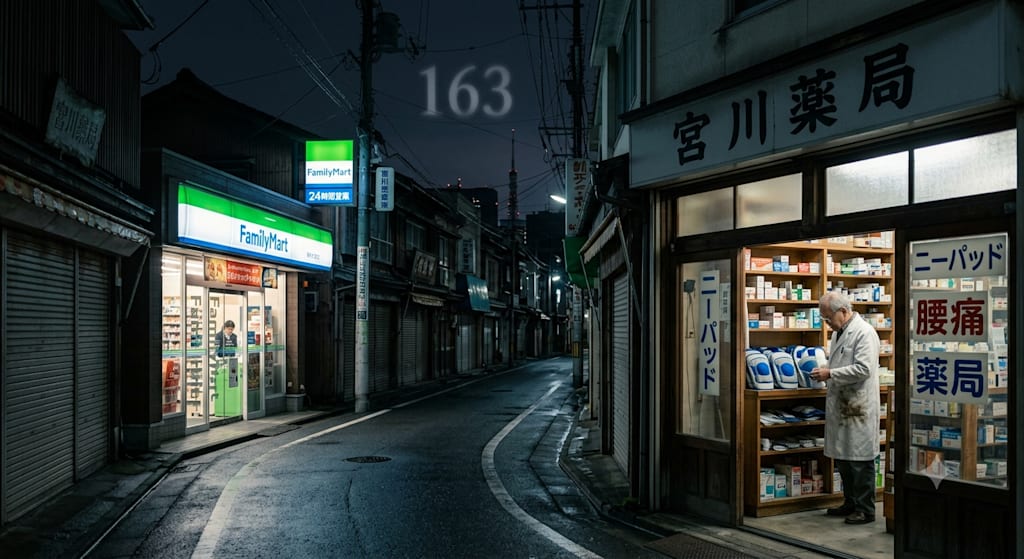
VI. Three Shops, One Convenience Store, One Pharmacy, One Pair of Knee Pads
If there’s one image from this piece that I hope stays with you, it’s this:
Niigata Prefecture. A local shopping street. Wednesday, 3 PM. Not a holiday. Nothing out of the ordinary. Two stores are open: a convenience store and a pharmacy. The pharmacy owner is stocking a new shipment of knee pads on the shelf. He’s alone. No one comes in. No one walks by. Not even a single car passes down that street. After arranging the knee pads, he says to them: “Dropped in price again.” Just that one sentence. It’s the first time he’s spoken to anyone today. And the person he spoke to was a row of knee pads.
This is the real face of Japan at 163. Not the trading floors of Tokyo. Not the conference rooms of the Ministry of Finance. Not the press conferences at the Prime Minister’s office. It’s an owner on an empty shopping street, talking to a shelf of knee pads.
Empty daily life is more honest than any data.
VII. Conclusion: Don’t Summarize. Do One Thing.
The narrative framework demands that the ending shows change through action, not through verbal promise.
So this is not the place to write “what Japan should do.” Instead, here is one small, real action:
In June 2026, a well‑known economist who had argued in 2023 that “Japan doesn’t need to raise rates—inflation is imported, let’s wait and see” deleted the core paragraph from that earlier paper in his latest publication. He didn’t write a separate “I was wrong” article. He simply added a footnote in the new paper: “Previous analysis underestimated the impact of exchange rate pass‑through on SME liquidity.” Then he used three paragraphs to recalculate a model: if 0.5% of GDP were allocated annually to retraining programs in AI‑assisted manufacturing and biomaterials, how many jobs lost to traditional industry contraction could be recovered over a decade?
The number: roughly 420,000.
That number isn’t “hope.” It’s not large enough. But it’s a specific number in place of an abstract slogan. The action itself—deleting the old passage, writing the new calculation—is the entirety of how one person acknowledges the past and faces the future.
A country is no different.
163 is not the end. It’s just a milepost. There’s 170 ahead. And 180. The real question isn’t where the exchange rate stops. The real question is: when it finally stabilizes, will that shopping street still be there? Will the pharmacy owner, besides knee pads, have anything left to put on the shelves?
The answers to these questions are not in the central bank governor’s speeches. They’re in the unsettlingly specific numbers—and in what the people who stood in front of a printer until 2 AM, who stared at a blank calculator, who talked to a row of knee pads, do next.
What they do matters more than what they say.
About the Creator
Jin
Writer of reamstories
https://reamstories.com/jin
Enjoyed the story? Support the Creator.
Subscribe for free to receive all their stories in your feed. You could also become a paid subscriber, letting them know you appreciate their work.
Comments
There are no comments for this story
Be the first to respond and start the conversation.