
11.6 Million Views, Zero Downloads: The Three Founders Who Proved Traffic Doesn't Pay the Bills
A story about why the video with 370 views made money, the one with 11 million didn't, and what that means for anyone trying to sell something online.
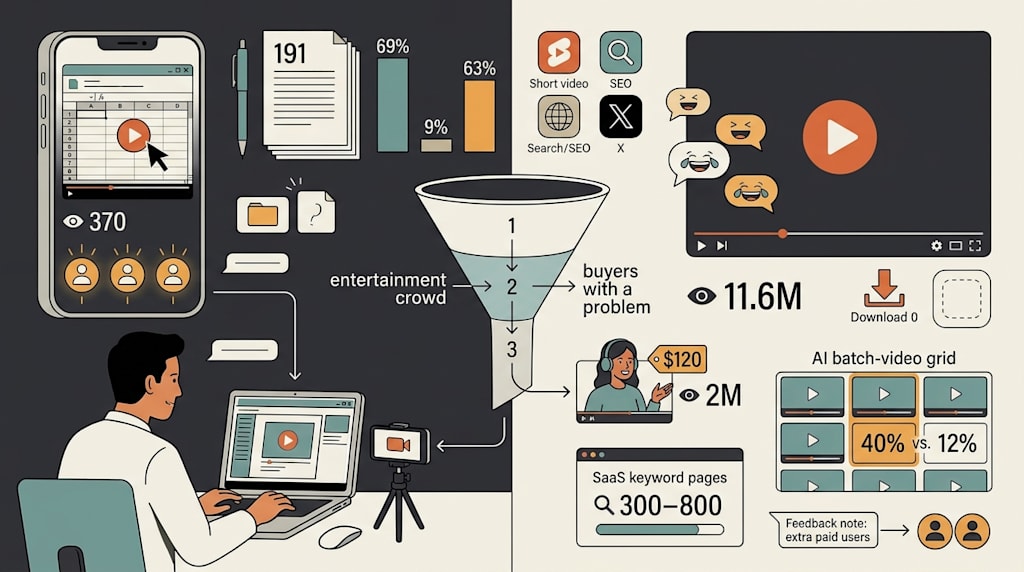
A software founder uploaded a YouTube video. It was a screen recording. A user dragged a messy spreadsheet into the product. The product reformatted it into a standard layout. The user exported it. No face on camera. No background music. The only voiceover line was “link in the description.”
The video got 370 views. Three people clicked the payment button.
Another founder posted a video for a mobile app. It reached 11.6 million views. The video had a storyline, a twist, and viewers laughing in the comments. The product interface never appeared. No voiceover said “download link in the description.” No frame suggested the video had anything to do with an app.
People watched. They swiped away. They kept scrolling. Backend downloads barely moved.
A third founder posted a video with 1,800 views. It generated about 80% of the revenue from one product launch. On the same launch, his Twitter post got 30,000 impressions and contributed about 20% of revenue.
The three cases are not a controlled experiment. They come from interviews with different founders. Put side by side, they make one thing hard to ignore: view count does not explain downloads.
A company called GetYouTubeTranscript pulled subtitles from 191 Starter Story founder interviews and used AI to organize them around the same questions. What do these founders sell? Where does revenue come from? How did they find their first customers? Which channels worked? Which failed?
The sample is not random. These are success stories already selected by Starter Story. The company doing the research sells a subtitle tool, and the article is also a product demonstration. So this is not a statistical survey. It is a systematic review of successful cases.
Still, some numbers stand out.
Of 179 founders who clearly named their main customer acquisition channel, 124 relied mainly on organic acquisition, about 69%. Sixteen listed paid ads as their main channel, about 9%. And 113 said growth was mainly attributable to one core channel, about 63%.
The 370-view video came from a founder running a micro-SaaS business. The product did one job. The video showed that job. A spreadsheet went in. A clean file came out. The viewer did not need to know the founder’s name or care about his story. The viewer needed the spreadsheet fixed.
Three people paid. One of them sent feedback from inside the product: “Can you add a date format option to the spreadsheet export?”
The founder added it. The next month, two more paid users.
The 11.6 million-view video did a different job. In the interview, the founder said the video itself was entertaining. It had a story. It had a twist. People laughed in the comments. But the product never appeared. No voiceover pointed to a download link. Nothing in the video told viewers that an app existed.
Viewers watched, swiped, and kept scrolling.
The same study includes another case: a slideshow video with 120,000 views brought in eight or nine trials.
The reason people watch a video and the reason people buy a product are often not the same. You see a funny AI outfit-change video on Douyin. You laugh, like it, share it with a friend. That does not mean you need an AI outfit-change app. It certainly does not mean you will pay a monthly subscription.
Now imagine you are searching for “how to practice English speaking with my kid.” You find a video where someone demonstrates how a piece of software corrects pronunciation, gives feedback, and designs exercises. You may not share it. You will search for the product.
One video asks to be shared. The other asks to be remembered when someone has a problem.
For a small company with a limited monthly marketing budget, a million entertained viewers and a thousand people looking for a solution are two different calculations.
A founder sees someone doing well on Xiaohongshu and opens an account. He hears TikTok sells apps and hires someone to make videos. He reads a Reddit post and starts posting. Product Hunt has a launch event, so he joins. Three months later, he has a dozen posts across five platforms. None of his accounts has more than 500 followers. He cannot say which content worked or why users converted.
Many founders in the study went the opposite direction. They found one channel that matched the product and went deep. After customers started coming in steadily, they considered expanding.
For a team of two or three people, running five or six platforms at the same time means each platform gets two hours a week. That is not enough time to build useful experience. Putting the same hours into one channel that is already producing customers at least lets you see which piece of content brought which customer.
Organic acquisition does not mean zero cost. Shooting videos, writing articles, maintaining a community, and sending direct messages all take time. Some founders do not buy platform ads, but they pay small creators to collaborate.
Before the product has been proven to sell, using paid traffic to amplify an unproven marketing method wastes money twice.
When the study grouped founders by business type, the channels separated.
Among 50 mobile app cases, short video and paid creator collaborations each accounted for about 32%, making them the most frequently mentioned main channels. Among 54 SaaS cases, SEO was the most common at 24%. Among 26 AI tool cases, X/Twitter was mentioned most often, at about 19%.
Small sample. Descriptive results. Not a formula. But the differences track concrete user behavior.
A photo restoration app shows before-and-after comparisons. Viewers understand the value in three seconds. Short video fits. An AI outfit tool lets users upload a few clothes and generates outfits. The visual is direct. Short video fits.
A contract management SaaS is different. An ordinary person scrolling short videos will not suddenly decide to buy enterprise software because of one feature. The people who need it are on Google searching “automatic contract renewal reminders,” “customer contract renewal management,” or “alternative to X system.” One founder in the study looked for keywords with only 300 to 800 monthly searches and built a detailed page for each one. The search volume is small. The people searching are looking for a solution.
Consumer products show results on short-video platforms. Enterprise services answer specific questions in search, Zhihu, WeChat public accounts, and industry communities.
One app founder paid about $120 to a small streamer to make a product-use video. The video got about 2 million views. Another founder paid $50 to two small creators. On the first day of launch, the product got about 45,000 downloads.
When they chose creators, follower count was not the first criterion. An app that helps athletes manage training does not need a fitness star with millions of followers. A creator with a few thousand followers who posts daily about a specific sport’s training experience may have the precise audience. The video may be rough. Viewers believe: this person has the same training problem I have.
There are failure cases too. One founder paid an influencer to make a video. The views were good. Sales were almost zero. When he asked the influencer for conversion data, the influencer only had platform backend view counts. The money was spent. He had no idea which piece of content brought which purchase.
The useful question is what you want a viewer to do after the video ends. Follower count does not answer that.
Take a product that helps job seekers improve their English resumes. A short video about “how hard it is to find a job this year” gets sympathy. People watch, like, and leave. A video that specifically shows “how to turn an ordinary English resume into a version that fits a particular job posting” gets fewer views. The people watching are job hunting. They will try it.
One builds awareness. The other sits closer to conversion.
In the past, posting ten videos a day meant producing a lot of video. Automation tools can now produce similar output. The hard part is knowing which ten to make.
One founder in the study made 10 TikTok videos a day for 30 consecutive days. On day 27, one format’s completion rate hit 40%. Previous ones were around 12%. He put his entire ad budget behind that format.
He started with a specific scenario, watched what users cared about, and tested ways to express it. The daily quota came later. AI can make more versions. It cannot tell you which question your customer is actually asking. In an unfamiliar industry, AI-generated content sounds correct. After reading it, people remember nothing.
The 370-view video is still there. Views climbed from 370 to just over 400. Three people clicked payment. One submitted feedback inside the product: “Can you add a date format option to the spreadsheet export?”
The founder added it. The next month, two more paid users.
The 11.6 million-view video still gets comments. The app’s download count has barely moved.
A date format option. From a person who paid.
About the Creator
Jin
Writer of reamstories
https://reamstories.com/jin
Enjoyed the story? Support the Creator.
Subscribe for free to receive all their stories in your feed. You could also become a paid subscriber, letting them know you appreciate their work.
Comments
There are no comments for this story
Be the first to respond and start the conversation.