

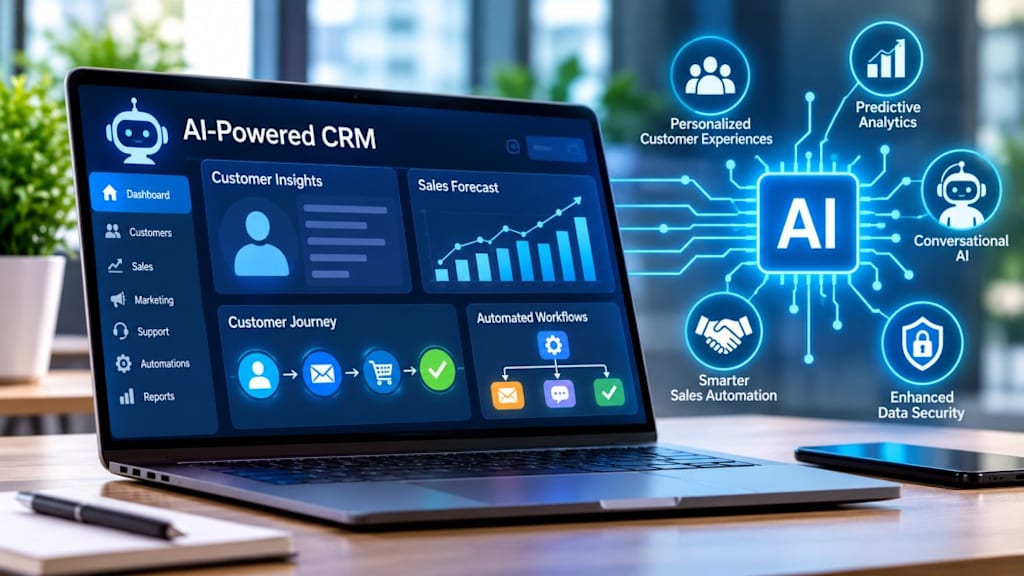
Artificial intelligence is changing how businesses manage customer relationships, track sales, and deliver customer support. In 2027, AI CRM platforms are expected to move beyond basic automation toward intelligent agents, predictive insights, and more personalized customer experiences. Businesses will increasingly use these technologies to understand customer behavior, reduce manual work, and make faster decisions. However, successful adoption will depend on reliable customer data, proper security, and human oversight. Here are 10 important AI CRM trends businesses should understand when planning their customer relationship management strategies for 2027.
1. Agentic AI Will Transform CRM Automation
Agentic AI is expected to become one of the biggest developments in CRM technology. Unlike traditional automation, which follows fixed instructions, AI agents can interpret goals, evaluate information, and perform tasks within defined permissions.
For example, an AI agent could identify a promising sales lead, review its interaction history, prepare a follow-up message, and recommend the next action. Depending on its permissions, it may also schedule a meeting or update the CRM record.
In 2027, businesses will increasingly explore agentic AI for:
Lead qualification and prioritization.
Automated customer follow-ups.
Sales opportunity management.
Customer support workflows.
Routine administrative activities.
Human approval will remain important for sensitive decisions and customer communications.
2. Predictive Analytics Will Improve Sales Forecasting
Traditional CRM systems mainly store customer information and sales records. AI-powered predictive analytics can use historical data and current activity to identify patterns and estimate future outcomes.
Sales teams can use these insights to understand which leads are more likely to convert and which opportunities need attention.
For example, a CRM platform may identify a sales opportunity with declining engagement. It can alert the sales representative before the opportunity becomes inactive.
In 2027, predictive analytics will play an important role in:
Sales forecasting.
Customer churn prediction.
Lead scoring.
Revenue planning.
Identifying potential sales opportunities.
These predictions depend on data quality and should support, rather than replace, human judgment.
3. Real-Time Customer Personalization Will Become More Important
Customers expect businesses to understand their interests and provide relevant experiences. AI CRM platforms can help companies deliver more personalized interactions by analyzing purchase history, preferences, previous conversations, and customer activity.
For example, an online retailer could use customer behavior to recommend relevant products. A sales representative could also receive suggestions based on a customer's previous purchases.
Real-time personalization may help businesses improve:
Product recommendations.
Marketing campaigns.
Customer communication.
Special offers.
Customer retention strategies.
However, personalization must respect customer privacy and applicable data protection requirements.
4. Conversational AI Will Improve Customer Interactions
Conversational AI is changing how customers communicate with businesses. Instead of navigating complicated menus or waiting for a representative, customers can use natural language to ask questions and receive assistance.
Modern CRM platforms are increasingly integrating conversational capabilities into customer service and sales workflows.
For instance, a customer might ask about an order status, request product information, or seek help with an account issue.
In 2027, conversational AI will continue developing through:
More natural chatbot conversations.
Voice-based customer assistance.
Context-aware responses.
Automated appointment scheduling.
Integration with customer support records.
Businesses should ensure that customers can reach human representatives when automated assistance cannot resolve their problems.
5. Multi-Agent CRM Systems Will Connect Business Workflows
A single AI agent can handle specific tasks, but multiple specialized agents can work together to complete more complex processes.
This approach is known as multi-agent orchestration. Different agents handle separate responsibilities while sharing relevant information through connected systems.
For example, a business could use:
A marketing agent to identify potential customers.
A sales agent to qualify leads.
A service agent to answer customer questions.
A reporting agent to analyze business performance.
These agents could coordinate activities across departments. However, businesses will need clear permissions, monitoring, and error-handling processes to keep these workflows reliable.
6. AI-Powered Customer Support Will Become More Advanced
Customer support is another area where AI CRM technology is creating new opportunities. AI-powered systems can help support teams manage repetitive requests, find customer information, and prepare relevant responses.
For example, when a customer submits a support request, an AI system could review previous interactions, identify the issue, and suggest possible solutions.
Important developments include:
Automated ticket classification.
Intelligent response suggestions.
Customer sentiment analysis.
Faster access to support histories.
Automatic ticket routing.
These capabilities can reduce repetitive work and help employees focus on complicated customer problems. Businesses should still review automated responses for accuracy and appropriate tone.
7. CRM Platforms Will Become Systems of Action
Traditional CRM platforms mainly serve as systems of record. They store contact information, sales activities, customer interactions, and business updates.
The next stage is a shift toward systems of action. Instead of simply displaying information, AI-enabled CRM platforms can help initiate and complete business activities.
For example, a CRM system might detect that a customer has not responded to a proposal. It could recommend a follow-up, prepare a message, and create a reminder for the sales representative.
This approach can help businesses connect information with practical decisions. The goal is to reduce the gap between identifying a business opportunity and taking action.
8. CRM Data Quality and Governance Will Become Critical
AI systems depend on reliable information. If customer records contain outdated details, duplicate contacts, or missing information, AI-generated recommendations may become inaccurate.
Data governance will therefore become a major priority for businesses adopting AI CRM solutions.
Companies should focus on:
Removing duplicate customer records.
Updating outdated information.
Establishing data access permissions.
Protecting sensitive customer details.
Monitoring how AI systems use business data.
Organizations must also understand where their information is stored and how CRM providers process it.
A strong data foundation will help businesses improve AI accuracy, customer trust, and operational reliability.
9. Omnichannel CRM Experiences Will Become Smarter
Customers interact with businesses through websites, email, social media, messaging applications, and phone calls. Managing these conversations separately can create inconsistent customer experiences.
AI-powered omnichannel CRM platforms aim to connect these interactions through shared customer records.
For example, a customer might ask a question through live chat and later contact the company by phone. A connected CRM system can help the representative access the previous conversation.
In 2027, businesses will increasingly focus on:
Connected customer communication channels.
Consistent interaction histories.
Automated conversation summaries.
Cross-channel customer insights.
More coordinated marketing and support activities.
The main benefit is a more consistent experience across different communication channels.
10. AI CRM Pricing and ROI Measurement Will Evolve
As AI features become more common, businesses will need to evaluate their CRM investments more carefully.
CRM providers may offer different pricing structures, including per-user subscriptions, usage-based charges, AI credits, and feature-based plans. Actual pricing depends on the provider and product.
This means companies should look beyond the advertised subscription price.
Before selecting an AI CRM platform, consider:
Total implementation costs.
AI usage and additional fees.
Integration expenses.
Employee training requirements.
Expected productivity improvements.
Measurable business outcomes.
Businesses should track results such as response times, lead conversion rates, customer retention, and time saved on repetitive work.
A useful AI CRM investment should deliver measurable value rather than simply introduce more technology.
How Businesses Can Prepare for AI CRM in 2027
Following emerging trends is useful, but businesses also need a practical adoption strategy.
Here are five steps to consider:
Review existing CRM systems: Identify problems with current workflows, customer records, and integrations.
Improve data quality: Remove duplicate records and establish clear data management practices.
Start with specific use cases: Test AI for lead qualification, customer support, or sales reporting.
Establish security controls: Define access permissions and human approval requirements.
Measure performance: Compare business results before and after introducing AI capabilities.
Starting with smaller projects allows businesses to understand the benefits and limitations before expanding AI across departments.
Conclusion
AI CRM technology is moving toward more intelligent, connected, and action-oriented business operations. Agentic AI, predictive analytics, conversational tools, and real-time personalization will influence how companies manage customer relationships in 2027. However, successful implementation requires more than adopting new features. Businesses must also prioritize reliable data, security, employee training, and measurable results. Companies that balance intelligent automation with human judgment will be better positioned to build stronger customer relationships.
Frequently Asked Questions
1. What is AI CRM?
AI CRM is customer relationship management software that uses artificial intelligence to analyze customer information, automate workflows, predict sales opportunities, and improve customer interactions.
2. What are the biggest AI CRM trends in 2027?
Major trends include agentic AI, predictive analytics, real-time personalization, conversational AI, multi-agent systems, automated customer support, and stronger data governance.
3. How does AI CRM help small businesses?
AI CRM can help small businesses automate follow-ups, organize customer information, prioritize leads, and improve customer communication without requiring large administrative teams.
4. Will AI replace traditional CRM systems?
AI is more likely to transform existing CRM systems than completely replace them. Businesses will continue using CRM platforms to manage customer records while adding intelligent automation and predictive capabilities.
5. Is AI CRM safe for customer data?
AI CRM can support secure customer data management, but safety depends on the provider's security controls, access permissions, privacy policies, and data handling practices. Businesses should review these factors before implementation.
About the Creator
Mohammad Akhtar
Mohammad Akhtar is an SEO and SEM Expert with over 10 years of experience in digital marketing and search engine optimization. A 2013 graduate of The Islamia University of Bahawalpur, he has worked with various IT companies.
Enjoyed the story? Support the Creator.
Subscribe for free to receive all their stories in your feed. You could also become a paid subscriber, letting them know you appreciate their work.
Comments
There are no comments for this story
Be the first to respond and start the conversation.