
Tatiana Protcheva on NFC Stones, QR Embroidery, and Ukrainian Digital Art
How does Tatiana Protcheva use NFC technology, QR codes, and embroidery to promote Ukrainian culture through wearable smart art?

Tatiana Protcheva is a Ukrainian mechanical engineer, textile artist, and digital-craft innovator living in Toronto. Inspired by mathematics, embroidery, and global travel, she transformed glow-in-the-dark thread, QR codes, and NFC chips into interactive Ukrainian cultural art. She founded a private embroidery museum, represented Ukraine internationally, and now creates smart stones, watches, ties, and accessories for promotion, memory preservation, mental-health support, archival storytelling, and diaspora engagement across communities.
In this interview with Scott Douglas Jacobsen, Tatiana Protcheva traces her path from engineering to embroidery, public exhibitions, and NFC-enabled art. She explains how glow-in-the-dark thread led to Ukrainian cultural projects, how QR codes expanded textile storytelling, and how natural stones became smart accessories. Protcheva discusses practical testing, chip sizes, epoxy sealing, phone scanning, and user reactions, while presenting technology as a humane tool for networking, archives, promotion, mental-health support, and Ukraine’s global cultural presence.
Scott Douglas Jacobsen: So, why did you focus on engineering in your education and early career?
Tatiana Protcheva: My mother was a mathematics teacher. I liked engineering because it was connected to mathematics, and I became a mechanical engineer. I also liked history.
At first, I was interested in embroidery. When I was working in Japan in 2005, a woman gave me a special thread - glow-in-the-dark thread. I did not know about this material before.
She spoke Japanese, and I spoke only a little English. When I came back to the hotel and saw the embroidery thread on the table, I thought it was interesting.
I did not know how to use it. It was a shock for me. Then, the next year, I was in Israel, in Tel Aviv, and the Ministry of Economy gave me a tour of holy places. I had an idea: I could use this special thread in an icon.
I started using it. Then, in 2010, I went to Shanghai for Expo 2010. The Ministry of Economy invited me to promote Ukraine. One man came to the Ukrainian pavilion and asked me, “Can I buy your collection?”
I asked, “Why do you need it?” He said, “I have a museum in Shanghai. I want it to be part of my collection.” I said, “Okay, I have a program with the government now, so I cannot talk. We can talk when the Expo is finished.”
During that time, I kept thinking, “Why do I need to sell this collection? I can open a private museum of embroidery in Ukraine.” When I returned to Ukraine, I opened my private museum. It was really successful because people came not only from different parts of Ukraine, but also from different countries, including Australia and Brazil. I promoted it, added information on TripAdvisor, and people booked visits. It was really successful.
Then, for Expo 2020 in Dubai, which was held in 2021 and 2022, I went again. Afterward, I could not return to my country. One family invited me to Florida. I lived in Orlando for one year. After that, I came to Toronto, and now I live in Toronto. In Toronto, it is not easy to start a new life with only one suitcase after travelling around the world.
I did not try to find a job because I had an interesting idea connected to my art. My son is a dentist. He said to me, “Mom, you are an engineer. I think you need to study how NFC works. It will be part of the future.” I researched everything for more than one year, and now I have started this business.
I find beautiful natural stones and encode information into an NFC chip. I integrate the chip into a beautiful accessory. Now, I have come to Ukraine to visit my son and my family, and also for medical reasons. I have an idea for a project: “Ukraine Without War,” meaning a quiet Ukraine. I want to translate it more correctly: “Ukraine Without Words.”
Because I feel that, not only in Ukraine but around the world, people need help with mental health. In Toronto, I see many immigrants, including Ukrainian people, who need mental health support. My idea is to encode each stone with something helpful. For example, one stone can contain relaxing music. Another stone can contain a motivational topic. I do not know the exact words in English. I have this program in Ukrainian. When I translate it, maybe I will send you what I want to encode. But, in general, it is for mental health.
Jacobsen: For those who may not know how these systems work, why use stone rather than metal?
Protcheva: Because stone works well with an NFC chip. When I tried the chip with metal, it was blocked. It did not work. That came from my own experiment, because during one year of research, I did not only research theoretically. I also researched practically. I bought many different NFC chips in different sizes. For example, you can see that one is big and another is small. I tried everything. When I tried metal, it did not work. When I tried wood, it worked. With stone, it worked. Stone is a natural material.
Jacobsen: It creates less interference. What about QR codes and making those pieces of art, including things like watches? How did you choose the watches? How did you take them apart, and how did you make the QR codes part of the art?
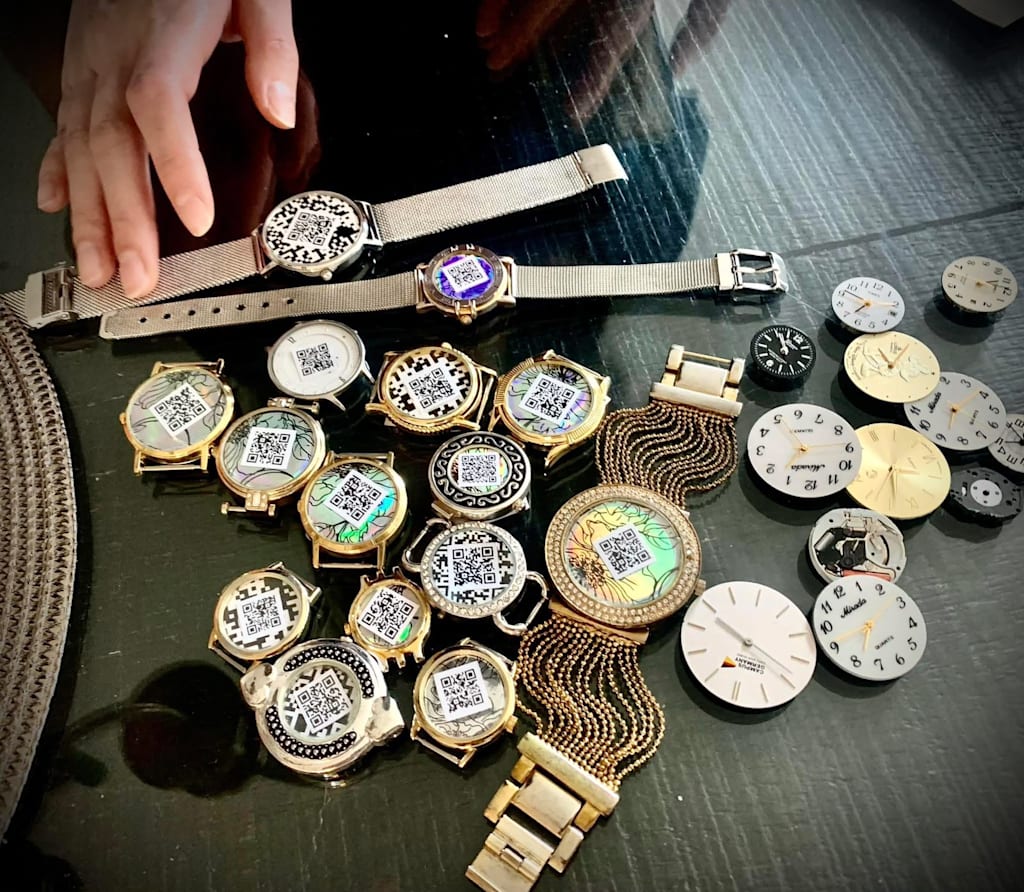
Protcheva: In Miami, every week on Lincoln Road, there is a vintage market. Usually, I like to go to vintage markets and buy vintage things. Then I saw a very beautiful watch, and I wanted to cover it.
It was a watch, maybe from a famous brand, but what was inside was not important. For me, the cover was very important. It looked very beautiful.
I bought the watch. Some watches are easier to open. I can open the cover with a small knife and take everything out. With some watches, it is not possible. I tried to find a watch repair company, and it was not easy. They helped me open the watch. Then I researched famous people who have Ukrainian roots, e.g., Leonardo DiCaprio and Sylvester Stallone.
Then I found information on Wikipedia about these famous people, and I made a record from this link. It is interesting. I gave this project the name “Time for Ukraine,” because it is really true. First, it is related to time because it uses watches. Second, it is for Ukraine because it is about Ukraine and promotes Ukraine. Now, at this time, it is really important. When I was in Los Angeles, I asked people, “Did you know Sylvester Stallone has Ukrainian roots?” They said, “No, we did not know.”
I think I really have good material to show how talented Ukrainian people are. But it was also a surprise for me when I started researching which famous people have Ukrainian heritage.
Jacobsen: Ukraine has a very strong IT culture. Certain big cities in India are very IT-savvy. The same is true in Ukraine.
Even when you go to the old metro built during the Soviet period, people can use their credit cards. If you go to Israel, Vancouver, or Toronto, you have a Compass Card, a PRESTO card, and so on. Here, you can get a transit card, but you can also use your bank card directly.
That is a small example, but you see it throughout the country in terms of IT and technical proficiency. It is not only technical proficiency. The culture is very friendly to technology, in a way similar to South Korea or Japan. Naturally, Japan and South Korea have some of the most advanced technology in the world, outside places such as San Francisco, Los Angeles, and the major technology companies.
In general, I like how your art incorporates something very smart about the culture here. Technology, if it is used for everyday purposes, has very few downsides. It typically makes life easier. Or, if it does not make life easier, it allows people to do more things.
What has been the positive feedback, and what has been the negative feedback, on the art? Whether it is QR codes or other forms of digital recognition and identification, what feedback have you heard?
Protcheva: I have not heard negative feedback. I feel only positive reactions. Usually, I go to the Small Business Expo in Miami every year. I also go to New York for some IT exhibitions. People say, “Wow.” But I see that not everybody knows about this innovation.
I explain it this way: It is like going to a hotel and using your card to open the door. It is easy. It is also used in public transport. You touch your card to the machine, and you have your ticket. It is so easy. But people do not always know how it works. Sometimes people are a little afraid when I show it, as if it is something magical. But it is simple, absolutely simple.
Yesterday, my friend told me, “Wow, I gave a present with NFC.” She bought some pieces from me for promotion. When she gave one to someone from a company, he reacted like a child. It was new for him.
In the business community, I see that the younger generation usually understands it. When I say “NFC,” I do not need to explain what it means. They just take their phone from their pocket, tap it, and say, “Okay, go, go, go.” At some events, especially with IT companies, people do not even ask for a traditional business card. They just say, “Please, what do you do? What is your business?” There is almost no long conversation. We save the contact and then think later about what we need. It is easier for promotion.
You know, networking is very popular now. How can I represent myself in one minute, or even 30 seconds? This is one way. I make a short promotional speech about it. It is easy. Please, be open to this.
Jacobsen: From an engineering perspective, how does NFC work? From a business perspective, what is the attraction for Ukrainians? Why do they use it?
Protcheva: Because we do not need an app. We only need the internet. It is easy and very fast. You just tap it, and that is all. All the information appears on your phone. It is easy for promotion.
In the business community, it is very helpful. But now I have found another interesting direction: an archive, or a history stone. For example, when the war started, my son was here. What did he take? Only a bank card, car keys, and that was all. He had to run.
With this archive stone, people can put all their photos and documents into Google Drive. It is like a tree of life. I encode only the Google Drive link into the NFC chip. People can order different information, and the file can grow more and more. The link stays the same. It is like an archive stone. You see?
Jacobsen: Is that glitter glue?
Protcheva: I put resin on it. It is a special resin for waterproofing, Epoxy. Epoxy resin.
Jacobsen: Yes, it is very, very tough.
Protcheva: It is waterproof because you need protection. It is not easy. I studied everything to understand how it works. My apartment is like a workshop. When somebody visits, they ask, “What is this? Do you live here, or do you work here?”
Jacobsen: So, basically, you carve a bit of the rock out, put the NFC chip inside, and then seal it with epoxy. Yes?
Protcheva: Yes. Stone, chip, epoxy.
Jacobsen: Where do you get the chip?
Protcheva: I buy them online.
Jacobsen: How do you encode the information?
Protcheva: I use a special program. I researched everything. I spent one year studying it. There are many nuances. For example, on an iPhone, you scan one part of the phone. On Android, it is usually the middle of the phone. You need to know where to tap. There are many different nuances. But I created my own website, and I promote and explain this there. I am happy.
Jacobsen: What was the hardest part to learn and to do before making this product?
Protcheva: At first, I was afraid. I could not find a lot of clear information. Different chips work with different programs. It is not easy to make everything work together.
For example, one type of chip works with one program, but another type of chip does not work with that program. The size is also different. If it is a small chip, it cannot hold a lot of information. If we need more information, we need a bigger chip because of the antenna size. For example, a small antenna cannot hold or transmit as much information. A bigger one can do more.
I bought bigger chips because I also make textile art. I put large chips into my textile art. There are many different possibilities.
Jacobsen: Thank you very much for the opportunity and your time, Tatiana.
Scott Douglas Jacobsen is a blogger on Vocal with more than 200 publications on the platform. He is the Founder and Publisher of In-Sight Publishing (ISBN: 978–1–0692343; 978–1–0673505) and Editor-in-Chief of In-Sight: Interviews (ISSN: 2369–6885). He writes for International Policy Digest (ISSN: 2332–9416), The Humanist (Print: ISSN, 0018–7399; Online: ISSN, 2163–3576), Basic Income Earth Network (UK Registered Charity 1177066), Humanist Perspectives (ISSN: 1719–6337), A Further Inquiry (SubStack), Vocal, Medium, The Good Men Project, The New Enlightenment Project, The Washington Outsider, rabble.ca, and other media. His bibliography index can be found via the Jacobsen Bank at In-Sight Publishing, comprising more than 10,000 articles, interviews, and republications across more than 200 outlets. He has served in national and international leadership roles within humanist and media organizations, held several academic fellowships, and currently serves on several boards. He is a member in good standing in numerous media organizations, including the Canadian Association of Journalists, PEN Canada (CRA: 88916 2541 RR0001), Reporters Without Borders (SIREN: 343 684 221/SIRET: 343 684 221 00041/EIN: 20–0708028), and others.
Image Credit: Tatiana Protcheva.
About the Creator
Scott Douglas Jacobsen
Scott Douglas Jacobsen is the publisher of In-Sight Publishing (ISBN: 978-1-0692343) and Editor-in-Chief of In-Sight: Interviews (ISSN: 2369-6885). He is a member in good standing of numerous media organizations.
Enjoyed the story? Support the Creator.
Subscribe for free to receive all their stories in your feed.
Comments
There are no comments for this story
Be the first to respond and start the conversation.