Thought Leaders
Interview: The Discipline Behind Nasdaq Futures Trader Koushik Ranjit
Known for his structured approach to Nasdaq futures and his ability to manage multiple six-figure funded accounts, Koushik Ranjit has built a quieter, steadier style of trading. He relies on routine, emotional balance and mathematical clarity rather than prediction or aggressive risk-taking. Raised in Hasnabad, West Bengal, he often says the discipline he uses in markets today was shaped long before he ever saw his first chart.
By Manish Bhatia11 months ago in Interview
REIL Capital’s Growth Journey Under the Leadership of Evan Samlin
Look at the world of small business financing today, and it is easy to forget that so many entrepreneurs still struggle to find access to the capital they need. Banks say no. Traditional lenders take too long. And business owners are often left to manage everything themselves. That’s precisely the gap REIL Capital stepped in to solve-and at the heart of that mission is one person: Evan Samlin, Founder and president of the company.
By Evan Samlin11 months ago in Interview
Finding Laughter Everywhere”: An Interview with Kolkata Comedian Shahrukh Murshed
Kolkata’s stand-up comedy scene has been steadily gaining momentum, and at the heart of this growth is Shahrukh Murshed, a prominent comedian and show host known for his sharp observational humour and dynamic audience interactions. As a familiar face in the city’s comedy circuit, Murshed reflects on his journey, his craft, and the evolving landscape of comedy in Kolkata.
By Manish Bhatia11 months ago in Interview
When the Harmonium Finds a New Voice: A Conversation with Sadakat Aman Khan
At twenty eight, Sadakat Aman Khan, popularly known as Mr. Harmonium, has taken an instrument often used only for accompaniment and placed it at the center of the musical spotlight. A simple box of bellows and reeds becomes something entirely different in his hands. It becomes lyrical, restless, emotional, sometimes even rebellious.
By Manish Bhatia11 months ago in Interview
Honestly, I wonder what’s wrong with me”: Elon Musk Finally Explains His Fascination With the Letter ‘X’
Elon Musk’s latest appearance on Nikhil Kamath’s widely followed podcast WTF is has triggered intense buzz across social platforms. The conversation, which covered a broad range of topics related to business, technology and global trends, offered one moment that especially caught the attention of viewers. Musk finally opened up about his lifelong fascination with the letter X, a theme that runs through several of his ventures and personal decisions.
By Manish Bhatia11 months ago in Interview
The Quiet Support We Often Need: How Real-Time Guidance Can Transform the Way We Work. AI-Generated.
There’s a moment most professionals experience but rarely speak about — the moment you look at your screen, your task, your deadline, and whisper silently to yourself, “I don’t know what to do next.”
By Pamela Kholi11 months ago in Interview
The Interview I Wasn’t Prepared For
M Mehran I have been through interviews before—phone screens, Zoom calls, panel rooms with too-bright lighting and too-fake smiles—but nothing prepared me for the one scheduled at 9:00 a.m. on a rainy Tuesday in November. It wasn’t the weather that made me nervous. It was the fact that this time, I needed the job. Not wanted. Needed. Rent was late. My savings account was a joke. My parents had already said the sentence no adult wants to hear: “Maybe you should come back home for a while.” So I ironed my only blazer, practiced answers I hoped sounded confident, and arrived thirty minutes early—because desperation is very punctual. The building surprised me. It wasn’t glass and metal like I imagined. Instead, it was small, quiet, almost old-fashioned, with a handwritten sign on the door: “Please ring once.” No logo. No receptionist. Just a bell. I hesitated, then pressed it. A woman in her sixties opened the door with a smile warm enough to melt the rain off my shoulders. “You’re early,” she said. “I—yes. I thought it would be better than being late.” “Sometimes,” she replied, “people arrive early because they don’t know where else to be.” I forced a laugh, pretending she was wrong. She wasn’t. --- The waiting room looked nothing like a corporate office. No motivational posters. No glossy magazines about success and productivity. Just shelves filled with books, many without titles on their spines. There were no other candidates. No background music. Only the soft ticking of a wall clock and the fast heartbeat inside my chest. After a moment, the woman returned. “We’re ready for you.” We? I followed her into a small room with two chairs and a single round table. No panel. No notepads. No laptop recording everything I said. Just one interviewer. He looked up from a folder when I entered—kind eyes, quiet face, the sort of person who didn’t need authority to be respected. “Thank you for coming,” he said. “Thank you for having me.” My voice sounded practiced, like something I borrowed instead of owned. He didn’t ask for my résumé. He didn’t ask about my strengths, weaknesses, or where I saw myself in five years. Instead, he asked: “Who taught you the meaning of work?” I froze. This was not in any list of common interview questions. “I… I’m not sure,” I said slowly. He nodded, as if uncertainty was the correct answer. “What brought you here today?” “I’m looking for a job.” “That’s what you need,” he said gently. “I’m asking what you’re searching for.” My throat tightened. I wanted to say stability. I wanted to say purpose. I wanted to say that I was tired of feeling like I was always catching up to everyone else. But all that came out was: “I don’t know anymore.” He didn’t write anything down. He didn’t look disappointed. He just sat with the silence like it wasn’t uncomfortable at all. --- Then he slid a blank card across the table. “On this card,” he said, “write one thing you stopped believing about yourself.” My hand hovered above the pen. I thought of who I used to be—someone who filled notebooks with ideas, someone who didn’t apologize for taking up space, someone who laughed without checking if it was appropriate. Somewhere between moving out, paying bills, and pretending not to be scared, I misplaced that version of myself. I wrote: “I stopped believing I was capable.” I expected him to take the card. He didn’t. “Keep it,” he said. “You’ll need it later.” --- The questions continued, but not the kind that measured skills. “Tell me about a time you failed and didn’t pretend it didn’t hurt.” “What do you wish people understood about you?” “When was the last time you did something for the first time?” Each question felt less like an interview and more like someone turning on lights in a room I had been sitting in for years without realizing it was dark. Somewhere between the third and fourth question, I stopped trying to sound impressive. I started sounding like myself. I talked about fear, and how it often wears the mask of being “realistic.” I talked about dreams I folded into smaller shapes until they could fit into a life I didn’t even want. The interviewer listened—not like someone evaluating me, but like someone witnessing me. --- Finally, he closed the folder. “That’s all,” he said. My pulse jumped. “Did I… get the job?” He smiled in a way that made the room feel suddenly warmer. “This wasn’t an interview for a position,” he said softly. “It was an interview to see whether you were ready to start again.” I blinked. “Start what?” “Your life,” he said. “The one you paused.” The woman from earlier appeared in the doorway. She handed me a simple envelope. Inside was neither a contract nor a rejection. It was a note: “Come back tomorrow at 9 a.m. Not for a job— for a place to become yourself again.” Underneath was a second line, written in unfamiliar handwriting: “Bring the card.” --- When I stepped outside, the rain had stopped. For the first time in months, I didn’t feel like I was failing. I felt like I was beginning. Because sometimes, the most important interview of your life isn’t the one that gets you hired— it’s the one that reminds you you’re still worth choosing.
By Muhammad Mehran11 months ago in Interview
The Philosopher's Stone: Using AI And Logic To Redefine Auto Insurance
As an outsider looking in on the auto insurance space, Robert Smithson quickly identified a recurring, fundamental problem for drivers: generic premiums based on a traditional model stuck in the past. Smithson, fresh from the sale of Genius Sports, a $280 million business that used data to understand and predict sports performance, had found his next target ripe for transformation.
By Léa Carlsen11 months ago in Interview
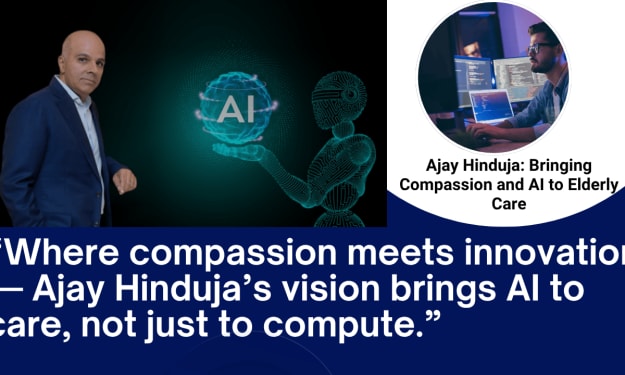
Ajay Hinduja on AI-Powered Domestic Assistant: Redefining Elderly Care with Compassionate technology
Artificial Intelligence is no longer confined to data centers or industrial robots—it is entering our homes, reshaping the way we care for the elderly. One of the most impactful applications of Physical AI is in AI-powered domestic assistants designed to provide physical support, companionship, and continuous health monitoring for seniors. These intelligent systems are not just machines; they are empathetic companions that help older adults live independently, safely, and with dignity.
By Geoff Lyon12 months ago in Interview