Filmmakers
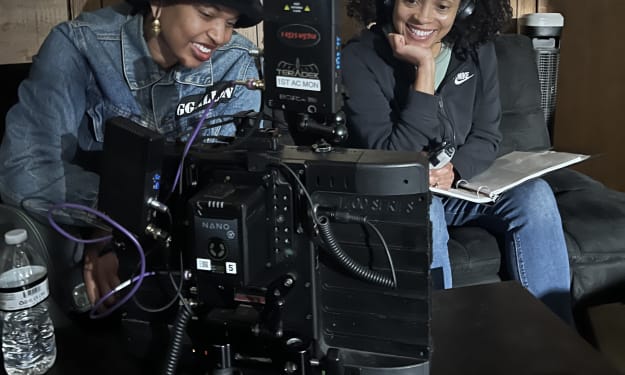
Dara Frazier's Not Every Woman Confronts the Weight Black Women Carry and the Freedom of Letting Go
Dara Frazier's Not Every Woman arrives with the kind of honesty that doesn't ask permission. It steps directly into the emotional lives of Black women. The exhaustion, the humor, the expectations, and the quiet places where we finally admit what we're tired of carrying. The film captures the conversations that happen when the world isn't watching, the ones where we confess that the invisible cape is slipping and that being "strong" has never been the whole story.
By Tammy Reese11 months ago in Interview
Reason First: 50 Cent Shares Unseen Diddy Footage From Netflix Documentary: “[It] Shows You His Character”
Diddy is guilty. That is apparent. What has to be explored is the road leading up to his conviction on prostitution charges. Mogul Curtis “50 Cent” Jackson and filmmaker Alexandria Stapleton have in the cannon footage Diddy days before his appearance as a then suspect in the cases brought against him.
By Skyler Saunders11 months ago in Interview
The Interview I Wasn’t Prepared For
M Mehran I have been through interviews before—phone screens, Zoom calls, panel rooms with too-bright lighting and too-fake smiles—but nothing prepared me for the one scheduled at 9:00 a.m. on a rainy Tuesday in November. It wasn’t the weather that made me nervous. It was the fact that this time, I needed the job. Not wanted. Needed. Rent was late. My savings account was a joke. My parents had already said the sentence no adult wants to hear: “Maybe you should come back home for a while.” So I ironed my only blazer, practiced answers I hoped sounded confident, and arrived thirty minutes early—because desperation is very punctual. The building surprised me. It wasn’t glass and metal like I imagined. Instead, it was small, quiet, almost old-fashioned, with a handwritten sign on the door: “Please ring once.” No logo. No receptionist. Just a bell. I hesitated, then pressed it. A woman in her sixties opened the door with a smile warm enough to melt the rain off my shoulders. “You’re early,” she said. “I—yes. I thought it would be better than being late.” “Sometimes,” she replied, “people arrive early because they don’t know where else to be.” I forced a laugh, pretending she was wrong. She wasn’t. --- The waiting room looked nothing like a corporate office. No motivational posters. No glossy magazines about success and productivity. Just shelves filled with books, many without titles on their spines. There were no other candidates. No background music. Only the soft ticking of a wall clock and the fast heartbeat inside my chest. After a moment, the woman returned. “We’re ready for you.” We? I followed her into a small room with two chairs and a single round table. No panel. No notepads. No laptop recording everything I said. Just one interviewer. He looked up from a folder when I entered—kind eyes, quiet face, the sort of person who didn’t need authority to be respected. “Thank you for coming,” he said. “Thank you for having me.” My voice sounded practiced, like something I borrowed instead of owned. He didn’t ask for my résumé. He didn’t ask about my strengths, weaknesses, or where I saw myself in five years. Instead, he asked: “Who taught you the meaning of work?” I froze. This was not in any list of common interview questions. “I… I’m not sure,” I said slowly. He nodded, as if uncertainty was the correct answer. “What brought you here today?” “I’m looking for a job.” “That’s what you need,” he said gently. “I’m asking what you’re searching for.” My throat tightened. I wanted to say stability. I wanted to say purpose. I wanted to say that I was tired of feeling like I was always catching up to everyone else. But all that came out was: “I don’t know anymore.” He didn’t write anything down. He didn’t look disappointed. He just sat with the silence like it wasn’t uncomfortable at all. --- Then he slid a blank card across the table. “On this card,” he said, “write one thing you stopped believing about yourself.” My hand hovered above the pen. I thought of who I used to be—someone who filled notebooks with ideas, someone who didn’t apologize for taking up space, someone who laughed without checking if it was appropriate. Somewhere between moving out, paying bills, and pretending not to be scared, I misplaced that version of myself. I wrote: “I stopped believing I was capable.” I expected him to take the card. He didn’t. “Keep it,” he said. “You’ll need it later.” --- The questions continued, but not the kind that measured skills. “Tell me about a time you failed and didn’t pretend it didn’t hurt.” “What do you wish people understood about you?” “When was the last time you did something for the first time?” Each question felt less like an interview and more like someone turning on lights in a room I had been sitting in for years without realizing it was dark. Somewhere between the third and fourth question, I stopped trying to sound impressive. I started sounding like myself. I talked about fear, and how it often wears the mask of being “realistic.” I talked about dreams I folded into smaller shapes until they could fit into a life I didn’t even want. The interviewer listened—not like someone evaluating me, but like someone witnessing me. --- Finally, he closed the folder. “That’s all,” he said. My pulse jumped. “Did I… get the job?” He smiled in a way that made the room feel suddenly warmer. “This wasn’t an interview for a position,” he said softly. “It was an interview to see whether you were ready to start again.” I blinked. “Start what?” “Your life,” he said. “The one you paused.” The woman from earlier appeared in the doorway. She handed me a simple envelope. Inside was neither a contract nor a rejection. It was a note: “Come back tomorrow at 9 a.m. Not for a job— for a place to become yourself again.” Underneath was a second line, written in unfamiliar handwriting: “Bring the card.” --- When I stepped outside, the rain had stopped. For the first time in months, I didn’t feel like I was failing. I felt like I was beginning. Because sometimes, the most important interview of your life isn’t the one that gets you hired— it’s the one that reminds you you’re still worth choosing.
By Muhammad Mehran11 months ago in Interview
Questions That Build Tomorrow
In the bustling town of Crestwood, where busy streets hummed with stories and daily routines, lived a young college student named Zayan. Unlike many students, Zayan wasn’t dreaming of becoming a doctor or an engineer—he dreamed of becoming a journalist who used interviews to understand the world. To him, interviewing someone wasn’t just asking questions. It was discovering a hidden universe in every person. His journalism teacher, Mr. Ray, noticed Zayan’s curiosity and decided to give him an important task. “You will interview someone who influenced this town,” he said. “Choose wisely. The best interview is not with the most famous person, but with the person who holds wisdom.” Zayan thought hard. Famous business owners, well-known teachers, even athletes came to mind. But there was one person he always noticed in the morning—a quiet old man who cleaned the town’s main library garden. He was never in a hurry, never angry, and always smiling politely. People passed him every day, never wondering who he was. So, Zayan made his choice. The next morning, armed with a notebook, recorder, and a heart full of nervous questions, he walked toward the library garden. The old man was trimming bushes with careful hands. “Sir… may I interview you? My name is Zayan,” he asked politely. The man looked surprised. “Me? I am no one important.” “That’s exactly why I want to talk to you,” Zayan replied with a smile. The old man laughed softly and agreed. They sat on two wooden chairs near the garden fountain. His name was Mr. Haleem, and he had worked as the gardener for thirty years. Zayan began the interview with simple questions, asking about his job and routine. But as minutes passed, the simple conversation turned deeper. “What keeps you smiling every day?” Zayan asked. Mr. Haleem paused, eyes reflecting memories. “Because life is like a garden… If you care for it patiently, it blooms. People get busy chasing big things, but they forget small joys. Those are the seeds of peace.” Zayan felt something shift in his heart. He wasn’t just receiving answers—he was receiving lessons. “Have you ever dreamed of becoming someone else?” Zayan asked. “No,” replied the old man. “Dreams are not always about what you want to be, but who you want to become. I chose honesty over fame, patience over rush, and service over pride. That is enough.” The interview lasted for an hour. Zayan wrote quickly, feeling that every word was precious. When he finished, he thanked Mr. Haleem and turned off the recorder. “You asked good questions,” the gardener said. “You did not interview a job, you interviewed a person. That is real journalism.” Zayan walked home with a calm heart. He realized interviewing wasn’t about clever questions, but honest listening. A week later, his interview was published in the college journal. Readers were moved—many had seen Mr. Haleem every day, yet never knew the wisdom behind his smile. Students visited the library garden just to greet him, and teachers praised Zayan for choosing someone humble yet deep. But the greatest reward wasn’t the praise. It was the lesson he carried: Behind every ordinary life, there is an extraordinary story—if we ask with respect and listen with sincerity. And so, Zayan understood something beautiful: Interviews don’t just reveal truths about others. They also reveal truths about ourselves.
By Spotlight stories 11 months ago in Interview
Thiago Leoni: An Explorer Behind the Scenes
In a rapidly changing film industry, one director has managed to stay both relevant and distinctive over the past decade: Thiago Leoni. For him, filmmaking is more than a profession; it is his primary language. It is how he captures and expresses emotion, transforms silence into storytelling, and brings people closer together.
By Arpan Thapa11 months ago in Interview
Talking With Dana Lyn Baron about ‘BETTY & MARY’
This edition of Talking With focuses on the multi-hyphenate talents of Dana Lyn Baron, who is gaining momentum on the festival circuit as the writer, producer and star of the comedy short “BETTY & MARY: The Actors Prepare.”
By FierceScribe11 months ago in Interview
Delilah Napier and Lucy Powers Bring Dark Humor and Raw Honesty to Modern Love with Floating Carousel
Filmmaking duo Delilah Napier and Lucy Powers are no strangers to pushing creative boundaries. With their new dark comedy feature, Floating Carousel, the pair dive into the chaos of modern dating through a surreal, witty, and painfully relatable lens. The film, making its World Premiere at the Woodstock Film Festival on Friday, October 17th at 8:30 PM, follows five twenty-somethings as they navigate love, loneliness, and connection in what many call "the loneliest century." Blending satire, realism, and emotional depth, Napier and Powers craft a story that mirrors the absurdity of our digital-age relationships and proves once again why they're among the most exciting emerging voices in indie cinema.
By Tammy Reeseabout a year ago in Interview
Tahkyah Brings Plenty Makes a Public Appearance in Los Angeles. AI-Generated.
Tahkyah Brings Plenty, the well-known celebrity admired for her talent and growing influence in entertainment, was recently spotted making a rare public appearance in Los Angeles. The late September sighting captured the attention of fans and media alike, marking one of her first public appearances after spending several months away from the spotlight. Her presence in the city quickly drew attention, with fans sharing photos online and media outlets highlighting her return to visibility.
By Allie Jackson about a year ago in Interview
Wild Willie’s Soul Impact:
When Wild Willie grabs the mic, it’s more than a podcast—it’s a force. As the creator and host of Soul Impact: How Music Saved Us, the award-winning show on The Scene Projects network, Wild Willie has carved his own lane with storytelling that refuses to play it safe. His mission is bold, his delivery unapologetic: to prove music isn’t just background noise—it’s a lifeline.
By Independent Indie Artist Radarabout a year ago in Interview
Willie Thornton: The Voice Behind Soul Impact
Willie Thornton is not just a name—it’s a movement. As the creator and host of Soul Impact: How Music Saved Us, an award-winning podcast under The Scene Projects network, Willie has carved out a lane that’s uniquely his. His work is electric, raw, and deeply human, taking listeners on a ride through stories of resilience, transformation, and hope. At its core, the show is about survival, about thriving, and about how music—something so universal—can become a lifeline when the world feels like it’s caving in.
By The Blacksheepkid Collective by: El Pablo 1xabout a year ago in Interview
How Viral Moments Create Internet Celebrities Overnight
Fame used to take years to build. Singers had to release albums, actors needed movie contracts, and athletes spent decades training for the spotlight. But in today’s digital world, fame can arrive in a matter of hours. One viral moment—a short clip, a bold post, or a trending challenge—can turn an ordinary person into an internet celebrity almost overnight.
By Shiraz Kahnabout a year ago in Interview