
Ola Rondiak on Ukrainian Identity, Psychotherapy, Kyiv, and Art
How did Ola Rondiak’s Ukrainian-American upbringing, psychotherapy background, and move to Kyiv shape her contemporary art?

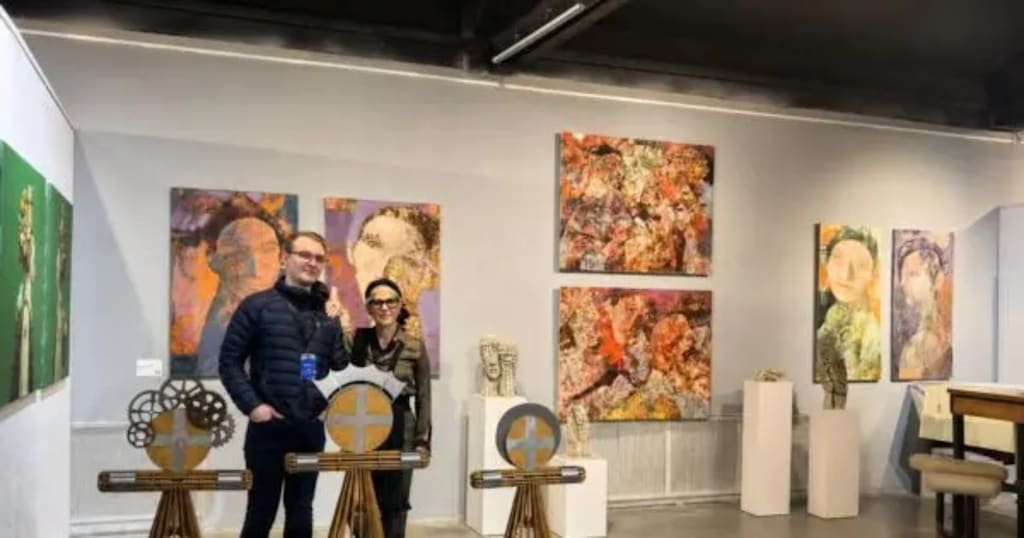
Ola Rondiak is a Ukrainian-American contemporary artist, sculptor, and former psychotherapist whose work explores identity, memory, displacement, and Ukrainian cultural resilience. Raised in the United States by Ukrainian immigrant parents, she later relocated to Kyiv, where her artistic practice deepened through engagement with Ukraine’s political upheavals and historical trauma. Known for her large-scale motanka sculptures, collage, and mixed-media works, Rondiak combines personal family history, women’s experiences, and national memory into visually layered narratives exhibited internationally.
In this interview, Scott Douglas Jacobsen speaks with Ola Rondiak about her Ukrainian-American upbringing, move from Ohio to New York, studies at Hunter College, and early work in social services. Rondiak reflects on immigrant identity, bureaucracy in child welfare, clinical psychology, marriage, motherhood, and relocating to Kyiv. Her story links psychotherapy, family choices, and Ukrainian cultural belonging to the later emergence of her art, shaped by memory, displacement, resilience, and cross-cultural life in contemporary Ukraine.
Scott Douglas Jacobsen: Why New York? What is the family history behind getting there?
Ola Rondiak: Oh gosh. Well, I grew up in Ohio, but I had a grandmother who lived in New York. I started at Ohio State University and never felt super comfortable there, so I transferred to Hunter College because there was an opportunity for me to live with her in New York City. That began my New York life, really, at 20 or 21. I also had a lot of friends in New York through the Ukrainian community because every summer I went to Ukrainian scouting camps, so I met Ukrainians from all over the U.S. I wanted to experience New York and see what else was out there.
Jacobsen: So Ohio felt uncomfortable, out of place, and New York seemed…
Rondiak: Oh, I would not say that. I mean, there was nothing wrong with my childhood growing up in suburbia, except that I was different from everybody because I was first-generation, from immigrant parents, so I was a little bit weird. But I had a great group of friends. They just laughed about it. I would go to school smelling like garlic and things like that.
Jacobsen: That would keep the vampires away. So what did New York represent to you then, and Hunter College particularly?
Rondiak: Oh, it represented a bigger part of the world that I wanted to explore. I guess Ohio felt kind of closed in for me, and New York was exciting. It felt more like what the real world was about. It also related to having a lot of Ukrainian friends from New York whom I had met over the summers throughout my youth. I grew up with two lives. I grew up with my American friends in American school, but every summer and on Saturdays, I was with my Ukrainian friends. Obviously, as first-generation, my parents were very different from all my American friends’ parents in Ohio. So being in New York, around a lot of those immigrant families, felt more like me. I suppose I felt a little out of place.
Jacobsen: Out of place? Those are my words, not yours.
Rondiak: I mean, we got back there. That is kind of what you started with.
Jacobsen: What did you find at Hunter College?
Rondiak: It was cool. I mean, it was good. It was the late ’80s. I had to add one semester, I believe, because not everything transferred equally. But I did not mind, and it actually helped my grades because I was motivated and chose a major that I was interested in.
Jacobsen: Which was?
Rondiak: Kind of a double major, with psychology and education.
Jacobsen: Did both of those feed into your psychotherapy background?
Rondiak: Yes. Then I worked as a social worker in Brooklyn for a few years and got fed up with bureaucracy, honestly.
I thought maybe I would be better off working one-on-one with people because the whole system kind of drove me mad. You are there wanting to help kids. I had about 55 kids on my roster. It was part of the adoption and foster care unit, and also the, what did they call it? I was reaching out to family members who were not necessarily in New York, trying to find places for the kids. There were roadblocks everywhere. I felt very frustrated. I kept thinking, “Are we here to help the kids, or are we not?” It seemed so bureaucratic. I guess it just was not my language or my world to be in there because I thought I was going to be helping the kids, and I barely got to see them once a week.
It is funny. I have not talked about this for a while. It was more like going to court every week, looking for the parents, and doing a lot of paperwork. I thought, “Well, the kids are never going to trust me because I do not even have time to build a relationship with them.” So I decided to go back to graduate school and study psychotherapy because I thought I would prefer to work one-on-one with people.
Jacobsen: So would you characterize the bureaucratic process as depersonalizing in some way because you could not build those relationships?
Rondiak: Yes, and I think there is a very high burnout rate in that field. People either leave for something else, or if they stay, they are often half checked out. So if you are trying to get permission from Supervisor One or Supervisor Two, and they do not really care anymore because they are fried, it becomes difficult. Then, as a young person at 22, coming in wanting to save the world, or at least thinking you can make a difference…
Jacobsen: That is a common error.
Rondiak: Exactly.
Jacobsen: Would you characterize it as idealistic? You at 22, going into this thinking you were going to save the world?
Rondiak: I am saying that loosely. I did not think I could save the world, but I thought I could make a bigger difference than just getting caught up in bureaucratic tasks.
Jacobsen: What strand of psychotherapy did you pursue in graduate school?
Rondiak: I began in a very small program. I think they selected only about 15 of us. I did not think we were going to talk about this. I thought we were going to talk about my art. This was a long time ago.
Jacobsen: We are getting to the art. The art does not just appear out of nowhere.
Rondiak: Wow, I just have not been in that room in my mind for so long. My initial graduate program acceptance was in clinical psychology. That was the broad term for it. We were learning different theories and approaches within clinical psych.
Halfway through the program, I fell in love. My future husband was not living in Ohio. So I found myself in this decision-making process: do I stop at the master’s degree, or continue toward a doctorate? But I was already around 26 or 27, and I wanted to get married and have children. That became my next goal.
Jacobsen: At what age did that become a goal and a dream for you?
Rondiak: I always knew I wanted to be a mom, but I was also very interested in having a career, so it was always both. Then, once I fell in love, it became very realistic. I knew I wanted to have a few children. I have three. My youngest is in New York right now, Brooklyn.
So it was a difficult decision, but I thought that if I did not go for the doctorate right away, the master’s degree in clinical psychology did not allow you to do very much professionally. You really had to continue for the doctorate because you could not get licensed independently. For example, I could not practice psychotherapy on my own.
So I transferred into the education department, into community counseling, because that pathway would allow me to become licensed to practice if I decided to stop there for a while. That is what I did.
Then my husband proposed, and when I graduated, we moved to Philadelphia, where he was living at the time.
Jacobsen: How long did you work in clinical psychology, and how long were you and your husband together before he proposed?
Rondiak: Wait, how long did I use the clinical psych degree? You mean how long was I working as a therapist? Right after I graduated that spring, he invited me to move to Philadelphia and start planning our wedding. We got married that November.
Jacobsen: What age were you then?
Rondiak: Twenty-seven, I think.
Jacobsen: Was he always clear about his intentions in that regard?
Rondiak: Yes. We had already known each other for about 15 years. We met in Canada at a Ukrainian ski camp when we were around 18. So then we moved to Philadelphia, and I worked there as a therapist in a clinic until we moved to Ukraine.
Jacobsen: To Kyiv. And when did art become the main inspiration and focus of your productive life?
Rondiak: We moved to Kyiv, and I worked here privately, helping children with English language learning, and I also did some work connected with the Peace Corps. I did some therapy as well.
Jacobsen: What year was this approximately?
Rondiak: Mid-1990s. We came for about a year, maybe a year and a half. I started feeling my biological clock ticking, even though my husband wanted to stay longer. We moved back to the U.S. because, at that time, things here were still uncertain, especially for foreigners. The systems were not set up the way we were used to in the West with maternity hospitals and things like that. There were also lingering concerns about radiation levels after Chernobyl.
There were many uncertainties. The U.S. Embassy was issuing advisories like “Do not eat strawberries,” along with lots of other protocols.
Jacobsen: That is incredibly specific and interesting. There is probably a whole story there too.
Rondiak: I am sure there is. I thought, if we have the opportunity to have our children in the U.S., then let us do that. My husband was able to work remotely from the U.S. because his boss was American-based but running a company in Kyiv. So we ended up having three children in three years and then moved back to Ukraine with them. And then I had all these anxieties about whether there was radiation in the bath water while I was bathing them. Those kinds of stresses. “Do not put the water in your mouth.”
Jacobsen: That has never been a stressor in my life. Do you feel any superpowers coming out of the radiation? Preferably only good ones.
Rondiak: Only good ones. That is good.
Jacobsen: This is good. It is like supes from The Boys.
Rondiak: I guess we all became resilient somehow. So we lived for a few years in the city with the kids. Then, when school was starting, we decided we were going to stay longer, so we moved a little outside the city because the children were going to the Kyiv International School.
Jacobsen: Why select an international school?
Rondiak: That is an interesting question. My husband and I thought we should keep their options open. At the time, Kyiv was still predominantly Russian-speaking, whereas in Lviv, for example, we heard much more Ukrainian. Kyiv felt a little more foreign to us because even activities like gymnastics were conducted in Russian.
Since we had grown up in the United States, international school felt like a good choice. We wanted the kids to maintain their English, and they had not chosen to live in Ukraine. We thought an international education would give them broader opportunities and make it easier if they later transferred somewhere else, whether in Europe, the U.S., or elsewhere.
Jacobsen: I feel like you never fully expected to stay there as long as you did.
Rondiak: That too. We always thought we might move again, so it seemed easier for them to transfer from an international school if necessary. Even if they ended up spending their whole childhood in Ukraine, which we did not know at the time, we thought it would still help if they later chose universities abroad.
Jacobsen: Thank you very much for the opportunity and your time, Ola.
Scott Douglas Jacobsen is a blogger on Vocal with more than 200 publications on the platform. He is the Founder and Publisher of In-Sight Publishing (ISBN: 978–1–0692343; 978–1–0673505) and Editor-in-Chief of In-Sight: Interviews (ISSN: 2369–6885). He writes for International Policy Digest (ISSN: 2332–9416), The Humanist (Print: ISSN, 0018–7399; Online: ISSN, 2163–3576), Basic Income Earth Network (UK Registered Charity 1177066), Humanist Perspectives (ISSN: 1719–6337), A Further Inquiry (SubStack), Vocal, Medium, The Good Men Project, The New Enlightenment Project, The Washington Outsider, rabble.ca, and other media. His bibliography index can be found via the Jacobsen Bank at In-Sight Publishing, comprising more than 10,000 articles, interviews, and republications across more than 200 outlets. He has served in national and international leadership roles within humanist and media organizations, held several academic fellowships, and currently serves on several boards. He is a member in good standing in numerous media organizations, including the Canadian Association of Journalists, PEN Canada (CRA: 88916 2541 RR0001), Reporters Without Borders (SIREN: 343 684 221/SIRET: 343 684 221 00041/EIN: 20–0708028), and others.
Image Credit: Scott Douglas Jacobsen.
About the Creator
Scott Douglas Jacobsen
Scott Douglas Jacobsen is the publisher of In-Sight Publishing (ISBN: 978-1-0692343) and Editor-in-Chief of In-Sight: Interviews (ISSN: 2369-6885). He is a member in good standing of numerous media organizations.
Enjoyed the story? Support the Creator.
Subscribe for free to receive all their stories in your feed.
Comments
There are no comments for this story
Be the first to respond and start the conversation.