
Mark McNamee on Ukraine’s Defense Tech, Wartime Economy, and Military Innovation
How is Ukraine’s defense technology sector reshaping its wartime economy, reconstruction, and strategic role in Europe and NATO?

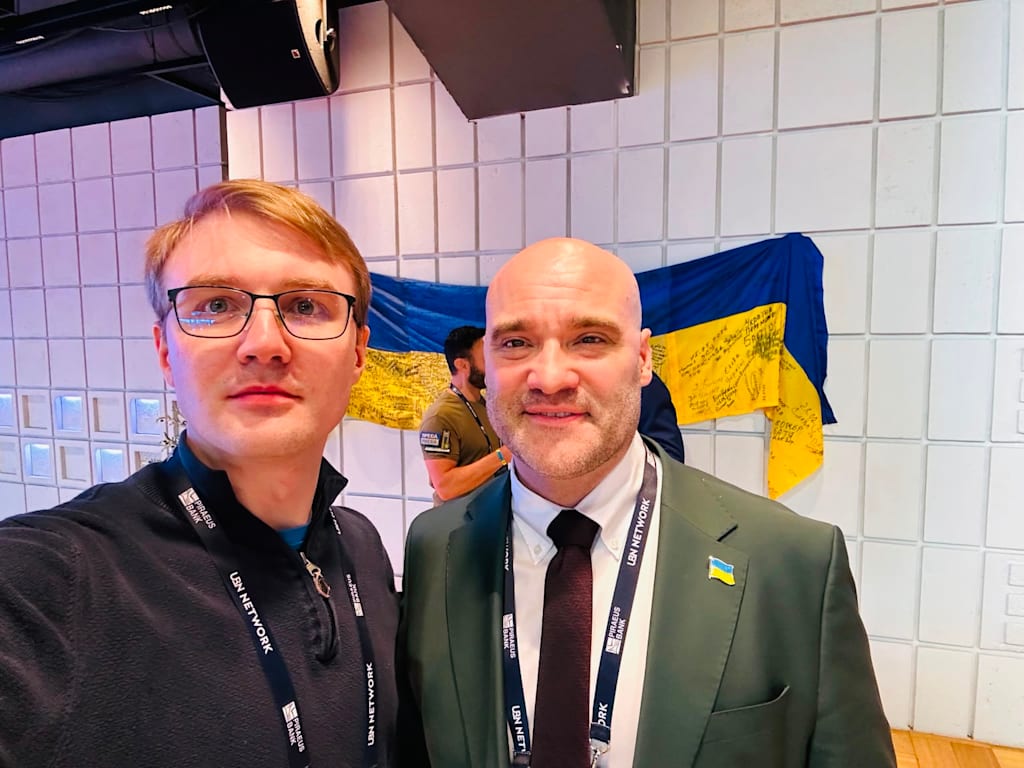
Mark McNamee is a Kyiv-based analyst and commentator on Ukraine’s political economy, defense technology, and wartime industrial transformation. Living in Ukraine through the full-scale invasion, he examines how the country’s logistics, ports, private sector, drone producers, and procurement systems adapt under Russian attack. His work emphasizes Ukraine’s endurance, Western-oriented business culture, miltech innovation, reconstruction during war, and the strategic importance of Ukrainian defense firms for Europe, NATO, and the wider democratic world today and beyond.
Scott Douglas Jacobsen asks Mark McNamee about Ukraine’s wartime political economy and defense technology sector. McNamee argues Ukraine is enduring rather than merely resilient, adapting logistics, ports, and industry under Russian attack. He says reconstruction is already underway through defense production, especially drones, electronic warfare, missiles, and procurement reform. McNamee also highlights Western investment, younger Ukrainian entrepreneurs, and Ukraine’s growing importance to Europe, NATO, and democratic military innovation in a transformed era.
Scott Douglas Jacobsen: How would you describe the overall military tech and political economy landscape of Ukraine now, particularly as we are in the fifth year of the full-scale invasion?
Mark McNamee: Well, I would divide this into two parts: the broader political economy and the defense miltech economy. So, to summarize briefly, I would give you two quick answers.
The political economy, I would say, is enduring. I am using that word instead of “resilience” because “resilience” has become one of the more overused words I have heard over the last four and a half years of living here. We keep hearing about “resilient Ukrainians,” and that is absolutely true. It obviously goes without saying at this point, but it has become a cliché. It can also become a way of saying, “Ukrainians are resilient, so they can handle themselves, while we in the West continue to sleep through this war and congratulate them and pat them on the back for their suffering, handing them a couple of dollars here and there as necessary.
They can do all the dirty work for us to protect Western civilization, and bravo, because they are so tough,” while we in the West are frankly not nearly as resilient or tough as Ukrainians. So I am a little tired of “resilience.” Let me get that off my chest to start this interview on a negative note. Moving to endurance, though, that is how I would describe the political economy. It is remarkably adaptive to the circumstances. This is the fifth year of the full-scale war, and Ukraine is a country far smaller than Russia in population, territory, and overall economic scale, yet it has endured.
There is an economic war going on here as well. Russia is trying to decimate the country and win in any way possible. If that means bombing the country into submission, not winning at the front, but devastating the whole country, then that would be victory for Russia. And that has not happened.
That is why I refer to the economic front in this war. I do not say that out of disrespect to the other real front, of course, where men are dying as we speak in the east. But there is, in a way, an economic front in this war. That is what I feel I am contributing to, or at least helping with. We are enduring. I am using that word because of the adaptation, the innovation, and the effort to keep transport and logistics functioning.
Just one clear example: in the first quarter of 2026, Ukrainian ports handled more than 21 million tonnes of cargo and met 98 percent of their transshipment target, even though port infrastructure was being attacked regularly. Russia has continued to target transport nodes, port infrastructure, and other parts of Ukraine’s logistics system with drones and missiles. Yet Ukrainian companies and private citizens have been able to adapt, still get products to market, and keep the economy flowing.
So, while on the one hand you could say the economy is struggling, and that is true, it is still expected to grow modestly this year. Current forecasts place Ukraine’s 2026 growth roughly in the low single digits, with the IMF estimating about 1.0 to 1.6 percent, the World Bank about 1.2 percent, and the EBRD about 2.2 percent. Russia’s growth is also expected to be weak, with IMF and World Bank projections around 1.1 to 1.3 percent.
But I would simply say Ukraine is enduring. It keeps going. Now, all of that said, if you go specifically to the second part you mentioned, miltech, and turn to the defense sector here, that sector is growing rapidly. It also points to a deeper issue that I think many people outside Ukraine are missing: reconstruction is already going on today. People have it in their heads, particularly Westerners who are sitting on the sidelines, monitoring, interested, supportive of Ukraine, and wanting to invest, but they say it is too risky. There is a war going on. The risk-reward calculation is still not quite there. Yes, they say they are ready for reconstruction, of course. Ra-ra Ukraine. There will be a massive opportunity. This could be the Marshall Plan times ten. People see that happening five or ten years from now. But the reality is that this is a misframing of what is going on here in the defense sector. I say that because the defense sector is proof that industrial reconstruction is already happening.
Defense was not a dominant sector of Ukraine’s economy after independence over the last 30-plus years. Now we can say decisively that, for the next generation, defense is likely to be one of the core pillars of Ukraine’s economy, helping drive it out of this war. Ukraine’s domestic defense industry has expanded dramatically since the full-scale invasion, with major growth in drones, electronic warfare, and private-sector defense startups. But the point is that this is happening during the war. So we have this strange mental framework: you have war.
Then victory comes on May 8, 1945, and reconstruction begins on May 9, 1945. The same applies to Japan: the formal surrender took place on September 2, 1945, and reconstruction begins immediately after that. So we still have that framework, which is entirely outdated, of course. That is not what is happening here. There will be some form of hostility: a Cold War, periods of kinetic war, perhaps even another iteration, in a downside scenario, of a third Russian invasion in the coming years.
There may be a simmering conflict, or some level of conflict on the spectrum, but recovery and reconstruction will be going on simultaneously. Investors have to get used to that. This is not just Ukraine. If you look around the world, conflict is obviously defining this period, and that is likely to be the case for the next five or ten years. So marking these clear lines, war, then the war ends decisively, then we move to reconstruction, is really an outdated mental framework.
That is why I talk about the defense sector as proof of that, because we are seeing a rapidly growing sector here with enormous potential. It is hard even to say how far it can go. On the defense-sector side, there is a lot to say. You can look across all sorts of areas: millions of drones produced this year, advances in interceptor drones, electronic warfare, domestic production of ballistic missiles, domestic production of FPV drones, critical medical equipment for the front, artillery, and ammunition.
Ukraine is now producing a large share of its defense needs domestically. In some categories, Ukrainian firms are teaming up with European defense companies, which means production domestically in Ukraine, as well as production in Europe, the United States, and some other non-European countries. We are also seeing demand for this technology in the Middle East, with joint ventures and deals being signed with several countries in the region. So that is proof that this is moving.
The last point I will make, which I think people fail to appreciate regarding the defense side of things, and not just defense, but other areas as well, is that some of these burgeoning and reviving sectors are going to drive the economy forward. That includes areas related to AI, which is tangential to defense, as well as transport and logistics. You can see companies such as Nova Poshta and how active they are. These are the kinds of sectors that will help drive the economy going forward.
This also touches on the “C word,” which every single Western investor talks about, unfairly but constantly, when discussing Ukraine: corruption. The positive point here is that many of these defense firms, and many of the other firms in the sectors I mentioned, are run by forward-thinking, Western-minded, younger Ukrainians. Particularly in defense, they are doing this for their country. These people were formerly accountants, tour guides, agricultural workers, and people from all sorts of other backgrounds. The commander of Ukraine’s unmanned-systems forces, for example, had a very different civilian career before helping lead one of the most important drone forces in the world.
These are the people who are going to help lead the broader economy because they are going to help lead the defense sector. The very positive news is that, by and large, they are Western-minded and do business in a Western style. That is one reason they have been successful. I would not say anything is completely black and white, but broadly speaking, they are not defined by the old corrupt patterns people often associate with Ukraine. That is critical because this is how you clean up the business environment: you have successful companies, Western companies joining them, and instead of constantly fighting things out in the courts, you have a cleaner sector to invest in.
I am raising that point because I think it is an undervalued aspect of everything going on here. There is a lot of talk, of course, about defense tech. I am sure you have the statistics from your own research, and that is, those stories, I think, have been told to death. But some of the aspects I mentioned should get a little more attention.
Jacobsen: Thank you very much for the opportunity and your time, Mark.
Scott Douglas Jacobsen is a blogger on Vocal with more than 200 publications on the platform. He is the Founder and Publisher of In-Sight Publishing (ISBN: 978–1–0692343; 978–1–0673505) and Editor-in-Chief of In-Sight: Interviews (ISSN: 2369–6885). He writes for International Policy Digest (ISSN: 2332–9416), The Humanist (Print: ISSN, 0018–7399; Online: ISSN, 2163–3576), Basic Income Earth Network (UK Registered Charity 1177066), Humanist Perspectives (ISSN: 1719–6337), A Further Inquiry (SubStack), Vocal, Medium, The Good Men Project, The New Enlightenment Project, The Washington Outsider, rabble.ca, and other media. His bibliography index can be found via the Jacobsen Bank at In-Sight Publishing, comprising more than 10,000 articles, interviews, and republications across more than 200 outlets. He has served in national and international leadership roles within humanist and media organizations, held several academic fellowships, and currently serves on several boards. He is a member in good standing in numerous media organizations, including the Canadian Association of Journalists, PEN Canada (CRA: 88916 2541 RR0001), Reporters Without Borders (SIREN: 343 684 221/SIRET: 343 684 221 00041/EIN: 20–0708028), and others.
Image Credit: Scott Douglas Jacobsen.
About the Creator
Scott Douglas Jacobsen
Scott Douglas Jacobsen is the publisher of In-Sight Publishing (ISBN: 978-1-0692343) and Editor-in-Chief of In-Sight: Interviews (ISSN: 2369-6885). He is a member in good standing of numerous media organizations.
Enjoyed the story? Support the Creator.
Subscribe for free to receive all their stories in your feed.
Comments
There are no comments for this story
Be the first to respond and start the conversation.