
George Mihaita on Humanitarian Work, Language, and Ukrainian Resilience
How does George Mihaita connect humanitarian volunteering, language education, and cultural solidarity while supporting Ukrainians during the war?

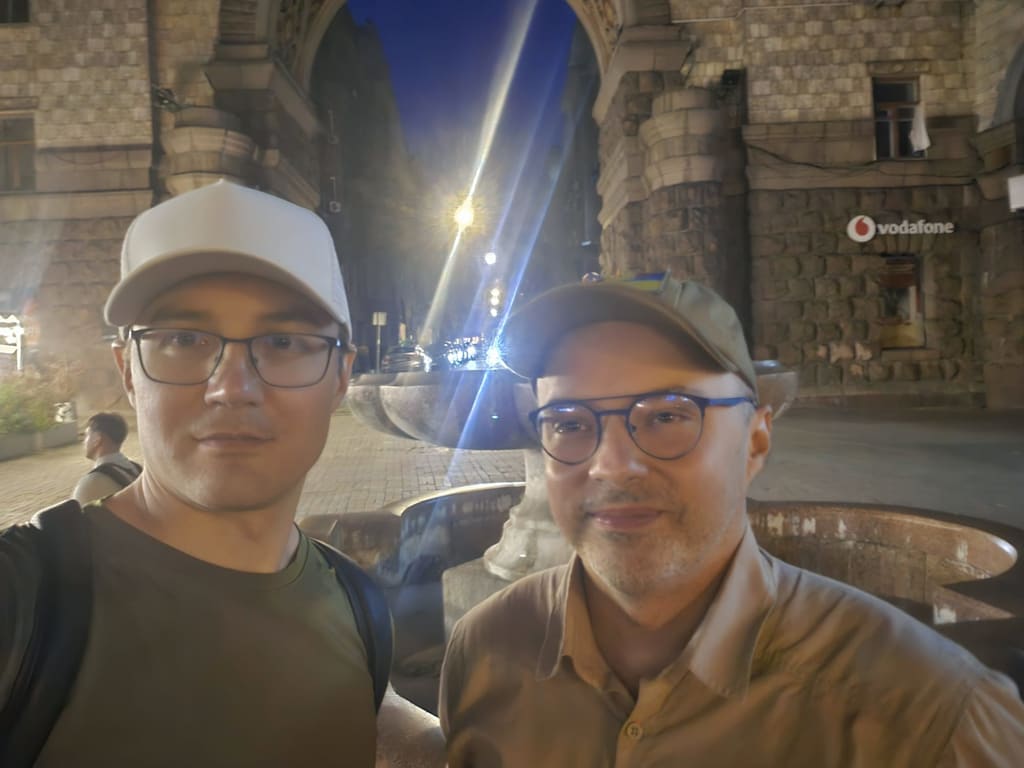
George Mihaita is a Romanian English teacher, authorized translator, humanitarian volunteer, and citizen journalist active in Ukraine. An educator with more than a decade of teaching experience, he has taught Romanian and Ukrainian students, including Ukrainian civilians and military personnel. His volunteer activities include language education, humanitarian assistance, accessibility projects, and documenting the effects of Russian attacks. Mihaita also advocates for Ukrainian sovereignty and promotes greater cultural and linguistic exchange between Romania and Ukraine.
In this interview, Scott Douglas Jacobsen speaks with George Mihaita about humanitarian volunteering, language education, and life in wartime Ukraine. Mihaita discusses building an accessibility path, documenting attack sites, encounters with police, and teaching English and Romanian to Ukrainians. He reflects on language identity, Russian-speaking Ukrainians, stigma facing men abroad, Romanian attitudes toward Russia, and the growing importance of English. He also considers future cultural ties between Romania and Ukraine during postwar reconstruction.
Scott Douglas Jacobsen: How do you feel now that you have put so much time and volunteer work into teaching English and doing humanitarian work?
George Mihaita: Yes, something I did not tell you about, because it is a rather recent project, is that I am building a path in the Ivankiv area. It is about 80 to 85 kilometres north of Kyiv. There is a small village where a woman who uses a wheelchair lives at the end of a roughly 50-metre dirt path. She cannot get out of her own backyard when it rains.
I am building the path using my own funds, with the exception of 10,000 hryvnias that were donated to me by Ukrainians I teach. So, thank you, Dmytro, and his wife, Nadiia; Nadiia means “hope.”
Now, how do I answer your question? It is hard to say. I would never... Sometimes, I have to be honest, we have a rough night. I try to make my way to the sites that have been attacked, either to lend a hand or simply to take pictures and show this dramatic reality that my own people back home refuse to acknowledge. I want to shove it down their throats without any lubricant whatsoever.
Sometimes I cannot find the place. Sometimes people become suspicious simply because I ask where it is, and I am sure you can empathize with this. Sometimes I get picked up by the police because people think I am taking too many pictures.
Jacobsen: Yes, I have been accused of being a Ukrainian spy, a Russian spy, an American spy, and a Chinese spy, and more!
Mihaita: You put yourself out there much more, so it is bound to happen.
Jacobsen: Apparently.
Mihaita: In my case, there was only an insinuation that I might be a Romanian spy, which I found quite flattering because, I guess, if I were, we would be on the same side. Nobody ever thought I was Russian because, I guess, my Russian is far too bad for me to be a viable Russian spy.
I have also been accused of being a war tourist. Unfortunately, I understand that as well. I would not want somebody taking pictures of my house if it had just been bombed.
Jacobsen: Correct.
Mihaita: And I understand it. I have spent dozens of hours in police custody while they were simply looking through my pictures. At the end, they would say, “Thank you for your service. Keep up the good work,” and that was it.
Jacobsen: What do Ukrainians say when you have finished teaching them English and they have genuinely learned something? It is something they care about. They want to learn English.
Mihaita: Well, usually they say, “Thank you, George, for your time, and thank you for your lesson.”
Jacobsen: What is the demographic of the people who come to you?
Mihaita: There is something to be said about this. I do not know exactly why, but the vast majority of Ukrainians who are looking to learn either English or Romanian from me are women.
Jacobsen: Is part of that because women have the ability to leave the country?
Mihaita: Well, first, there is that. Second, there are, of course, Ukrainian men as well. But I think there is a stigma attached to being a Ukrainian man in another country, and that prevents some of them from engaging too much.
But I always make sure that, in my class, no Ukrainian ever feels judged. And I say “no Ukrainian” because, over time, a woman from Moldova also joined us. She actively supports Ukraine, so she joined the class as well.
Nobody ever... This has to do with my professionalism. I always make sure that I listen and do not judge, with the obvious exception that there are some limits. Those limits are obvious and implicit in my position in all of this. So there is no false equivalence between Russian casualties and Ukrainian casualties.
There is no question, let us say, and sometimes this is brought up, of what kind of justice Russian soldiers who have been mobilized deserve. In my view, they face the consequences of combat for participating in the invasion of Ukraine. Or, to put it more bluntly, the consequence of being killed in combat while invading another country.
That is about as politely as I can put it.
Again, some of my students speak Russian. This repeatedly comes up as a topic because some have made the effort to switch to Ukrainian as their main language. Others still use Russian at home, whether they are now living in Spain, Finland, or Romania. They are spread all over the world, but for some of them Russian remains their native or primary home language. Some of the other students frown upon this.
This is not, and has never been, my subject. I always say that my job is to support Ukraine. As long as we are clear about that, I am not going to judge a family that, for various reasons, has not had the time, opportunity, or resources to switch completely to Ukrainian. Of course, I think it would be better if they did, but it is not my place to judge them, so we avoid turning it into a point of conflict.
Jacobsen: Yes.
Mihaita: I try to impart that outlook to the others. Of course, credit should go to those who have made the effort to speak Ukrainian, but it is not my place, or to some extent their place, to judge the others.
Some men are in Ukraine fighting. Some men are in Bucharest. Their individual circumstances and choices differ. Again, this is not something I am in a position to judge, and I do not want it to become part of the subject. But it does come up repeatedly.
Of course, during an English class, there will be subjects such as travel. Immediately, we have an issue. Some people can travel, while others cannot. I think one reason some Ukrainian men avoid these classes is that they know sensitive subjects like this are likely to come up.
I am proud to say that two men do attend my Romanian classes, and I feel that this can be even more sensitive.
Mihaita: Because of the large number of Putinists, I simply call them baboons.
Jacobsen: Baboons?
Mihaita: Putinist baboons that we have in Romania. That is another subject I do not want to waste time on, and I make my position very clear. I am here to capture the truth and shove it down their throats.
But I also tell my students, “You should protect yourselves,” because, you know, people in Berlin in the 1930s also felt safe until suddenly they did not. Unfortunately, we also have a very popular political movement in Romania that I regard as pro-Russian.
But, yes, the demographic of my students is mostly middle-aged Ukrainian women. Most of them have children, and many would also like their children to learn English with me. We are still looking into the possibility of creating a separate group for the children.
Jacobsen: Do you think English will eventually become the second most widely spoken language in Ukraine?
Mihaita: Well, as you can see, there is a long way to go. Unfortunately, I think part of the problem comes from the isolation of the post-Soviet environment.
But I think that, if all things go well, yes. Russian is still a strong competitor, of course. If English ever does become the second most widely spoken language, I will be proud to call even one percent of that my work.
Jacobsen: Are there many Romanians who want to learn English or Ukrainian?
Mihaita: There is consistently a healthy number of Romanians who want to learn English, and many people in Romania speak English to some degree.
Ukrainian, on the other hand, no. I have only met Romanians who wanted to learn Ukrainian partly as a political statement because they support Ukraine.
Jacobsen: Other than that, no?
Mihaita: No. They want to learn it because they support Ukraine, because they want to understand the culture better, and because they understand that language is a vessel for cultural identity and, to some extent, personal identity.
You cannot fully understand Shevchenko, Taras Shevchenko, unless you read him in Ukrainian, just as you cannot fully understand Shakespeare if you read him only in Romanian.
But that is pretty much the extent of it for now. I am confident that this will change and that the numbers will grow as we move from active war into rebuilding. Inevitably, as neighbouring countries, Romania and Ukraine will be doing more together.
I recently met a Romanian man who moved here to work in agriculture, so some people are already looking into opportunities like that. I do not think there will be a flood of people coming until there is some sort of end to the war, of course, because nobody wants to get bombed.
I have also met a few Romanian volunteers who take aid to eastern Ukraine. But they are really focused on their work, not so much on learning the language and culture.
Jacobsen: Thank you very much for the opportunity and your time, George.
Scott Douglas Jacobsen is a blogger on Vocal with more than 200 publications on the platform. He is the Founder and Publisher of In-Sight Publishing (ISBN: 978–1–0692343; 978–1–0673505) and Editor-in-Chief of In-Sight: Interviews (ISSN: 2369–6885). He writes for International Policy Digest (ISSN: 2332–9416), The Humanist (Print: ISSN, 0018–7399; Online: ISSN, 2163–3576), Basic Income Earth Network (UK Registered Charity 1177066), Humanist Perspectives (ISSN: 1719–6337), A Further Inquiry (SubStack), Vocal, Medium, The Good Men Project, The New Enlightenment Project, The Washington Outsider, rabble.ca, and other media. His bibliography index can be found via the Jacobsen Bank at In-Sight Publishing, comprising more than 10,000 articles, interviews, and republications across more than 200 outlets. He has served in national and international leadership roles within humanist and media organizations, held several academic fellowships, and currently serves on several boards. He is a member in good standing in numerous media organizations, including the Canadian Association of Journalists, PEN Canada (CRA: 88916 2541 RR0001), Reporters Without Borders (SIREN: 343 684 221/SIRET: 343 684 221 00041/EIN: 20–0708028), and others.
Image Credit: George Mihaita.
About the Creator
Scott Douglas Jacobsen
Scott Douglas Jacobsen is the publisher of In-Sight Publishing (ISBN: 978-1-0692343) and Editor-in-Chief of In-Sight: Interviews (ISSN: 2369-6885). He is a member in good standing of numerous media organizations.
Enjoyed the story? Support the Creator.
Subscribe for free to receive all their stories in your feed.
Comments
There are no comments for this story
Be the first to respond and start the conversation.