
CaptainAustinShark returns with Oracle:
The Album That Proves he's Only Just Getting Started.

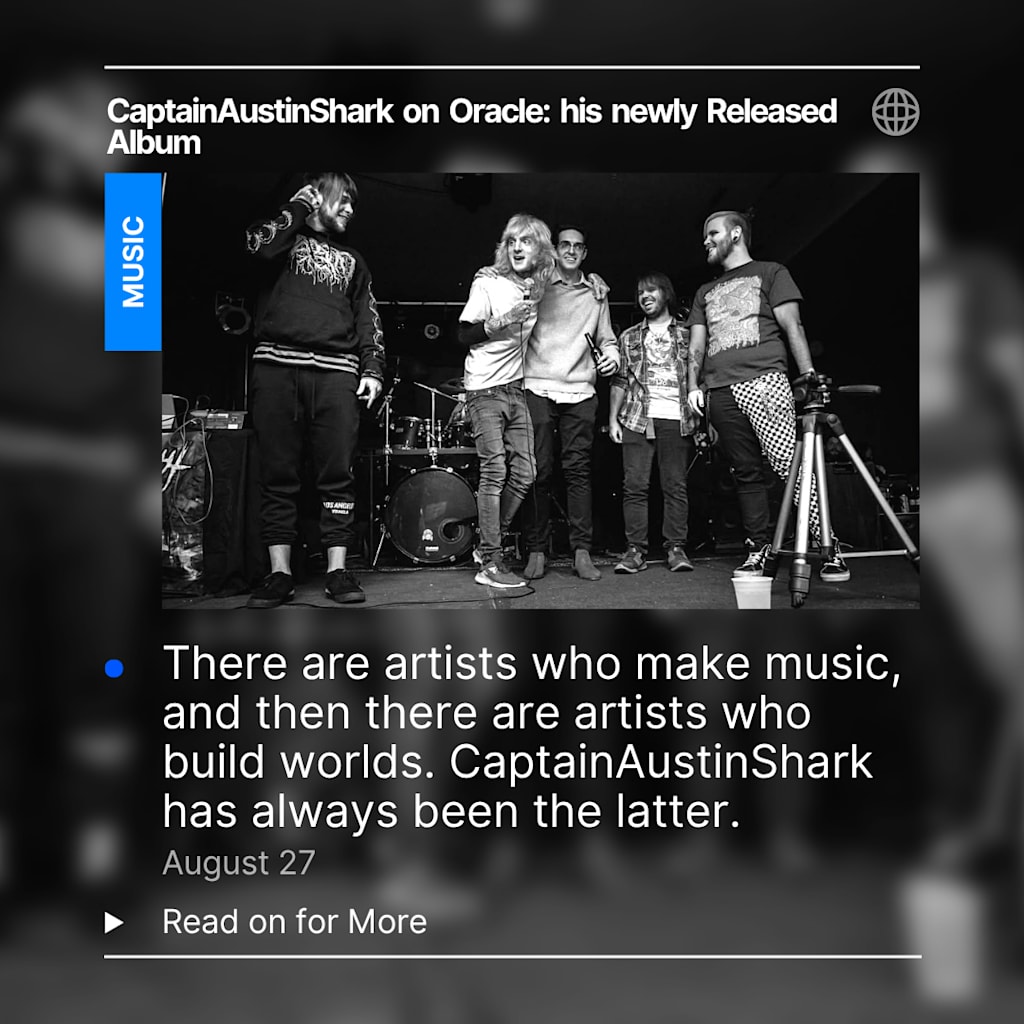
From his humble beginnings in a small Midwestern town, Austin has steadily carved out a sound that is entirely his own: a blend of experimental compositions that feel both melodic and deeply emotional. What truly sets him apart is his refusal to be boxed in. Track by track, he's built a loyal following, a distinct voice, and a reputation for turning personal pain into something more powerful.
After years of much anticipation, he returns with Oracle, a testament to the idea that we can transform our pain into something meaningful. And in true CaptainAustinShark fashion, he's not just giving us music. He's giving us a glimpse into his evolution as an artist, a survivor, and a storyteller.
I've sat down with Austin to discuss his journey, his struggles, and what he hopes fans will take away from his music.

The Name Behind the Music
CaptainAustinShark is not a stage name, it's an autobiography.
"In certain shark species, like sand tiger sharks, survival begins before birth—the developing embryos can consume their siblings in the womb, meaning before they ever see the ocean, they're already fighting for the chance to exist. That always resonated with me because, in my own way, I was introduced to survival before I was introduced to safety."
CaptainAustinShark
As someone who has walked through grief and found music to be a lifeline, I don't just hear what he's saying—I feel it. Like many of you reading this, I know what it's like to navigate the world with a sensitive nervous system, to carry loss, and to search for connection in places that often feel isolating.
He grew up with abuse, neglect, grief, instability, bullying, hunger, and betrayal—circumstances he never asked to inherit. But he refused to let those experiences define him.
"The shark isn't a symbol of being vicious or heartless to me. It's a symbol of what happens when something is handed a cruel beginning and is forced to adapt just to make it to tomorrow. And then there's the 'Captain'—the part of me that eventually decided survival wasn't enough; I wanted control of where my life went next."
CaptainAustinShark
The shark represents what survived. The Captain represents taking command of what survived.

A Soundtrack for the Unseen
I asked him how he would describe his music to someone who's never heard it. He didn't give me a genre. He gave me a feeling.
"I'd describe my music as what happens when emotions become too big for words alone. It can be beautiful and almost comforting one moment, then chaotic, overwhelming and unsettling the next—because that's how life actually feels."
CaptainAustinShark
He's less interested in fitting into a genre than he is in capturing the emotions people struggle to explain: grief, anger, isolation, love, numbness, fear, hope, and everything in between.
"More than anything, I want someone listening during a moment when they feel completely misunderstood to hear my music and think, 'Someone finally put a sound to what I'm feeling.' I don't just want people to hear my music—I want them to recognize a piece of themselves in it and realize they were never as alone as they thought they were."
CaptainAustinShark
The People Who Shaped Him
When I asked Austin about the artists who inspired him, his answer went beyond music.
"I'm inspired by people who refuse to become what happened to them—people who take pain, rejection, failure, or being misunderstood and turn it into something that gives their life meaning."
CaptainAustinShark
Musically, he admires artists who aren't afraid to evolve, take risks, and create their own world instead of chasing what's popular. But his deepest influences were closer to home.

"The ones who loved me, the ones who hurt me, and even the versions of myself I had to outgrow. I learned that inspiration doesn't always come from someone you want to become—sometimes it comes from something you survived and promised yourself you'd never become."
CaptainAustinShark
The Art of Turning Pain Into Sound
When I asked which song best captures the process of turning pain into creativity, he didn't point to a single track—he pointed to a philosophy.
"There are a few, but I think the songs that capture it best are the ones where I'm not trying to make pain sound beautiful—I'm trying to make it honest."
CaptainAustinShark
For him, writing gives overwhelming feelings somewhere to go. He takes moments of powerlessness and transforms them into something enormous through music.
"The experience doesn't disappear, but my relationship with it changes. I can't always control what hurts me, but I can decide what that pain becomes. And if somebody hears that song while going through something similar, then something that once hurt one person can potentially help another."
CaptainAustinShark
Even for someone who channels pain so powerfully into music, the creative process isn't always smooth.
"Definitely. And strangely, I think some of my worst creative blocks came from trying too hard to create something good. The second you start asking, 'Will people like this? Is this better than my last song? Is this impressive enough?'—you stop creating and start auditioning."
CaptainAustinShark
The way through? He had to learn to make things badly again.
"To write the stupid line, make the weird sound, follow an idea that might go nowhere. Because you can edit something imperfect; you can't edit a blank page. Perfectionism taught me how to judge my art. Curiosity taught me how to make it again."
CaptainAustinShark
I asked if there was a specific moment when everything shifted.
"I don't think there was one giant movie moment. It was more like I looked backward one day and realized there was actually a road behind me. Songs existed that once only existed in my head. People I'd never met were listening. I had an identity, a body of work, mistakes I'd learned from, and ideas I couldn't have created when I started."
CaptainAustinShark
"I'm still nowhere near finished. But that was an important realization: sometimes progress is invisible when you're facing forward. You have to turn around occasionally to see how far you've actually walked."
CaptainAustinShark
The Story Behind the Sound
Oracle is not just an album—it's a message. It's a testament to the idea that we can transform our pain into something meaningful.
"Oracle feels less like a collection of songs and more like entering a world. With previous work, I was learning how to express what was inside me. With Oracle, I wanted to understand why it was there in the first place."
CaptainAustinShark
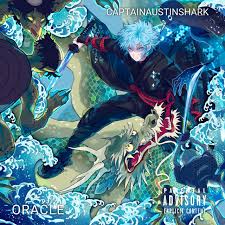
The album confronts identity, trauma, mortality, anger, isolation, spirituality, and the war between who you were, who the world tells you that you are, and who you're trying to become.
"Even the title Oracle plays into that idea: everyone wants something to tell them what happens next, but sometimes the answer you're looking for is buried in the parts of yourself you're afraid to confront."
"This album isn't me predicting the future. It's me interrogating the past so it stops predicting mine."
CaptainAustinShark
The Hardest Part: Honesty Without Armor
I asked him what the hardest part of making this album had been.
"Knowing when to stop protecting myself from my own writing. There are things that are easy to turn into metaphors because metaphors give you somewhere to hide. With this album, there were moments where I had to ask myself, 'Am I writing what sounds powerful, or am I writing what's actually true?' Those aren't always the same thing."
"The hardest part wasn't making darkness sound beautiful. It was admitting which parts of that darkness were mine."
CaptainAustinShark

One track on the album, "574," carries a weight that goes beyond music. It's named after the area code of South Bend, Indiana, the town we both up in. A place that can feel like a trap, a cycle, a gravity that pulls you back even after you've left.
Oftentimes growing up I'd compare South Bend to that of Silent Hill, a town in a video game of the same title, where evil spawns and shapes itself to torment you in a way that is specific to your sins and tragedy.
In the song, he sings with a raw, defiant energy, words that feel less like lyrics and more like a survivalist's chant. It's an ode to a place that shaped him, marked him, and almost kept him.
It's like a curse, many of us had come to this conclusion on our own, "If you leave, never, ever, come back."
I know this fear all to well myself. I moved overseas, and still, I have nightmares about returning , about missing my flight back to Aotearoa, New Zealand. That's the kind of hold a place like South Bend can have. It's not just the geography, it's the weight of everything you survived there.
Samurai, Yokai, and the Courage to Keep Fighting
The artwork for Oracle reflects this internal battle. It depicts CaptainAustinShark as a samurai standing against yokai—mythical creatures from Japanese folklore.
"The samurai and yokai aren't really about a literal battle—they represent an internal one. The samurai is the version of me that keeps getting back up, and the yokai represent everything you can spend your life fighting: trauma, fear, depression, expectations, memories, self-doubt, and sometimes yourself."
"What I love about the imagery is that the samurai doesn't need to be shown as someone who has already won. Courage isn't standing over a defeated monster. Sometimes courage is standing in front of something terrifying and raising your sword anyway. You don't have to be fearless to keep fighting. Sometimes showing up to the battle is the victory."
CaptainAustinShark
"Severed heart strings can't sing without an inspiring sympathy."
This line, from his track "Die a Fable" has always sent chills down my spine. It's delicate, heartbreaking, and achingly human.
Lyrics That Grow With You
He writes in a way that allows his listeners to find new meaning over time.
"I actually love writing that way because I want someone to be able to hear a lyric at 20 and understand it completely differently at 30."
CaptainAustinShark
He explained that imagery like oceans, burial, monsters, decay, battles, cages, bodies, flowers, and death isn't necessarily literal.

"Death, for example, can represent the death of an identity rather than a person. A monster can be trauma. A battle can happen entirely inside someone's head. Even something rotting can represent transformation, because decay isn't only an ending—it becomes the material something."
CaptainAustinShark
A Mission to Connect
Throughout our conversation, it's clear that for CaptainAustinShark, it was never about the fame or the money. It was always about the people.
"Connection is probably the entire reason I still make music. Money can disappear, attention moves on, algorithms change, and eventually somebody newer comes along. But if a song finds somebody at two in the morning when they feel like nobody understands them, and for four minutes they don't feel completely alone—that's real."
CaptainAustinShark
With Oracle, he hopes to do that again—to create something that helps listeners feel seen and understood.
"I've spent enough of my own life feeling misunderstood to know how powerful it is when something finally makes you feel seen."
"I don't need listeners to have lived my exact life; I just want them to recognize some part of themselves in mine. I'd rather mean everything to a small number of people than mean nothing to millions."
CaptainAustinShark

Looking Forward
When I asked where he would want to perform overseas, his answer was immediate: Japan.
"There's so much about Japanese art, history, mythology and visual storytelling that fascinates me, and those influences have found their way into the world surrounding my music. To actually experience the country instead of admiring it from thousands of miles away would mean a lot."
"To take something I created in my own little corner of the world and hear people singing it back on the other side of the planet would be one of those moments where you'd have to stop and ask, 'How did I get here?'"
CaptainAustinShark
He admitted his dream isn't about the size of the venue:
"I've learned that ten people who genuinely care can mean more than ten thousand people staring at their phones. The dream isn't really to play the biggest room. It's to someday walk into a room anywhere in the world and realize the people inside came because something I created mattered to them."
CaptainAustinShark
When I asked who he'd want to share a stage with, his answer was humble:
"At this point in my life, I'd be grateful for anyone willing to take a chance on me. I'd be thankful for any opportunity given to me."
CaptainAustinShark
How It Feels to Return
I asked Austin how does he feel after his much awaited return:
"It feels different now because I'm not making music from the same person I used to be. I've lost things, survived things, questioned myself, stopped, started again, and had moments where walking away would've been much easier."
"Every release is evidence that whatever happened to me didn't get the final word. I'm not returning because nothing hurt me. I'm returning because it did hurt me, and somehow there's still something inside me that wants to create. There's something incredibly freeing about realizing you can be damaged by a chapter without allowing it to become the ending."
CaptainAustinShark

Where to Find Him
"Search CaptainAustinShark wherever you listen to music or follow artists online. I actually like telling people to search the name rather than sending them toward one specific platform, because wherever you find me—music, visuals, posts—you're finding another piece of the same world."
"And if you're discovering me because of this interview, welcome. You don't have to know the whole story to start in the middle of it."
CaptainAustinShark
A Final Word
"Especially for the person reading this who feels behind in life, misunderstood, unwanted, or like everybody else received some instruction manual for being human that you somehow missed: please don't mistake a difficult beginning for a predetermined ending."
"I can't give anyone some perfect answer for that. What I can tell you is that some of the things I once thought were proof that I was broken eventually became the things I created from."
"That's why I make this music. Not because I conquered everything. Not because I have life figured out. But because I'm still here figuring it out alongside you."
"So if CaptainAustinShark ever means anything, I hope it means this: You can come from violent waters without becoming the storm that hurt you."
CaptainAustinShark
---
About the Creator
Adrian
I'm a storyteller at heart—whether that's poetry, gaming articles, or quiet reflections of the world around me. When I'm not writing, you'll find me sketching, gaming, or getting lost in a good book.
Enjoyed the story? Support the Creator.
Subscribe for free to receive all their stories in your feed. You could also become a paid subscriber, letting them know you appreciate their work.
Comments