
WITCH ROAD:
The Wisconsin Road That Became a Legend of Witches and the Dead

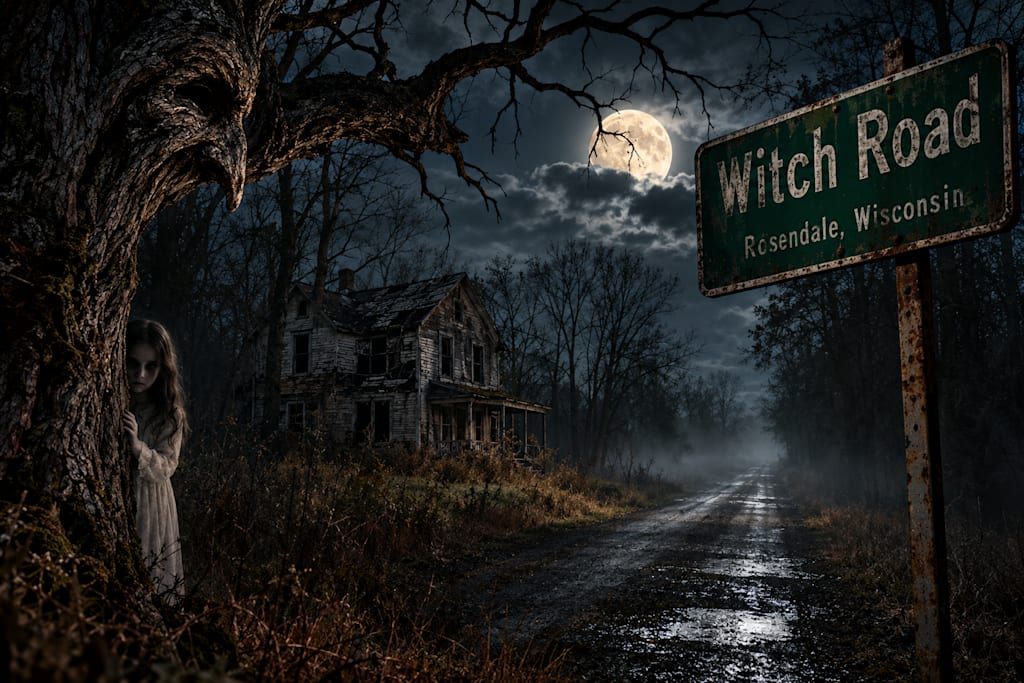
An abandoned farmhouse. Two sisters who lived far from the public eye. A child said to linger among the trees. And a lonely Wisconsin road where folklore transformed ordinary lives into something far more sinister.
What happens when a real place, real people, and decades of whispered rumors become tangled together until nobody can separate the truth from the nightmare?
In the quiet countryside of Fond du Lac County, Wisconsin, there is a stretch of rural road known by a name that sounds as though it belongs in a horror movie rather than on a map.
Witch Road.
Its reputation has been built on stories of an old woman accused of practicing dark arts, a decaying farmhouse swallowed by the landscape, strange lights appearing between the trees, and the ghostly figure of a young girl who supposedly watches from the shadows.
Visitors have described unusual cold spots, unexplained sounds, and an oppressive darkness that seems to settle over certain sections of the road after sunset. Some stories claim that a twisted tree resembles the face of an old witch, its branches forming the outline of a crooked nose and a hunched figure.
And then there is the house.
Or, more accurately, what remains of the story of the house.
Because beneath the paranormal claims lies something much more tangible: a rural property with a documented family history, two sisters who lived there for decades, and a community whose rumors eventually helped transform the location into one of Wisconsin's most recognizable haunted-road legends.
But were these women ever witches?
Was a child ever harmed?
Did something terrible happen on this isolated stretch of countryside, or did generations of imagination turn privacy, loneliness, and an abandoned building into a supernatural spectacle?
To investigate Witch Road, we must travel backward through the folklore and examine the people who became trapped inside it.
And the deeper we look, the more unsettling the story becomes.
Not necessarily because we find evidence of ghosts, but because we begin to see how easily a real person's life can disappear beneath the weight of a legend.
🌲 A Road with a Dark Reputation
Witch Road is commonly identified as Callan Road, a rural stretch branching off Highway KK in the Fond du Lac County countryside. Sources variously associate it with Rosendale, Ripon, and the nearby community of Metomen.
That geographical inconsistency is worth noting. The road's popular paranormal identity is much better established online than a single, universally consistent description of its exact location.
Unlike the grand haunted mansions and abandoned institutions that attract ghost hunters, Witch Road's appeal comes from its ordinary surroundings.
This is rural Wisconsin: open fields, wooded patches, quiet roads, and properties separated by stretches of land where the nearest neighbor may be difficult to see through the trees.
During daylight, a country road can appear almost aggressively unremarkable. Sunlight spills across the pavement or gravel. Birds move through the hedgerows. Leaves rustle in the wind. The landscape belongs to farmers, wildlife, and the slow rhythm of the seasons.
After dark, however, the same environment can become something else entirely.
Headlights illuminate only a narrow corridor. Trees gather along the roadside, their branches overlapping overhead. A deer standing motionless beyond the ditch can resemble a human figure until it turns its head. A crooked branch catches the light, creating the suggestion of a face where there is only bark and shadow.
The darkness beyond the headlights becomes a blank space into which the imagination can pour almost anything.
And Witch Road has given that imagination plenty to work with.
Paranormal accounts describe strange white lights among the trees, areas that supposedly become unnaturally cold, unexplained noises, and the appearance of a little girl hiding behind trunks before disappearing into the woods.
Some versions of the legend also mention the sound of trickling water, even when travelers cannot identify a nearby stream.
These reports have circulated through Wisconsin paranormal websites, local-interest publications, and haunted-location lists. They are part of the road's modern folklore, although their original witnesses, dates, and circumstances are not consistently documented.
That distinction matters.
The stories exist. The legend exists. But the existence of a story is not proof that the events described in it occurred.
Still, one question remains: why did this particular road acquire such a sinister reputation?
For that answer, we must leave the ghosts behind for a moment and examine the people who may have inspired them.
🏚️ The Farmhouse That Became a Nightmare
According to the most frequently repeated version of the legend, a mysterious older woman once lived in a house along the road.
The property was isolated, and the woman supposedly kept to herself. Rumors began to circulate about her behavior, her habits, and what might be happening inside her home.
In some tellings, she was accused of practicing witchcraft. Other versions describe ominous chanting coming from the house, while later accounts portray her as an evil figure responsible for the haunting that followed her death.
Eventually, the woman died, and the house was abandoned.
Or so the simplified legend goes.
The real history appears more complicated.
An article published by Volume One in October 2014, titled “7 Legendary Wisconsin Monsters,” described Witch Road through the familiar story of an isolated woman living in a dilapidated house. That account placed the woman's residence approximately seven decades earlier and repeated rumors about ominous chanting and supposed unholy rituals.
Other paranormal accounts describe a ruined house in the woods, a gnarled tree associated with the witch, and unexplained phenomena along the road.
Over time, the farmhouse became more than an abandoned building. It became the physical centerpiece of the legend.
A decaying house is an invitation to speculate. Broken windows suggest secrets. Collapsing walls seem to conceal histories that nobody wants to discuss. An overgrown yard gives the impression that nature itself is trying to erase something.
When the people who once occupied a building are no longer there to explain themselves, the building becomes a blank page.
And on Witch Road, people filled that page with witches, ghosts, and a child who could never quite escape.
Yet the historical record offers a different starting point, one involving a family whose names can actually be identified.
👁️ Grace and Gertrude Thorndike: The Women Behind the Legend
One of the most important historical details associated with Witch Road comes from reporting by Wisconsin Frights, which identifies the former residents as twin sisters Grace and Gertrude Thorndike.
According to that account, John and Cleora Thorndike purchased a farm in the area in 1893. Their twin daughters, Grace and Gertrude, were born in 1894 and continued living at the family property after their parents died.
Grace died in 1971.
Gertrude remained the last living member of the family at the property until her death in 1987.
These dates are significant because they give the story something the supernatural claims frequently lack: identifiable people and a historical timeline.
The sisters apparently lived on the property for decades. Later accounts describe them as private women who rarely ventured into town, and rumors surrounding their secluded lives eventually became attached to the witch legend.
The distinction between what is documented and what is alleged is crucial here.
The names, family connection, property history, and reported death dates provide a starting point for historical investigation. The accusations of witchcraft, however, are not established by those facts.
There is no reliable evidence presented in the commonly circulated accounts that Grace or Gertrude practiced witchcraft, harmed children, or committed a supernatural or criminal act.
Nor does the fact that the sisters lived privately establish that anything sinister occurred behind their doors.
Think about that for a moment.
Two women spend much of their lives on a family farm. They do not socialize extensively, or at least that is how later accounts characterize them. Their lives are unfamiliar to people outside their immediate circle.
Their privacy becomes a source of speculation.
Speculation becomes rumor.
Rumor becomes a story about witchcraft.
And eventually, their home becomes associated with a haunting that outlives the people who once lived there.
We should be careful not to turn the sisters into villains simply because later generations found their lives mysterious.
We also should not assume we know how they felt about their isolation, what their relationships with their neighbors were like, or what truly happened inside their home. Those details require historical records, not imaginative reconstruction.
What we can say is that their story illustrates how an ordinary family history can become distorted when the people involved are no longer around to defend their own names.
The most disturbing part of Witch Road may not be the possibility of a ghost. It may be the way two real women became characters in a story they could never correct.
🕯️ When Did the Witch Story Begin?
This is where the investigation becomes more difficult.
There is no clearly established, independently verified date for the first telling of the Witch Road legend in the sources commonly cited today.
The online accounts repeat similar details, but repetition does not necessarily mean independent confirmation. Several websites may be drawing from the same local story, an earlier article, or one another.
The October 2014 Volume One article is a traceable published account of the legend. A 2016 paranormal article from Horror Addicts also described the road, repeating the claim that a witch had lived there roughly six decades earlier.
Neither account, by itself, establishes when the rumor originated.
The story may have circulated orally for years before it appeared in print. That is entirely possible. Rural legends are often passed between neighbors, repeated during gatherings, and shared with younger generations long before anyone thinks to record them.
But possibility is not documentation.
To establish the earliest version with confidence, researchers would need to examine historical newspaper archives, property records, obituaries, census records, and interviews with people who can identify when and how the story first circulated.
The Rosendale Historical Society maintains local historical materials, including old newspapers, cemetery records, and historical plat books. Those collections offer a promising starting point for investigating the property's history and the people associated with it.
A systematic search could potentially establish when the Thorndike family occupied the property, whether contemporary newspapers mentioned the family or the house, and when the witch story first began appearing in the public record.
Until that work is completed, the responsible conclusion is that the legend's earliest origins remain uncertain.
And that uncertainty is fascinating in its own right.
Because the absence of a documented origin leaves us with a question that no ghost story can answer on its own: did the legend begin with an actual incident, a misunderstanding, a neighborhood rumor, or the slow transformation of an unusual but otherwise ordinary family into a source of local fascination?
We simply do not have enough verified evidence to choose one explanation.
🌳 The Witch in the Trees
One of the most enduring details associated with Witch Road is a gnarled tree whose branches supposedly resemble an old woman's face.
It is a small detail, but it reveals a great deal about the way haunted places acquire their reputations.
Imagine driving along a wooded road at night. Your headlights sweep across a cluster of trees. One trunk bends at an awkward angle, and several branches jut outward like crooked fingers.
For a fraction of a second, the arrangement resembles a hunched figure.
You look again.
The shape is still there.
Now imagine that somebody has already told you a witch lives in those woods.
The tree is no longer just a tree. It has become a possible witness, a landmark, and a supposed manifestation of the legend itself.
This is one reason visual details become so powerful in paranormal storytelling. Once people expect to see a particular shape, their brains naturally search for patterns that match the expectation.
That does not mean every witness is lying. People can sincerely report what they believe they saw while still misinterpreting what was actually there.
Low light, unfamiliar surroundings, moving branches, shadows, and heightened anticipation can all affect perception.
The tree's alleged resemblance to a witch may therefore be an example of folklore shaping the way people interpret the landscape.
Or it may simply be an eerie-looking tree that became famous because it happened to grow beside a road with a frightening reputation.
Either explanation is possible.
What has not been established is that the tree represents a supernatural being or that it has any connection to the deaths of the Thorndike sisters.
But the image persists: an old woman's face emerging from the woods, watching the road long after the farmhouse has disappeared.
It is an image designed to stay with you.
👧 The Little Girl Who Hides in the Woods
If the witch is the central figure in the legend, the little girl is its most haunting mystery.
In several versions of the story, travelers report seeing the apparition of a young girl peeking from behind trees.
She does not necessarily approach the road. Instead, she appears to watch from a distance, disappearing when people attempt to get a better look.
Some tellings weave her into the witch's story, portraying her as a child who was somehow trapped by the older woman and is still trying to escape her.
It is a deeply unsettling image: a small figure standing among the trees, caught between the darkness of the woods and the narrow beam of a passing vehicle's headlights.
But where did the girl come from?
Was a child ever associated with the property? Is there a historical record of a death, disappearance, or tragedy that could explain her presence in the legend?
The commonly circulated accounts do not provide a reliably documented identity for the supposed apparition. They do not establish the girl's name, age, family, or date of death. Nor do they identify a verified historical event involving a child at the farmhouse that would explain the story.
That absence matters.
It would be irresponsible to invent a murdered child, attach an actual person's name to the legend without evidence, or claim that the Thorndike sisters harmed someone.
The ghost story may have developed independently of the family history. It may have been added later to make the tale more frightening. It may also have emerged from an event that has yet to be identified.
At present, those possibilities remain unresolved.
The little girl is part of the folklore, not an established historical victim.
And perhaps that is why this part of the story feels so unfinished. The legend gives her a role, but it gives us no reliable history.
We are left with a figure behind a tree, a glimpse in the darkness, and a story that refuses to tell us who she was supposed to be.
❄️ Strange Lights, Cold Spots, and Unexplained Sounds
Witch Road's reputation extends beyond its central characters.
Paranormal accounts describe strange lights appearing among the trees, localized cold spots, unusual sounds, and an atmosphere that visitors interpret as oppressive or unnatural.
Some versions mention the sound of trickling water where no obvious source can be identified.
These reports are frequently presented as evidence that something supernatural remains attached to the location.
But there are important questions to ask.
Who witnessed these events? On what dates? Under what conditions? Were photographs or recordings made? Could the lights have come from passing vehicles, distant homes, farm equipment, or other ordinary sources?
What appeared to be a sudden temperature drop could have several explanations, including wind, changing terrain, differences in air movement, or a faulty measurement.
Sounds travel unpredictably through wooded landscapes. Water, wildlife, rustling leaves, and distant machinery can become difficult to identify when the source is hidden.
None of those explanations proves that every reported experience has an ordinary cause. They simply demonstrate why individual claims must be examined before being treated as evidence of paranormal activity.
A chilling experience is still an experience. A witness may sincerely believe that something unexplained occurred.
But the conclusion that a ghost caused it requires evidence beyond the feeling that something was wrong.
In the available accounts, the alleged phenomena are not accompanied by a consistent, independently verified body of measurements, recordings, or documented witness statements that establishes a supernatural explanation.
That leaves Witch Road in the familiar territory of paranormal folklore: a location with a reputation, a collection of stories, and unanswered questions.
For some visitors, that is enough to make the road frightening.
For investigators, it is a reason to keep asking questions.
🔥 What Happened to the House?
The farmhouse is another central piece of the story.
According to Wisconsin Frights and other accounts of the legend, the building eventually became vacant and was damaged by vandalism and fire. The house was subsequently destroyed, leaving the property without the structure that once gave the story its physical center.
The precise sequence of events is not consistently documented in the popular retellings, so it is important not to assume that every detail has been independently verified.
Nevertheless, the disappearance of the house changed the nature of the legend.
An abandoned building can be explored visually, photographed, and examined for clues about its former occupants. Even without entering it, people can look at its structure and imagine the lives that unfolded inside.
Once the building is gone, the story becomes harder to investigate through physical evidence.
The house becomes a memory.
The memory becomes a rumor.
And the rumor begins to occupy the space where the house once stood.
This transformation can make a location more mysterious, not less. The absence of the original structure gives the imagination room to rebuild it in whatever form the legend requires.
The house may have been a modest farmhouse, but in the popular story it becomes the dwelling of a witch. Its former occupants become mysterious figures. Its destruction becomes another layer of the haunting.
Yet there is a very ordinary explanation for why an old rural building might disappear: buildings deteriorate, properties change hands, and abandoned structures can be damaged or demolished.
Without additional records, the destruction of the farmhouse should not be interpreted as evidence of supernatural activity or as proof that someone was trying to conceal a terrible secret.
There is also an important practical point for anyone interested in visiting the location. Reports describe the former house site as private property, and paranormal interest has reportedly attracted people who trespass or disturb the area.
The legend does not grant anyone permission to enter private land.
A haunting may be part of local folklore, but property boundaries are very real.
📰 The Legend Spreads Beyond the Countryside
Witch Road did not remain confined to neighborhood whispers.
Over time, it appeared in articles and lists devoted to Wisconsin's haunted places. Paranormal websites repeated its stories, and social media helped introduce the legend to people who had never driven through the surrounding countryside.
By October 2014, Volume One had included Witch Road in its collection of Wisconsin legends. In 2024, Q98.5 published another account of the road, describing its witch story, the alleged apparition of a girl, and reports of unexplained activity.
These publications demonstrate that the legend has circulated beyond a single isolated telling. They do not establish that its supernatural claims are true.
That distinction is particularly important in the internet age.
A story can be repeated by dozens of websites until it appears to have dozens of independent sources. In reality, those articles may be drawing on the same original account.
Each repetition adds familiarity. Familiarity can be mistaken for confirmation.
A rumor about an old farmhouse becomes a haunted-road article. The article becomes a social media post. The post attracts someone who visits the location expecting to encounter something frightening. A shadow becomes a possible apparition, and the visitor's account becomes another piece of the legend.
This is how folklore can grow without requiring a new supernatural event.
It does not mean that Witch Road's stories are worthless. Folklore tells us something about the fears, values, and imaginations of the communities that preserve it.
It does mean that historical research must distinguish between a story's popularity and the reliability of the evidence supporting it.
The more famous Witch Road becomes, the more important that distinction is.
🔎 Separating the Historical Record from the Haunting
So, what do we actually know?
The most responsible investigation separates the story into three categories.
What has a historical basis:
The road is associated with a real rural property and the Thorndike family. Wisconsin Frights identifies John and Cleora Thorndike as purchasers of a farm in 1893 and names their twin daughters, Grace and Gertrude, as later residents. The account gives their deaths as 1971 and 1987, respectively.
These details provide concrete leads for further archival research.
What belongs to the documented folklore:
The witch legend, the mysterious farmhouse, the gnarled tree, the supposed apparition of a little girl, strange lights, cold spots, and unusual sounds are all recurring elements in published accounts of Witch Road.
Their existence as stories can be documented, even when the events described within them cannot be independently confirmed.
What remains unproven:
There is no established evidence in the commonly cited accounts that either Thorndike sister practiced witchcraft, that a child was murdered or held captive on the property, that a crime explains the haunting, or that any reported apparition has been demonstrated to be supernatural.
The first telling of the legend also remains uncertain.
These gaps are not minor details. They are the difference between a compelling local mystery and a historical accusation.
If researchers wanted to investigate the legend more deeply, several avenues would be worth pursuing:
Property records: Trace the farm's ownership, buildings, and transfers over time.
Census records and obituaries: Establish a fuller timeline of the Thorndike family and their lives.
Historical newspapers: Search for contemporary references to the family, the farmhouse, fires, property damage, or the earliest appearance of the witch story.
Local oral histories: Interview long-time residents who may remember when the story first circulated and who first told it.
Paranormal documentation: Seek original witness accounts, dates, photographs, recordings, and other evidence rather than relying exclusively on repeated summaries.
The Rosendale Historical Society's historical collections and the area's newspaper archives could provide useful starting points.
Such research might uncover a more complete explanation for the legend. It might reveal an older story that has not yet been traced. Or it might show that the witch narrative developed gradually without a single dramatic event behind it.
Any of those outcomes would tell us something meaningful about Witch Road.
🕯️ Was There Really a Witch on Witch Road?
The temptation is to demand a simple answer.
Either the witch existed, or she did not.
Either the road is haunted, or it is not.
But the actual history is more complicated than those choices suggest.
We know that the road's legend has become part of Wisconsin's paranormal folklore. We have published accounts describing the alleged haunting, and we have a reported family history that offers a tangible starting point for further investigation.
What we do not have is verified evidence establishing that the Thorndike sisters were witches, that a child died under sinister circumstances on the property, or that the strange experiences described by visitors were caused by the dead.
The legend may have grown from suspicion surrounding private lives. It may have absorbed unrelated ghost stories. It may preserve an event that has been distorted by decades of retelling.
Without stronger historical evidence, we cannot responsibly determine which explanation is correct.
And I think that uncertainty deserves to remain part of the story.
There is something deeply unsettling about the possibility that two women lived their lives on a family farm, died, and were eventually remembered by strangers primarily through a legend that portrayed their home as the dwelling of an evil witch.
We cannot know what Grace and Gertrude would have thought of their posthumous reputations. We cannot assume that the stories reflect their actual lives.
What we can recognize is the power of a rumor to outlive the people who inspired it.
The farmhouse is gone. The women are gone. The original conversations that may have produced the legend are largely beyond our reach.
What remains is a road, a name, and a collection of stories that continue to circulate.
🌑 The Most Unsettling Thing About Witch Road
Picture the road at dusk.
The fields are losing their color. The trees have become dark silhouettes against a fading sky. Somewhere beyond the roadside, a branch moves in the wind, and a shadow shifts across the ground.
There is no farmhouse waiting among the trees now, no living witness who can explain exactly how the legend began, and no verified apparition standing at the edge of the woods.
There is only the landscape, the history we can recover, and the stories people have attached to it.
Perhaps someone will eventually uncover an old newspaper article that explains the first rumors. Perhaps a local historian will find a document that adds another piece to the Thorndike family story. Perhaps the legend will remain unresolved, passed from one generation to the next until its origins become even harder to trace.
What I find most fascinating about Witch Road is not the promise of a ghost sighting.
It is the collision between the lives people actually lived and the lives that folklore assigns to them after they are gone.
A private family becomes a mystery. A farmhouse becomes a haunted ruin. A tree becomes a witch's face. An unidentified figure becomes a lost child. And an ordinary country road acquires a reputation that transforms every shadow into a possible warning.
We may never know exactly why the legend began.
But we can investigate the people behind it, question the stories that have grown around them, and resist the temptation to mistake an eerie tale for established history.
That is where the real mystery lies.
Not in proving that the dead walk among the trees, but in understanding how the living created a story that refuses to die.
Because sometimes the most enduring hauntings are not the ones we can prove exist. They are the stories that remain long after the truth has been buried beneath them.
And somewhere in the quiet countryside of Fond du Lac County, the name Witch Road continues to invite the same question:
Are we afraid of what might be waiting in the darkness, or are we afraid of what we might discover if we finally turn on the light?
Sources and Further Reading
Wisconsin Frights: 8 Most Haunted Roads in Wisconsin
Volume One: 7 Legendary Wisconsin Monsters
Q98.5: Does Evil Await You on This Infamous Witch Road in Wisconsin?
Rosendale Historical Society
Fond du Lac Public Library: Local History and Genealogy
Note: The paranormal claims in this article are presented as folklore and reported experiences, not verified supernatural events. The earliest origin of the legend and the full historical circumstances surrounding the former farmhouse require further archival investigation.
If you enjoy dark history, Wisconsin mysteries, true crime, paranormal folklore, and the uncomfortable spaces where fact and legend collide, follow my Vocal Media profile for more investigations into the stories that refuse to stay buried.
About the Creator
Lilithea Adasia
I dig where others look away. 🖤 True crime, paranormal mysteries, uncomfortable truths, and the beautifully broken human experience. I chase the stories others bury and ask the questions others avoid. Come curious. Leave questioning.
Enjoyed the story? Support the Creator.
Subscribe for free to receive all their stories in your feed.
Comments