
Whitewater, Wisconsin: The Second Salem
Where the witches never quite left, the dead have unfinished business, and the shadows know your name.

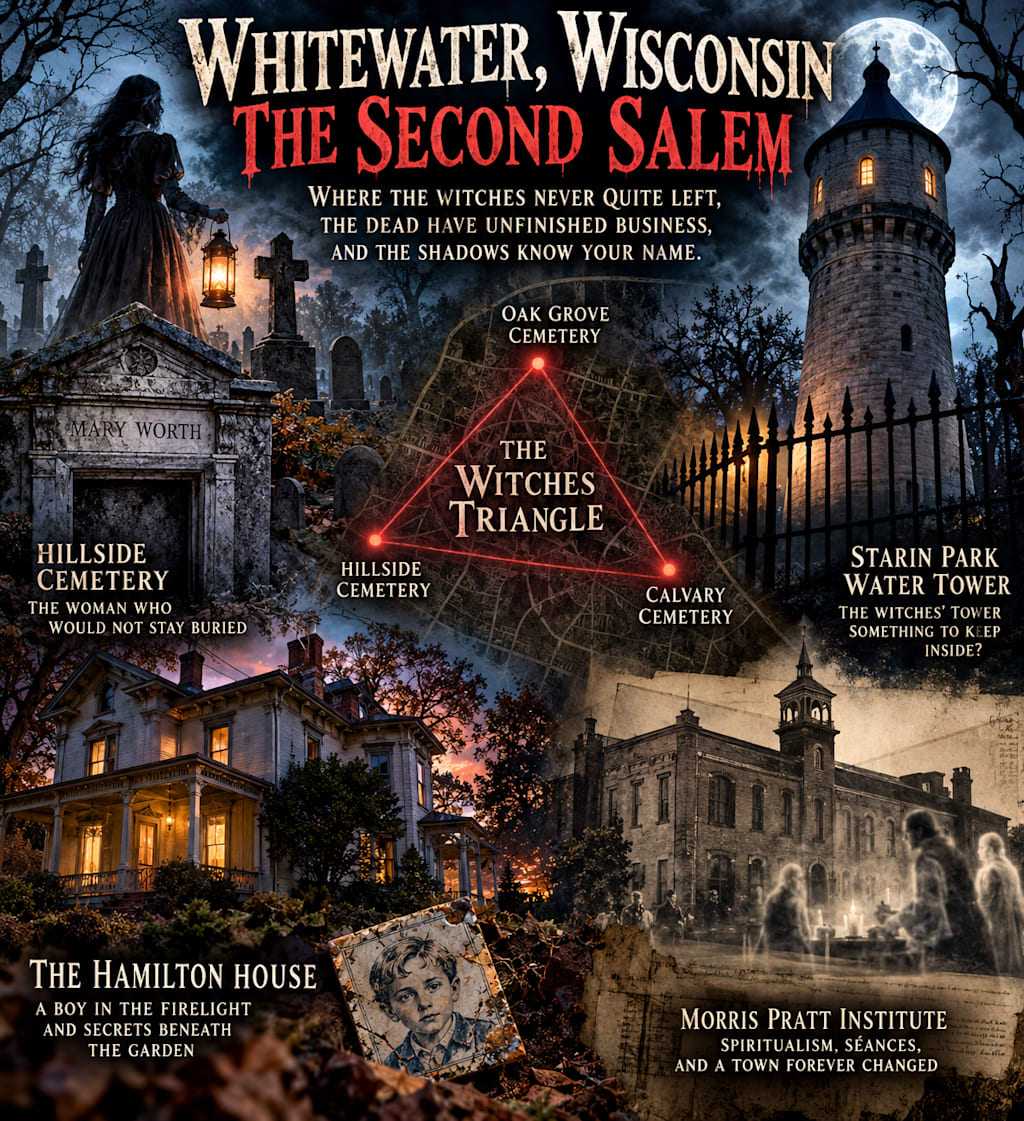
Whitewater, Wisconsin: The Second Salem
Where the witches never quite left, the dead have unfinished business, and the shadows know your name.
By Miss Lil | Dark History & Haunted Places
There are towns that wear their history proudly, displaying it in museums, polishing it into brass plaques, and printing it on little tourist brochures. Then there are towns whose history clings to the walls like damp wallpaper, whose old buildings seem to watch the street long after their windows have gone dark, and whose legends are whispered rather than spoken.
Whitewater, Wisconsin, belongs to the second category.
Nestled among Wisconsin's rolling countryside, Whitewater has acquired a reputation that would make a sensible person keep a light on and a Bible, a lucky rabbit's foot, or perhaps a particularly aggressive house cat close at hand. It has been called the "Second Salem of the United States," a title steeped in tales of witchcraft, strange occurrences, haunted landmarks, and a community fascination with the thin, unsettling line between folklore and the unexplained.
Now, before you pack your belongings, abandon your sensible shoes, and flee into the nearest brightly lit shopping mall, let us establish one thing. A spooky reputation is not proof of supernatural activity, and a ghost story is not a historical document.
But goodness gracious, darling, sometimes the stories are deliciously dreadful enough to deserve a closer look.
Because Whitewater has its Witches Triangle. It has Hillside Cemetery. It has the Hamilton House. And looming over it all, the Starin Park Water Tower offers a landmark around which local curiosity and eerie storytelling can gather.
And Miss Lil has questions.
More importantly, she suspects that by the time we finish, you might have a few of your own.
The Witches Triangle: Three Cemeteries, One Uncomfortable Question
Let us begin with the geography, because nothing says welcome to your nightmare quite like discovering that the town's most notorious legend has a map.
Whitewater's infamous Witches Triangle is formed, according to local lore, by three cemeteries: Oak Grove, Hillside, and Calvary. Draw lines between them, and you have a roughly triangular arrangement that has become central to the town's supernatural reputation. Some versions of the story claim that the entire area inside this boundary is touched by strange forces, making ordinary buildings and familiar streets potential stages for extraordinary events.
Now, geometrically speaking, three points make a triangle. That is hardly evidence of witchcraft. But folklore has never required a peer-reviewed paper before it starts making people sleep with the lights on.
The legend becomes especially intriguing when we consider what Whitewater once housed: the Morris Pratt Institute, an institution devoted to the study of Spiritualism, the nineteenth-century religious movement centered in part on communication with the dead. The institute opened in Whitewater in 1889, the same year the town's famous stone water tower was built.
Imagine living in a community where people gathered to discuss spirits, hold séances, and explore the possibility that death was not the end of human communication. To some neighbors, these practices were expressions of sincere religious belief. To others, they were strange, suspicious, and perhaps a little frightening.
As the years passed, spiritual mediums became entangled in stories of witches. Religious practice blurred into occult rumor, and rumor grew legs of its own.
Eventually, the institute disappeared from Whitewater, but the stories refused to pack their bags.
And that, dear reader, is how a town can inherit a haunting without ever agreeing on precisely what is doing the haunting.
Hillside Cemetery: The Woman Who Would Not Stay Buried
If Whitewater's legends have a leading lady, her name is Mary Worth.
Depending on which version you hear, she is described as a witch, a murderer, a woman condemned by the community, or a malevolent spirit with a grievance that death itself could not settle. The details change with the storyteller, which is one reason her tale belongs firmly to the realm of local legend rather than established historical fact.
One popular version tells of a woman denied a peaceful burial because of her supposed witchcraft. Her resting place became an above-ground crypt, and her anger allegedly gave rise to a curse connected to the Witches Triangle. In the most gruesome retellings, she rises from her grave on Halloween night and wanders among the tombstones, sometimes carrying an axe.
An axe, darling. Because apparently being dead, misunderstood, and denied eternal rest simply was not dramatic enough.
The real Hillside Cemetery is a historic burial ground and the final resting place of Morris Pratt and other notable members of the community. Its association with Spiritualism gives the site a genuine historical connection to the ideas that helped shape Whitewater's eerie reputation.
But what of Mary Worth?
The name and the stories surrounding her have become fixtures of Whitewater's supernatural folklore. The more lurid claims, however, should not be mistaken for verified criminal history.
Still, picture the cemetery on a cold October evening. The trees stand bare against a bruised-purple sky. Leaves scrape across the ground with that dry, whispering sound that makes every footstep behind you seem a little too deliberate.
You pass an old crypt.
Your flashlight flickers.
Somewhere beyond the next row of headstones, a branch snaps.
You turn.
Nothing.
And then, from somewhere behind you, comes the unmistakable sound of metal dragging over stone.
Would you look?
Miss Lil has a rule about situations like this: curiosity is a wonderful quality, but it is not a legally binding obligation to investigate every suspicious noise.
Especially when the noise might be carrying an axe.
The Hamilton House: A Boy in the Firelight
Some hauntings announce themselves with crashing doors and bloodcurdling screams. Others are far more subtle.
A shadow in a hallway.
A figure glimpsed at the edge of a room.
A child standing where no child should be.
The Hamilton House, one of Whitewater's historic homes, has accumulated precisely the kind of stories that make old houses so wonderfully unsettling. Built in the nineteenth century, the property has become associated with reports of a young boy appearing inside the house and a woman seen wandering through its garden.
According to one local tale, a decorative ceramic tile depicting a boy was discovered buried in the garden. The tile reportedly matched others around a fireplace inside the house. After it was returned to its original position, the apparitions were said to stop.
Now, is this a verified supernatural intervention? No. It is a reported legend, and the story's details should be treated accordingly.
But the image is deliciously creepy.
Imagine uncovering a face from the earth, brushing the soil away, and realizing that the little boy staring back at you belongs to a house that has stood for generations.
Who was he meant to represent?
Why was the tile buried?
And why did a story emerge connecting its return with the disappearance of the reported sightings?
There are ordinary explanations for old objects turning up in gardens. Renovations, discarded building materials, landscaping, and forgotten repairs can all leave strange little archaeological surprises behind.
Yet the human mind is a marvelous storyteller. Give it an unexplained object, an old house, and a tale of a child who appears when nobody expects him, and it will happily build you a ghost before supper.
The Hamilton House is also associated with stories of underground tunnels. Some versions suggest connections to the Underground Railroad; others weave the tunnels into tales of witches traveling unseen beneath the town. These competing accounts are part of Whitewater's folklore, not proof of a secret supernatural passage network.
And still, I cannot help wondering about the garden.
Because if a house could remember the people who once lived inside it, would it remember only their names?
Or would it remember the little things, too? The arguments behind closed doors. The footsteps climbing the stairs. The child who once pressed his hand against a warm fireplace and watched the flames dance.
And if something remained after the family had gone, would it know that the house had changed hands?
Would it understand that it was dead?
Or would it simply keep waiting for someone to come home?
The Starin Park Water Tower: Something to Keep Inside?
Every good haunting needs a landmark. Something tall enough to cast a shadow across the imagination, old enough to have secrets, and peculiar enough that people begin asking questions before they even hear the stories.
Whitewater has its tower.
Built in 1889, the Starin Park Water Tower is a remarkable stone structure with an eighty-foot masonry base supporting a steel water tank. It was an important part of the town's early water system, and it remains one of Whitewater's most recognizable historic landmarks.
But locals have another name for it.
The Witches' Tower.
According to legend, witches gathered near the tower to perform rituals. Some stories place occult activity inside the structure itself, while others suggest that the tower's position within the Witches Triangle gives it special significance.
And then there is the fence.
One of the strangest details in Whitewater's supernatural folklore concerns a fence that allegedly surrounded the tower with its spikes pointing inward. The unusual arrangement inspired a question that has haunted the story ever since: was the barrier designed to keep intruders out, or was it meant to keep something from getting out?
Now, let us pause here.
A fence installed backward is not evidence of a trapped coven. A historic water tower is not automatically a portal to the other side. There are perfectly mundane explanations for peculiar construction details.
But folklore is a creature that thrives on a good question.
Imagine approaching that tower after sunset. The masonry rises above you, pale against the darkening sky. Wind stirs the trees. The distant sounds of town grow quiet, and the tower's silhouette seems to stretch across the grass.
You know it is a water tower.
You know it was built to serve a practical purpose.
You know the stories are stories.
Then you hear footsteps on the other side of the fence.
One set.
Then another.
Then several more, moving together in a slow circle.
You look through the bars, but there is nobody there.
The footsteps stop.
And from somewhere inside the tower comes a single, deliberate knock.
Would you investigate?
Personally, I would suddenly remember an urgent appointment with my sofa.
Because if the stories of Whitewater have taught us anything, it is that a person does not need to believe in witches to recognize a poor life choice when one presents itself.
The Real Secret: Whitewater's Spiritualist Past
Here is where the story takes a fascinating turn, because the origins of Whitewater's eerie reputation are more substantial than a collection of spooky anecdotes.
In 1889, businessman Morris Pratt helped establish an institute devoted to Spiritualism in Whitewater. Spiritualism attracted people interested in the possibility of communicating with the dead, and the institute provided a place for the movement's teachings and practices. The institution eventually became known as the Morris Pratt Institute and later relocated to Milwaukee.
For its adherents, Spiritualism was not a horror story. It was a sincere religious and philosophical pursuit.
But unfamiliar beliefs can become frightening when filtered through suspicion and rumor. Practices involving séances and mediums were easily misunderstood, and in Whitewater, stories about Spiritualism gradually became mixed with allegations of witchcraft, haunted cemeteries, curses, and secret rituals.
The institute's original building was demolished in 1961. Its physical presence vanished, but the stories connected to it continued to circulate.
This is the detail I find most compelling.
Whitewater's supernatural identity did not spring fully formed from a single ghost sighting. It grew over time, shaped by real historical events, unusual religious practices, community anxieties, and the endless human appetite for a story that explains what we cannot quite understand.
The town's legends became a kind of unofficial history, passed from one generation to another.
And every retelling added another shadow.
Perhaps the most unsettling thing about the Second Salem is not whether a witch walks through Hillside Cemetery or whether something lurks inside the old water tower.
Perhaps it is how easily a real history can become a supernatural mystery, and how a mystery can survive long after the original facts have been forgotten.
Is Whitewater Really Haunted?
Let's be sensible for a moment, darling. Sensible does not have to mean boring.
There is no conclusive evidence establishing that Whitewater's landmarks are haunted by supernatural entities. Reports of apparitions, unexplained sounds, curses, and paranormal activity remain reports and legends rather than demonstrated proof.
What we can establish is that Whitewater has a fascinating history of Spiritualism, historic burial grounds, old buildings, and a collection of unusually persistent supernatural stories. The community itself embraces this heritage through its Haunted Whitewater resources and annual Spirit Tour, which explores the locations and people behind the legends.
And honestly? That history is compelling enough without pretending we can prove the unprovable.
Because folklore tells us something important about the people who create it.
It tells us what they feared, what they wondered about, whom they mistrusted, and what they hoped might exist beyond the boundaries of ordinary life.
Whitewater's stories carry all those questions.
Why do some places feel different after dark?
Why does an abandoned building seem to hold its breath?
Why does a cemetery become more unsettling when the wind drops and the trees stop moving?
There are psychological explanations for many of these experiences. Darkness limits what we can see. Expectation influences perception. An unfamiliar sound can become threatening when we anticipate danger.
But understanding those mechanisms does not necessarily make the experience less powerful.
Sometimes knowing why a story frightens us makes it even more interesting.
And sometimes, standing beneath a centuries-old tree with a cold wind slipping down the back of your neck, you simply decide that you have had quite enough intellectual curiosity for one evening.
A Final Word from Miss Lil
So, if you ever find yourself in Whitewater, Wisconsin, take a moment to explore the town's history. Learn about the Morris Pratt Institute. Discover the stories surrounding Hillside Cemetery. Look upon the old Hamilton House. And, if you pass through Starin Park, spare a glance for that stone tower that has inspired so many unsettling tales.
Remember, though, to respect private property, cemetery hours, and any posted restrictions. The dead, if the legends are to be believed, have been here a long time. They can manage without an unauthorized midnight visitor climbing their fences.
And should you hear a whisper in the dark, do not immediately assume it belongs to a restless spirit.
It could be the wind.
It could be your imagination.
It could be a perfectly ordinary sound that your nervous brain has dressed in a black cloak and handed an axe.
Or it could be something you cannot explain.
That last possibility is what keeps the stories alive.
Whitewater has earned its nickname, the Second Salem, through generations of folklore woven around a very real and unusual history. Whether you believe its haunted legends or dismiss them as elaborate tales, there is something undeniably fascinating about a town that has spent more than a century living alongside its own supernatural reputation.
Perhaps Mary Worth is nothing more than a character in a story.
Perhaps the Witches Triangle is simply an arrangement of three cemeteries on a map.
Perhaps the tower has never sheltered anything stranger than water and stone.
Perhaps.
But the next time you find yourself passing through Whitewater after dark, look toward the tower.
Watch the windows of the old houses.
Listen to the wind moving through the cemetery trees.
And ask yourself one small question.
If the stories were entirely forgotten tomorrow, would the places themselves feel any different?
Or would the town simply grow quieter, while whatever people believe they have seen continued to wait in the dark?
Sweet dreams, darlings.
And do try to keep your curtains closed tonight.
One never knows what might be watching from the other side.
Until next time, keep your eyes open, your mind curious, and your doors locked.
Miss Lil
Where the history is dark, the legends are darker, and the truth is sometimes the most unsettling thing of all.
Further Reading for the Curious (and the Brave)
Discover Whitewater: Haunted Whitewater and its legendary locations
https://www.discoverwhitewater.org/things-to-do/haunted-whitewaterWhitewater Historical Society: Spiritualism and the Morris Pratt Institute
https://www.whitewaterhistoricalsociety.org/post/spiritualism-the-morris-pratt-instituteMilwaukee Magazine: Second Salem: The Haunted History of Whitewater's Spiritualist Past
https://www.milwaukeemag.com/second-salem-the-haunted-history-of-whitewaters-spiritualist-past/
Miss Lil's note: The supernatural episodes in this article are presented as local legends and reported accounts, not verified paranormal events. The distinction matters, especially when real historical people and places are involved.
About the Creator
Lilithea Adasia
I dig where others look away. 🖤 True crime, paranormal mysteries, uncomfortable truths, and the beautifully broken human experience. I chase the stories others bury and ask the questions others avoid. Come curious. Leave questioning.
Enjoyed the story? Support the Creator.
Subscribe for free to receive all their stories in your feed.
Comments