
Whispers Beneath the Skin
The thread that unravels sanity

Prologue: The Stench of Memory
Akira Yamada, 31, lives in a city that swallows souls…. Tokyo is a concrete beast, its lights never dimming, its streets never sleeping. Yet, for all its constant noise, Akira hears something that others cannot—a persistent, nauseating hum that has haunted him since childhood…. It started the night his parents died in a car accident when he was seven. The hum was there, echoing in his skull, growing louder as the police officer whispered that they were gone. It became his only companion, a low frequency that crept into his thoughts, tainting every joyful moment.
He grew up in an orphanage, where he quickly learned that no one wanted to adopt a "troubled child" who spoke of voices under the floorboards. He grew bitter, the hum warping his perception of reality. At 18, he aged out of the system and found solace in a mundane job as a security guard at an office building, where the quiet of the nightshift matched the hollow ache inside him. He preferred the loneliness; it kept the memories at bay. But now, in his apartment, those memories felt closer than ever—like something clawing at his mind from the inside.
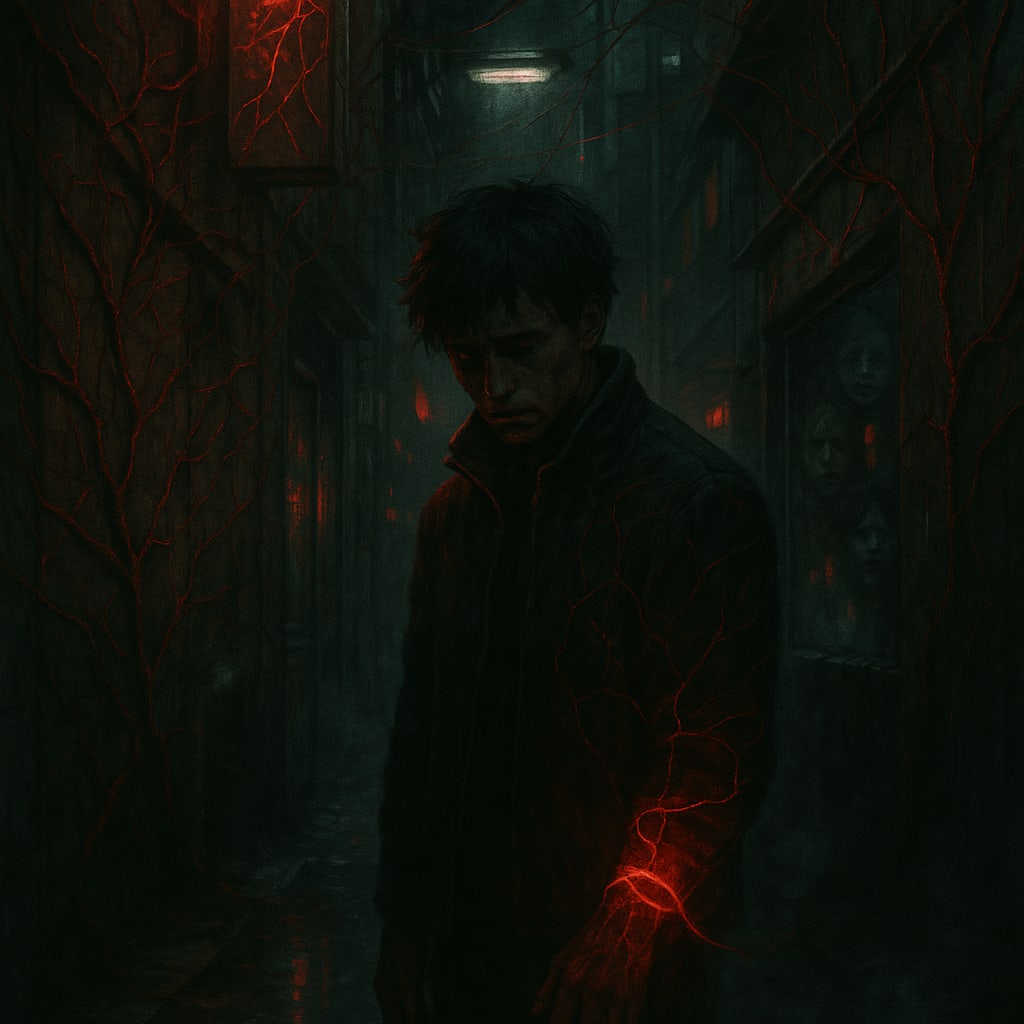
One night, he finds a note slipped under his door. It’s written in a spidery scrawl: “You hear it too, don’t you? Pull the thread if you want the truth.” Beneath the note is a small, blood-red thread.
Chapter 1: Unraveling the Noise
Akira stares at the thread, anger bubbling up within him…. He’s had enough of games, of people mocking his “condition,” but something about the message gets under his skin…. He tosses it aside, but when the hum rises that night, louder than ever, he snaps. He grabs the thread and pulls it.
The world flickers like a faulty light, and suddenly, he’s standing in the middle of the street where his parents died. The air reeks of gasoline, rain hisses against twisted metal, and he sees them—his parents—trapped in their mangled car, eyes wide with terror. But they’re not looking at the oncoming truck that crushed them. They’re looking *at him*. His own face, reflected in their dying pupils.
Akira jolts back to his apartment, the thread now wrapped around his wrist, tighter than before. It digs into his skin, and he can’t shake the feeling that it’s somehow *alive*, pulsing in time with his heartbeat. He tries to remove it, but the thread digs deeper, drawing blood. He stops going to work, obsessed with the thread, pulling it each night despite the horrific visions it brings. His parents' deaths. The faceless children at the orphanage, their laughter like grinding glass. The night he nearly ended it all with a razor to his wrist. Each memory leaves him gasping, the hum inside his skull now a shrieking roar.
Chapter 2: The Flesh of the Past
As the days blur together, the visions grow more twisted, no longer just memories but warped versions of reality. Akira finds himself in his childhood bedroom, but the wallpaper is made of flesh, pulsating like a heartbeat. The toys on the shelves have eyes that blink, watching him, their grins stretching too wide. He pulls the thread again, and the scene shifts to his old school, where the walls drip with a dark, viscous substance that smells like blood. He sees his younger self being bullied in the corner, his face beaten and bruised, but the bullies’ faces are hollow voids.
The thread seems to be leading him somewhere, revealing not just memories but twisted truths buried beneath them. He sees flashes of a shadowy figure in the background of every scene—an indistinct shape, always watching. When he pulls the thread again, he’s back at the accident scene, but this time, the shadow is closer, its hand resting on his shoulder. He feels its breath, cold and wet, as it whispers in his ear: “You remember, don’t you? What you did?”
He wakes up screaming, the thread now wrapped around his neck like a noose. It takes all his strength to loosen it, leaving a deep, red groove on his throat. He knows he should throw the thread away, burn it, but he’s addicted to the glimpses it gives him, the truth lurking just out of reach.
Chapter 3: The Truth Beneath
Akira delves into old records, trying to understand the shadowy figure. He finds an old news article from the time of his parents' death. It mentions a young boy found near the scene—*unharmed but in shock*—who claimed that something was *whispering to him*. The article dismisses it as trauma-induced hallucinations. But Akira remembers the whispers, remembers how they told him to stay out of the car that night, to stand on the sidewalk and watch.
He pulls the thread one last time, and the world shifts into a realm of twisted mirrors and endless reflections. He’s in a long, dark hallway lined with frames, each one showing a different version of himself—laughing, crying, dead-eyed. At the end of the hallway, he sees himself as a child, holding a bundle of black thread and smiling that too-wide smile. The child speaks in a voice that is his but not his: “You always knew, Akira. You let them die. You listened to the whispers, just like you’re listening now.”
The child becomes the shadowy figure, which lunges at him, wrapping the thread around his mouth, suffocating him with its oily grip. But instead of choking, he finds himself pulling the thread, unraveling his own skin, revealing layers of flesh that aren’t flesh—something *else*, something dark and ancient beneath his human form. He sees glimpses of a vast, monstrous entity made of writhing threads, stretching beyond time and space, feeding on despair, shaping memories like clay. And he realizes that he has always been part of it, a fragment of a larger nightmare.
Chapter 4: Becoming the Thread
Akira awakens in his apartment, but it’s no longer the place he knows. The walls are covered in black thread, pulsating like veins, and the hum has become a symphony of whispers. His reflection in the window shows the shadowy figure grinning back at him. The thread is no longer wrapped around his wrist; it’s fused to his skin, growing from his veins. He tries to scream, but all that comes out is laughter—a sick, echoing laugh that fills the room.
He stumbles outside, but the city is wrong—distorted like a reflection in a shattered mirror. People pass by, oblivious to the shifting shadows around them, to the way the buildings seem to melt into the sky. He sees others like him—people with threads wrapped around their limbs, faces twisted in agony, but they’re invisible to the ordinary citizens. Akira realizes that the city is filled with them, lost souls who pulled too far, who discovered the truth and were consumed by it.
He finds a mirror in a dark alley, the only place where he can see himself as he truly is. His body is unraveling, turning into a grotesque mass of threads, each one representing a memory, a piece of his past, and beneath them, there’s nothing—just a yawning, endless void. And in that void, he sees the truth: that life is nothing but a series of threads woven by the whims of ancient things, creatures that feed on the pain and suffering of humanity, that shape reality to their desires.
Epilogue: The Last Stitch
Akira’s final moments are a jumble of sensations—the hum growing deafening, the threads slicing through his skin, the world around him fading into a sea of blackness. He laughs until his throat bleeds, until he understands that there is no freedom from this reality, no escape from the truths beneath the surface. His mind snaps, unraveling like the thread that had once bound him. He becomes a shadow, another figure haunting the alleys of the city, slipping into the nightmares of those who dare to listen too closely to the whispers beneath the noise.
And on his old apartment floor, another spool of red thread appears, with a note written in that same spidery scrawl: “Pull to see the truth.” A new tenant moves in the next day, picks up the thread, and the cycle begins again.
About the Creator
Orin Ashfield
Orin Ashfield writes horror that blurs the line between memory and madness. His stories explore hidden trauma, unraveling minds, and the monsters we carry within. He believes the scariest truths are the ones we almost remember.
Enjoyed the story? Support the Creator.
Subscribe for free to receive all their stories in your feed.
Comments
There are no comments for this story
Be the first to respond and start the conversation.