
When Sacramento needed blood...
Richard Chase, six murders, and the terrible reality behind the Vampire of Sacramento..

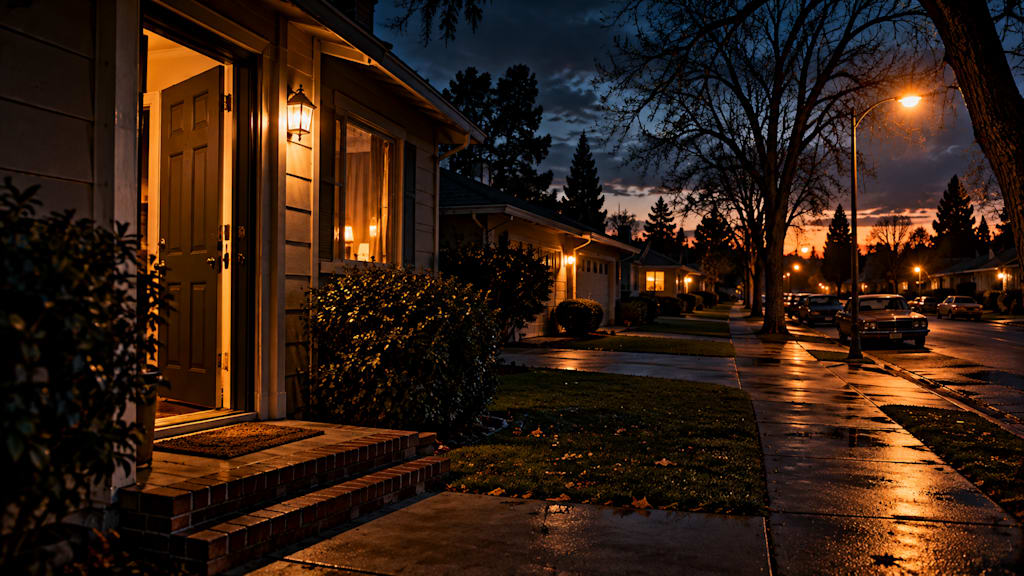
Sacramento, California. December 1977.
There was nothing remarkable about a man unloading groceries outside his home. An ordinary task, performed in an ordinary neighborhood, during the final days of an ordinary year. Fifty-one-year-old Ambrose Griffin had no reason to suspect that the simple act of returning home would place him in the path of a killer. On December 29, 1977, Griffin was shot and killed. No apparent robbery, no obvious personal dispute, and no clear reason for the attack. To investigators, the killing posed a deeply troubling question: Who would shoot a stranger without motive? The answer would emerge over the following month, and by the time police found it, five more people would be dead. The name Richard Trenton Chase would become associated with one of California’s most disturbing murder investigations. Newspapers and true-crime accounts gave him a moniker that sounded like something out of a horror novel: The Vampire of Sacramento. But there was nothing supernatural about Richard Chase. That was the most frightening part.
Richard Chase was born in 1950 and grew up in California. By his twenties, his behavior had become increasingly alarming. He developed bizarre beliefs about his body, fears that his blood was deteriorating, his organs malfunctioning, and that his life was threatened by physical processes that medical examinations could not substantiate. These were not ordinary health concerns; they were delusions. Chase received psychiatric treatment and was diagnosed at the time with paranoid schizophrenia. His history included disturbing incidents involving animals and blood, and during hospitalization, his behavior required intensive supervision. Eventually, he returned to the community.
It would be tempting to narrate this period as though every later event was inevitable. It wasn’t. Millions of people live with serious psychiatric illnesses without committing violence. A diagnosis does not predict murder, and Chase’s eventual crimes cannot be explained simply by naming his illness. The record shows a man whose behavior became profoundly disturbed, and whose subsequent actions grew increasingly dangerous. That distinction matters, because what happened in Sacramento was not the inevitable consequence of schizophrenia. It was the documented conduct of one particular individual. And by the closing weeks of 1977, that conduct had turned deadly.
Ambrose Griffin’s murder initially offered little explanation. He had been shot outside his home in what appeared to be a random attack. Investigators could not yet know that Griffin’s death would become the first of six murders attributed to the same man. Something is especially unsettling about a crime with no apparent connection between victim and offender. People often reassure themselves that violence follows recognizable patterns. A disagreement, robbery, a personal grudge, something identifiable and perhaps avoidable. Griffin’s killing offered no such comfort. The victim had been going about his life; the killer entered it without warning. And somewhere in Sacramento, the man responsible remained free.
On January 23, 1978, the violence escalated. Teresa Wallin, a pregnant woman, was murdered inside her Sacramento home. The crime scene was exceptionally disturbing. Investigators encountered evidence of extreme violence and mutilation, details that would later become central to public understanding of Chase’s crimes. There is no need to reproduce those details here; they were not inventions but injuries inflicted on a real woman whose life was taken. The investigation now confronted something beyond the unexplained shooting of Ambrose Griffin. The brutality of Wallin’s murder suggested a profoundly dangerous offender. Yet investigators still faced the same haunting problem: How do you identify a person with no obvious relationship to his victim? How do you anticipate where he might go next? How can you protect a city when victims follow no familiar pattern? Four days later, those questions became even more urgent.
On January 27, 1978, Richard Chase entered another Sacramento residence. Four people would die: Evelyn Miroth, Daniel Meredith, six-year-old Jason Miroth, and twenty-two-month-old David Ferreira. The ages of the youngest victims are especially difficult to comprehend. Whatever fascination later audiences developed with Chase’s nickname, his delusions, or the grotesque details of the investigation, the essential fact of that day remains unchanged: four people were murdered, two of them very young children. Responding officers confronted a scene of extraordinary violence. Investigators collected evidence, reconstructed movements, and connected the murders to earlier attacks. The public narrative would eventually focus heavily on the killer, his appearance, his behavior, his psychiatric history, his fascination with blood. But the investigation existed because six people had been killed, and their families deserved answers. That part of the story should never disappear behind a nickname.
In the days following the January 27 murders, investigators developed leads pointing toward Richard Chase. The investigation included witness information, physical evidence, and the examination of Chase’s residence. Police arrested him on January 27, 1978. The search of his apartment revealed evidence connecting him to the killings, including items associated with the victims, and exposed the disturbing circumstances in which he had been living. By then, the evidence was no longer a collection of unexplained incidents; the apparently random shooting in December and the January murders had become part of a single investigation. A suspect was in custody, and the public was about to learn details that seemed almost impossible to reconcile with ordinary human behavior.
The nickname “Vampire of Sacramento” emerged from the most grotesque element of the crimes: Chase had consumed blood. During the investigation and legal proceedings, evidence and statements about his blood-drinking became central to the case. His reported explanation was rooted in his delusional beliefs; he believed something was terribly wrong with his blood and that consuming blood could help him survive. This was not a supernatural belief made real, but a severely disturbed conviction accompanying acts of murder. The distinction may seem obvious, but the nickname obscures it. “Vampire” suggests a creature outside human rules, something ancient, unnatural, and dark. Richard Chase was none of those things. He lived in an apartment, moved through neighborhoods, encountered ordinary people. They could arrest him, investigate him, try him, and convict him. The horror was not that something impossible had entered Sacramento; it was that a human being had committed acts so extreme that folklore seemed easier to reach than reality.
One detail repeated in accounts of Chase’s case has acquired particular notoriety: he reportedly regarded an unlocked door as an invitation to enter. Later descriptions of his behavior attribute the statement to Chase, though it should not be mistaken for a universal explanation for every attack. Still, the idea has endured, perhaps because it transforms a basic feature of domestic life into something unsettling. A front door, a latch, a key, a person standing outside. Most people think of a locked door as a basic precaution, not a barrier against someone whose thinking has become dangerously detached from reality. No victim should be blamed for a perpetrator’s decision to enter a home and commit violence. The responsibility for Chase’s crimes belonged to Chase. But the reported fixation on unlocked doors became one of the details that kept the case lodged in the public imagination. It suggested a frightening arbitrariness, the possibility that any ordinary house might become a target for reasons that existed only in the offender’s mind.
Chase went on trial in 1979. His mental condition was a major issue. The defense argued he was legally insane at the time of the killings; prosecutors sought to show he could be held criminally responsible. The distinction between psychiatric illness and legal insanity is essential. A person may experience severe mental illness and still fail to meet the specific legal standard for an insanity defense. In May 1979, a jury convicted Chase of six counts of first-degree murder. He was sentenced to death. The verdict established his criminal responsibility under the law but did not erase the psychiatric history documented before and after his arrest. On December 26, 1980, Richard Chase died in San Quentin Prison from an overdose of medication. He was thirty years old. The case lasted just over three years from the first murder to the killer’s death. For the families of the victims, the consequences would extend far beyond that period.
True-crime history has a peculiar habit of remembering perpetrators more vividly than the people they harmed. A nickname survives. A photograph circulates. A particularly disturbing detail gets repeated until it becomes the whole story. Eventually, the actual human losses risk becoming background information. Richard Chase’s case is especially vulnerable to that transformation. The name “Vampire of Sacramento” practically invites embellishment, encouraging descriptions of a city haunted by something monstrous, as though the events belonged to Gothic legend rather than criminal investigation. But the facts are sufficient: between December 29, 1977, and January 27, 1978, six people were murdered in Sacramento. The victims included a pregnant woman and two small children. The offender had a documented history of severe psychiatric disturbance and behavior involving animal blood. Investigators identified and arrested him. A jury convicted him. He died in prison. Those are the foundations of the story. The rest demands care.
We cannot reconstruct every thought that passed through Chase’s mind. We cannot reduce his actions to a diagnosis, nor know which earlier intervention, if any, would have prevented the murders. And we cannot turn six deaths into supernatural entertainment because the killer acquired a frightening nickname.
One final reason this case remains so disturbing. Most horror stories give us a comforting separation between the ordinary world and the monster. The monster belongs somewhere else, in a castle, a crypt, behind a locked door at the end of a dark corridor. Sacramento offered no such separation. The victims lived in ordinary homes, on ordinary streets, during ordinary days. The person who killed them was not a creature from another world. He was a man living in the same one. And that was frightening enough.
About the Creator
Veil of Shadows
Ghost towns, lost agents, unsolved vanishings, and whispers from the dark. New anomalies every Monday and Friday. The veil is thinner than you think....
Enjoyed the story? Support the Creator.
Subscribe for free to receive all their stories in your feed.
Comments
There are no comments for this story
Be the first to respond and start the conversation.