
When Darkness Has a Name: Why Do Human Beings Commit Evil?
Veil of Shadows Exclusive

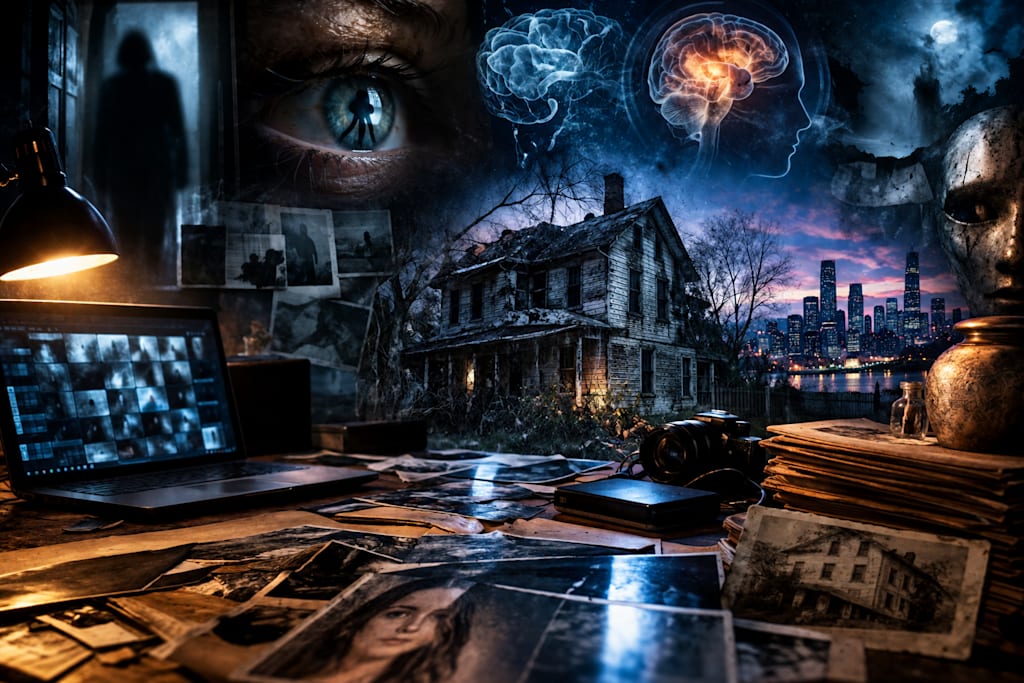
There are monsters that make sense... Vampires need blood. Werewolves have the moon. Ghosts have unfinished business. Demons, at least in the traditions that believe in them, have an explanation built directly into their existence. Human beings are much more difficult.
Throughout our travels behind the Veil of Shadows, we have encountered people capable of acts so disturbing that the first question almost inevitably becomes the same: Why? What happened inside that person? What transformed them? Was something broken? Was something done to them? Were they born different? Did trauma change them? Was there disease in the brain? Did hatred grow slowly until another human being ceased to matter? Did they simply choose? Or, as generations before us might have asked without hesitation, did something darker touch them?
Humanity has spent thousands of years attempting to answer those questions. We still haven’t.
The Comfort of an Explanation
When confronted with terrible behavior, we search backward. There must have been a moment. A childhood beating. An abandonment. A head injury. A psychiatric disorder. A humiliating rejection. A violent parent. A chemical imbalance. Something. Because if we can locate the beginning, perhaps everything afterward becomes understandable. More importantly, perhaps it becomes preventable.
Sometimes that search produces genuine insight. Childhood abuse and neglect can have profound and lasting psychological consequences. Trauma can alter the way people experience trust, fear, relationships, and danger. Substance misuse can increase behavioral risk. Environment matters. Genetics matter. Personality matters. Social circumstances matter.
But none provides a universal equation. Millions of people endure traumatic childhoods without becoming violent adults. Countless survivors of abuse become compassionate parents, teachers, nurses, neighbors, and friends. And history contains disturbing offenders whose childhoods, while never truly knowable from the outside, did not contain the convenient catalog of horrors we sometimes expect to find.
That creates an uncomfortable problem. If terrible childhoods automatically created terrible adults, humanity could identify the mechanism. They don’t. If loving families guaranteed benevolent adults, we would have solved another piece. They don’t. The breadcrumbs lead everywhere. But none leads all the way home.
"They Must Have Been Mentally Ill"
Perhaps no explanation is reached for more quickly. When someone commits an incomprehensibly violent act, people commonly say: “They had to be crazy.” But that assumption creates its own injustice.
The overwhelming majority of people living with mental illness are not violent. Psychological research has repeatedly found that psychiatric illness alone is a poor explanation for violence. Factors such as previous violence, substance misuse, environment, antisocial behavior, and personal history can matter substantially, and many of those same risk factors operate in people without serious mental illness.
A person can experience depression without hurting anyone. Someone can live with schizophrenia without becoming dangerous. A person can suffer devastating anxiety while posing a threat to nobody. Mental illness is illness. It is not another name for evil.
There are individual cases in which severe psychiatric symptoms can contribute directly to dangerous behavior. Psychosis can profoundly distort a person’s perception of reality. Certain symptoms can impair judgment. Treatment can matter enormously.
But even there, the equation refuses to become simple. A diagnosis doesn’t tell us what a particular person will do. And perhaps more importantly, when someone genuinely cannot perceive reality accurately, another ancient question appears: How morally responsible are they for actions they could not properly understand?
Suddenly we are no longer talking only about medicine. We have wandered into philosophy.
What If the Brain Changes?
There is another possibility. Sometimes the person changes because the brain changes.
One of history’s most famous neurological cases involved railroad foreman Phineas Gage. In 1848, an iron tamping rod passed through Gage’s skull during an explosion. He survived. Accounts afterward described significant changes in his behavior and personality, although popular retellings have exaggerated parts of his story.
Modern neuroscience has nevertheless established something enormously important that Gage’s case helped illustrate: damage to portions of the frontal brain can affect inhibition, judgment, emotional regulation, and personality. Tumors, degenerative disease, traumatic injury, and other neurological conditions can sometimes produce profound behavioral changes.
The implications are unsettling. We like to imagine personality as something almost immaterial, the permanent “us” inhabiting the machinery. But alter the machinery... and sometimes the person changes too.
Yet even neuroscience doesn’t reveal an “evil center” hiding somewhere behind the forehead. No scan identifies wickedness. No cluster of neurons signals that someone will become a murderer. Biology influences behavior. It does not hand us a simple map of morality. And once again the question retreats ahead of us.
Trauma Doesn't Finish the Equation Either
Trauma deserves particular care because it explains much while simultaneously being capable of explaining too much. Severe childhood adversity has been associated with numerous negative outcomes later in life. That matters. Understanding those relationships can help prevent suffering and identify people who need support.
But saying trauma can increase particular risks is very different from saying trauma creates monsters. It doesn’t. That distinction matters because survivors hear these conversations too.
Imagine surviving something horrific only to be told that your experience makes you inherently dangerous. For many people, adversity produces precisely the opposite response. They know what suffering feels like. Therefore, they become determined not to inflict it upon someone else.
Two people can endure superficially similar experiences and emerge very differently. Why? Genetics perhaps. Temperament. Support systems. Relationships. Opportunity. Culture. Resilience. Chance. Choices. Probably combinations we don’t yet completely understand. Again, there is no single road.
The People Who Seem to Have No Explanation
These may be the cases that trouble us most.
Occasionally, after something horrific happens, investigators dig into a person’s history expecting to find the answer. Neighbors are interviewed. School records are examined. Friends are questioned, and family history is reconstructed.
And instead of discovering a childhood nightmare, they encounter something disturbingly ordinary. There may have been problems. Every family has them. But no catastrophic revelation emerges that could explain what happened later.
People who knew the individual sometimes say things that have become almost clichés after terrible crimes: “He seemed normal.” “They were a nice family.” “I never would have imagined it.”
Those statements don’t prove that nothing was wrong. Families can hide secrets. People conceal parts of themselves. Neighbors know far less about one another than they imagine. Retrospective accounts are notoriously imperfect.
But sometimes there simply isn’t a satisfying origin story. And we hate that. Because if there is no obvious cause... what are we supposed to protect ourselves from?
The Ancient Explanation
Our ancestors possessed another answer: evil. Not metaphorical evil. Something spiritual.
Across religions and cultures, humanity has imagined destructive forces existing beyond ordinary human psychology. Christian traditions speak of Satan, temptation, demonic forces, sin, and corruption of the human will. Other religions and cultures possess their own concepts of malevolent spiritual influence.
For much of history, behavior that today might be examined neurologically or psychiatrically could instead be interpreted as possession, curse, or spiritual attack. Modern science has explained many phenomena once attributed to supernatural causes. Epileptic seizures do not require demons. Hallucinations can arise from identifiable medical and psychological conditions. Brain disease can radically alter behavior. Sleep paralysis can produce terrifying experiences without requiring an entity sitting upon someone's chest.
Those discoveries matter. But science and religion are sometimes answering different questions. Science asks: What mechanisms produced this behavior? Spiritual traditions may instead ask: What does this behavior mean? Those questions can overlap without being identical.
Science cannot diagnose demonic influence. Neither can a spiritual explanation substitute for medical evidence. Yet billions of human beings continue to understand good and evil partly through a spiritual framework. Perhaps that persists because there are moments when words such as disorder, trauma, and behavior feel inadequate to describe deliberate cruelty. So humanity reaches backward. And retrieves an older word: evil.
But What Do We Mean by Evil?
That question is harder than it sounds. Is someone evil because they hurt another person? Then nearly every human being would qualify at some level.
Does evil require intention? Does it require understanding that suffering is being inflicted? Does remorse matter? What about someone who knows an act is wrong, understands another person is suffering... and continues because that suffering itself is desired?
Here the language changes. We're no longer necessarily describing someone unable to control themselves. We may be describing choice. And choice frightens us differently.
A tumor can be removed. Psychosis can sometimes be treated. Trauma can be addressed. Addiction can enter recovery. But what treatment do we prescribe for someone who understands another person's humanity perfectly well and chooses cruelty anyway?
There are psychological concepts that can illuminate pieces of such behavior: callousness, lack of empathy, antisocial traits, sadism, dehumanization, moral disengagement. But labels describe patterns. They don't always tell us where those patterns ultimately came from. And describing something is not necessarily explaining it.
The Equation That Doesn't Exist
Perhaps that is the lesson hidden among centuries of horrifying cases. There is no formula. No checklist reading: Trauma + Mental Illness + Bad Childhood = Evil. Reality refuses to be that convenient.
People with mental illness overwhelmingly do not commit extreme violence. Most trauma survivors don't become perpetrators. Neurological abnormalities do not automatically produce cruelty. Difficult childhoods do not doom children to become dangerous adults. Stable childhoods do not guarantee virtue. Poverty doesn't create monsters. Wealth doesn't prevent them. Education doesn't inoculate us. Religion doesn't automatically cure us. Atheism doesn't cause us. No demographic offers refuge from the capacity for cruelty.
There are risk factors. There are patterns. There are warning behaviors. There are interventions that save lives. There is knowledge worth pursuing. But no machine can enter a human childhood and print out a prediction of the adult soul. Perhaps one day we'll understand considerably more. Today we don't.
Something Is Happening in Philadelphia
This week's journey behind the Veil actually began somewhere else: Philadelphia.
As this article is being written in September 2026, Philadelphia police and the FBI are conducting an extraordinary investigation centered on a house in the city's Olney neighborhood. Authorities are examining an enormous quantity of digital material and investigating possible connections involving women who have been missing for years.
The investigation is active. Important questions remain unanswered. Living people have not had every allegation against them adjudicated. Families are still waiting for information.
For those reasons, Veil of Shadows is not going to speculate about what happened inside that house or attempt to diagnose the people connected with it. There will be time for facts. Right now, investigators are still finding them. Readers who wish to follow the developing case can consult current Philadelphia reporting and official law-enforcement updates.
Perhaps someday, when evidence has been tested, and unanswered questions have become established facts, we will return to Olney. For now, we leave that door closed.
But the investigation caused us to ask the question behind this article. Because eventually investigators may determine what happened. They may establish when. They may establish where. They may establish who. But another question waits behind all of those. Why? And history suggests that may be the hardest question of all.
Behind the Veil
Thousands of years ago, humanity looked into darkness and saw demons. Later generations saw madness. Modern medicine discovered disease. Psychology discovered trauma. Neuroscience found extraordinary relationships between brain and behavior. Criminology identified patterns. Sociology illuminated environments. Genetics revealed predispositions.
Every generation pulled another thread from the mystery. And still, occasionally, we encounter an act of deliberate human cruelty that stops us cold.
We search the childhood. We search the brain. We search the family. We search the diagnosis. We search the environment. We search for trauma. We search for something, anything, that will let us point and say: There. That's where the darkness began.
Sometimes we find something important. Sometimes we find many things. Sometimes we find almost nothing.
And even when we identify contributing causes, explanation does not necessarily excuse it. Nor does the absence of a scientific explanation become evidence of something supernatural.
Another possibility humanity finds profoundly uncomfortable is that there isn't one answer. Maybe cruelty can emerge through many roads. Maybe biology, experience, environment, opportunity, and choice intertwine differently in different people. Maybe "evil" is not a substance waiting to be discovered under a microscope but a word humanity created for the moral boundary beyond which ordinary language begins to fail.
Or perhaps our ancestors were right to believe there is more to darkness than biology and circumstance. Science cannot answer that question yet. Neither can we. And perhaps that is the most unsettling answer Veil of Shadows has ever offered.
After thousands of years spent studying the darkest corners of human behavior, after philosophy, religion, medicine, psychology, and neuroscience, after prisons and laboratories, confessionals and courtrooms, we still cannot point to one place and say: This is where evil lives.
We can describe pieces. We can identify risks. We can sometimes prevent terrible things.
But when someone asks the oldest question... What makes one human being deliberately destroy another? We eventually arrive at four uncomfortable words.
We just don't know... And somewhere beyond those words... the darkness continues.
Behind the Veil of Shadows...
About the Creator
Veil of Shadows
Ghost towns, lost agents, unsolved vanishings, and whispers from the dark. New anomalies every Monday and Friday. The veil is thinner than you think....
Enjoyed the story? Support the Creator.
Subscribe for free to receive all their stories in your feed.
Comments
There are no comments for this story
Be the first to respond and start the conversation.