
Twenty-One Days: The Korean Taboo That Links Birth and Death
In Korean shamanism, a newborn and the newly dead share exactly 21 days. They must never occupy the same space.
This is the first chapter of a book I’ve been writing about Korean shamanistic taboos — the ones shamans know but ordinary people don’t.
———
On the morning a child is born, a rope is hung across the front gate.
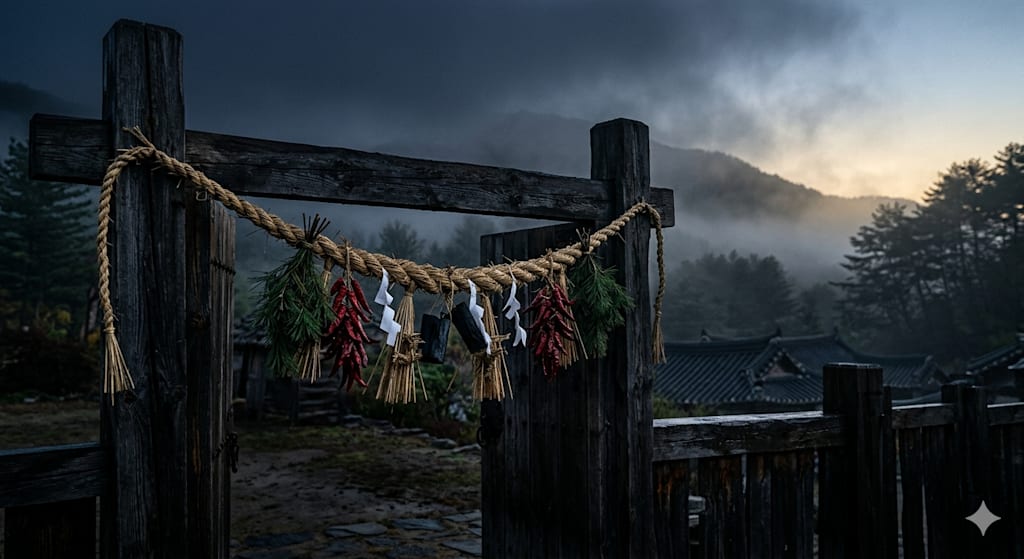
Twisted from straw and threaded with pine branches, charcoal, and — a red chili pepper for a boy, a strip of white hanji paper for a girl — the rope is rough and unassuming. Not threatening, exactly. And yet, in those days, people stopped at the sight of it. It was not a sign saying Keep Out. It was something closer to: Not yet. The life that had just arrived was not yet fully of this world.
The rope would stay for exactly twenty-one days. Koreans called this period sae-i-re.
Seven days, three times over. At each interval — the first seven, the second, the third — mothers rose before dawn to offer a bowl of rice and a bowl of seaweed soup to Samsin Halmae, the grandmother spirit who presided over birth. Only after the offering could the mother eat. Anyone who had recently attended a funeral, no matter how close a relative, was barred from crossing the threshold. It was believed that if a tainted energy reached the child, the spirit that Samsin was still holding by a thread might slip free. The child had been born, yes — but was not yet fully alive. Not until twenty-one days had passed.
And yet this story has a shadow side that must be read in reverse.
Shamans do not only watch the door through which the living enter. They know the same number is carved above the door through which the dead leave. When a person dies, the soul fractures into three parts. The yeong rises to the heavens. The hon descends into the underworld, where it faces forty-nine days of judgment. But the neok — the part most tightly bound to the flesh — is different. It remains, anchored to the exact place where its owner last drew breath, unable to leave for twenty-one days.
If the neok is not properly released through a ritual called jari-geot-i before those twenty-one days are up, it splits apart. It separates into the gwi — a hollow shell — and the jeong, its essence. The shell, stripped of warmth and memory, merges with surrounding dark energy and becomes something malevolent.
Life and death share the same number. Twenty-one days.
A newborn spends twenty-one days walking into this world. The newly dead spend twenty-one days walking out of it. If the arriving soul and the departing soul occupy the same space at the same time, both lose their way.
Even Korea's founding myth knew this number. The god Hwanung told the bear and the tiger to endure a hundred days. But it was at twenty-one days that the bear emerged, transformed into a woman. The minimum threshold for one thing to become something else entirely. The ancestors did not choose that number by accident.
— — —
1994. A modest apartment building in Gyeonggi Province. Min-ja had given birth three days earlier when the phone rang in the middle of the night. Her mother-in-law had collapsed — a stroke. She was unresponsive. As her husband grabbed his coat, Min-ja's mother stepped in front of the door.
"You cannot leave. Not before the twenty-one days are up. Not one step outside that door."
Her husband shouted. His mother was dying. What did any of this superstition matter? But the older woman did not move.
"That's exactly why you can't go."
He left alone. Min-ja stayed, holding her newborn in the dark. The straw rope still hung on the gate. Her mother-in-law died four days later. Min-ja did not attend the funeral. The neighbors talked — what kind of cold-hearted daughter-in-law stays home while her husband buries his mother?
But Min-ja's mother knew. In this room: a soul still arriving. At the hospital: a soul still leaving. When those two currents tangle, the weakest one loses its way. And the weakest one was the infant in Min-ja's arms.
The child grew up healthy. Min-ja still does not speak of those twenty-one days. Not because she's forgotten. Because saying it out loud feels like it might bring something back.
— — —
Twenty-one days. The time it takes for life to seep into the world — and for death to evaporate out of it. Korea's ancestors believed those two doors were exactly the same thickness
———
This is chapter one of a longer work. If there’s interest I’ll share more chapters here.
About the Creator
Hee Park
Korean-born writer exploring the shamanic taboos most people were never told about. Some rules exist for a reason. I write about those reasons.
Enjoyed the story? Support the Creator.
Subscribe for free to receive all their stories in your feed.
Comments
There are no comments for this story
Be the first to respond and start the conversation.