
Turnout
For Out of the Dream challenge


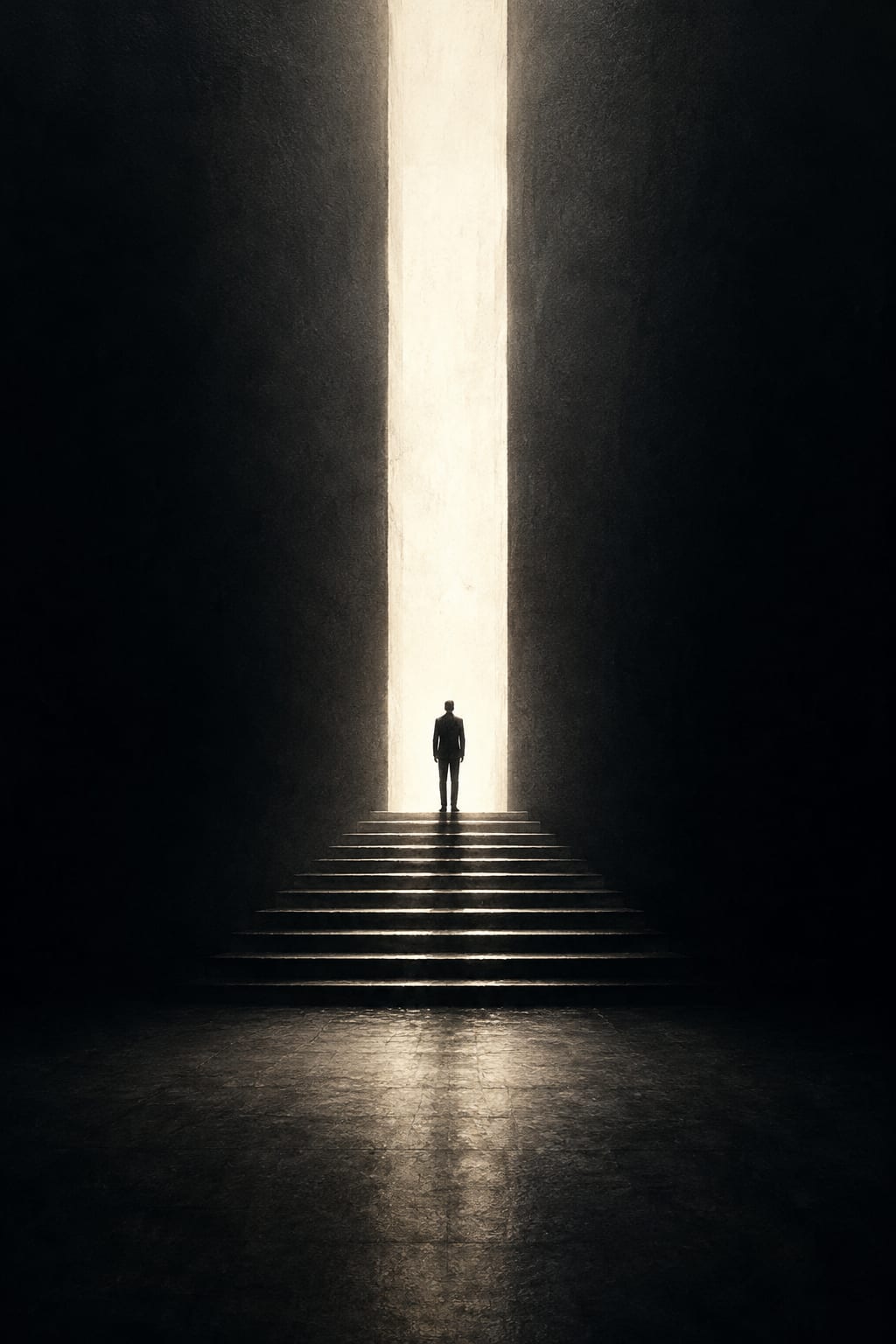
The light hits before anything else does, harsh and white and absolute, the kind that doesn't cast shadows so much as erase them. I'm standing at a podium. There's a microphone. Below the stage, a few steps down, begins the audience.
Thousands of them.
I have no memory of agreeing to any of this.
The theater is enormous, gilded in the way old theaters are, dark wood and tiered balconies and the faint smell of something I can't quite name, something that sits at the back of the throat. The seats go on far longer than they should. The back rows disappear into a murk the stage lights can't reach. There are people filling all of them. Every seat taken.
They are looking at me.
I adjust the microphone out of reflex. Someone, a stage manager, a handler, touched my shoulder before stepping back into the wings, and I heard them whisper, "Whenever you're ready." Their voice was warm and assured. As if they had done this a hundred times. As if I had.
So I start talking.
I don't know what I say, exactly. Words come. Something about beginnings. About where things started. I watch the faces in the front rows as I speak, looking for nods, for the small fidgets that mean someone is still breathing, still human. They watch me back. Their expressions are attentive in that polite way audiences are attentive when they're trying to look engaged. Eyes forward. Mouths settled in soft, courteous lines.
Nobody blinks.
I notice it gradually, the way you notice a sound has stopped rather than a sound beginning. I'm looking at a man in the third row, heavy-set, wire-rimmed glasses, and somewhere in the pause between my sentences I realize I have been watching his face for perhaps a full minute and his eyes have not flickered, have not done the small unconscious thing that eyes do.
I look away.
I keep talking. Something about a journey. About returning.
The woman beside him has her hands folded in her lap and her chin tilted slightly up, like someone posing for a portrait. The couple behind them, in matching pale shirts, which is either a coincidence or something else, hold the same angle of attention. The rows further back are harder to focus on. Faces blur into faces. The longer I look at them in aggregate, the more they start to resemble one another in ways I can't quite isolate: a sameness of expression, of posture, of something less definable than either.
I talk about gratitude. Arrival. The honor of being here.
The speech should have ended by now. I feel that clearly. I've reached what should be a natural close several times, a phrase that lands, a thought that resolves, and each time I trail off, the audience leans an almost imperceptible fraction forward and I find myself starting the next sentence. Then the one after that. I talk about roads, about distance, about what we leave behind.
The lights above me are very warm.
I've been speaking for I don't know how long. My watch is on my wrist, but when I glance at it, the face doesn't quite resolve into numbers. My mouth is dry. The light makes it impossible to see beyond the first dozen rows, and in some way that is a relief.
When I stop, really stop, mid-sentence, just letting the silence sit, the applause begins.
It is ordinary at first. Of course it is. The sound of two thousand pairs of hands. It rises and fills the hall and I exhale and reach for the microphone to say "thank you," which is what you say. The applause continues. I say thank you. It continues. I step back from the podium. It continues. It does not swell or build the way applause does when it catches hold of itself, it maintains the exact same volume, the exact same tempo, every clap landing in perfect synchrony, which is not how applause works, which is never how applause works, and I stand there counting the beats without meaning to and they are metronomic.
Perfectly. Exactly. Metronomic.
The side door is gone.
I'm certain there was a door stage left, I watched the handler exit through it, but the curtain hangs flat against what is now a wall with no seam, no handle, no outline. I cross to stage right and find the same. Red velvet from floor to ceiling. I press my palms against it and find nothing but fabric and then plaster, and I stand there while behind me the applause continues.
There are stairs down into the audience.
I take them.
The applause stops the moment my foot touches the floor.
The silence that follows is total.
The man with the wire-rimmed glasses is very close now. I can see his face clearly and the left half doesn't quite match the right, not grotesquely, nothing I could point to, just a subtle asymmetry that deepens the longer I look, as if both sides were constructed by different people working from a description rather than a reference. He is smiling. The smile has been there for a while. I step past him down the aisle.
The further I go, the more faces repeat. A woman with dark hair cut to her jaw, I pass her on the left, and then again three rows back, and again further in, not identically, the copies are slightly degraded each time, like a photograph of a photograph. Some hold programs in their laps and I catch the title on one as I pass and it says my name. I don't stop to read the rest. Several people turn their heads to follow me as I move, and none of their bodies move at all, only the heads, smooth and unhurried as something mechanical.
Someone is on the stage.
I become aware of it the way you become aware of something you've been actively avoiding: all at once. The spotlight is still burning. A figure stands inside it at the podium. I recognize the set of their shoulders from across the hall. The way they hold their hands on either side of the microphone.
I know those hands.
I work my way back toward the stage, edging between rows. Nobody moves to stop me. The person at the podium is speaking, I can hear the voice but not the words. The cadence is familiar in a way that works on me below thought. I reach the foot of the stairs and stop.
It is me.
Not a resemblance. Not a dream-approximation. The duplicate stands under that merciless white light delivering my speech in my voice wearing my clothes, and the audience receives it rapt and utterly still and not one of them has moved.
I call out. My voice sounds thin and wrong in the space.
Nothing happens.
I walk up the stairs. I say loudly, "Stop." I say, "Excuse me." I say this is, and the sentence breaks apart before I can find its end.
The duplicate finishes speaking.
Below me the applause erupts again, thunderous and synchronized, and it goes on and on, and when it finally ceases the duplicate turns.
Looks at me.
Smiles.
"You've been speaking for a very long time," it says.
It steps down from the stage and I step back without deciding to. It walks toward me through the audience, and as it moves, every head in the theater rotates, not turns: rotates, until every face I can see is aimed at me. Two thousand people and not one of them breathing, and my own face walking toward me out of the dark.
"Sit down," the duplicate says quietly. "It's your turn to watch."
I wake up on the stage.
My cheek is against the floor. The boards are real, I can feel the grain of them, smell old shellac and settled dust. I push myself upright and the theater surrounds me, enormous and dark. Emergency exit signs glow red in distant corners, barely enough to see by. The seats stretch out in every direction, empty, the audience simply gone, the whole impossible crowd absent as though it had never been.
I am alone.
The laugh that comes out of me is involuntary. A dream. Of course a dream. The sound bounces wrong in all that space. I laugh anyway, or try to, still figuring out how I got here, this must be the old theater on Fifth, I must have sleepwalked, I must have.
One clap.
Somewhere in the back of the dark, past the rows I can see, past the place where the light gives out entirely.
One single, deliberate clap.
And then nothing.
About the Creator
Aarsh Malik
Poet and storyteller who believes in the quiet power of words.
My first book, QUIET FLAME
Buy Coffee
⏳ 90 days. $2,000
If my words stay with you, a little tip can help me get there.
Enjoyed the story? Support the Creator.
Subscribe for free to receive all their stories in your feed. You could also become a paid subscriber, letting them know you appreciate their work.
Comments
There are no comments for this story
Be the first to respond and start the conversation.